
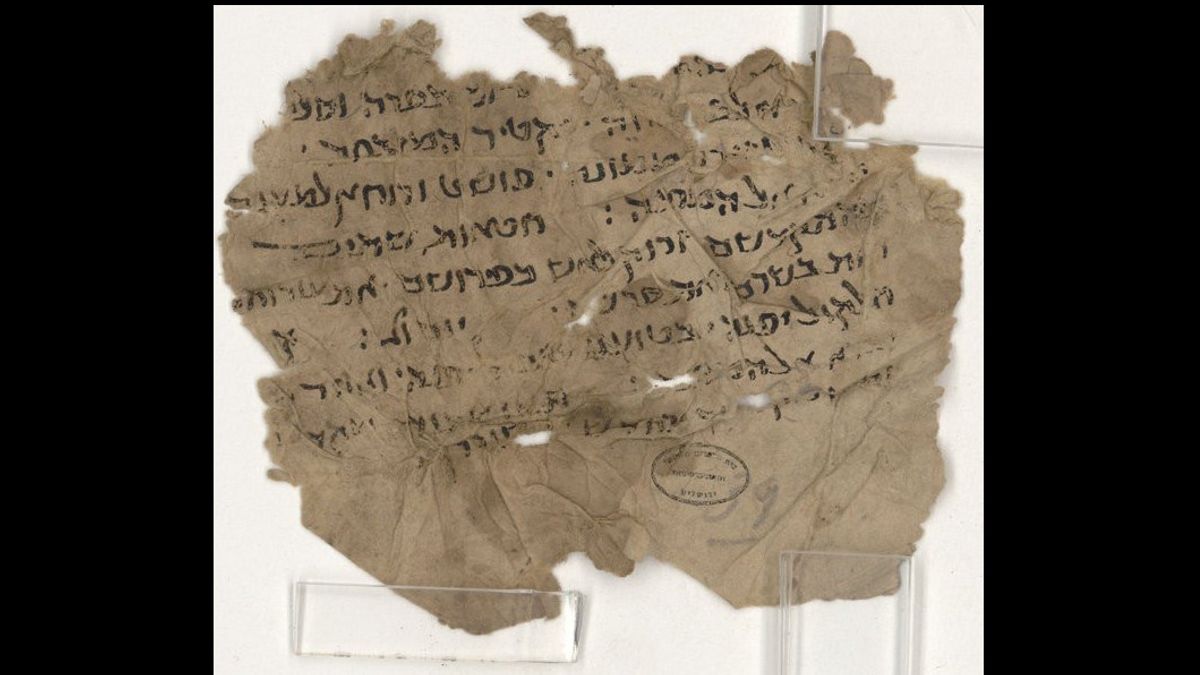


JAKARTA - Researchers in Israel opened a new chapter in Jewish history studies by utilizing artificial intelligence (AI) to explore more than 400,000 ancient manuscripts from Cairo Geniza a collection of the world's largest medieval Jewish documents.
The collection, which has been studied manually for more than a century, can finally be analyzed with unprecedented speed and depth.
Cairo Geniza, who comes from Sinagog Ben Ezra in Cairo, holds a variety of documents up to a thousand years old, ranging from administrative records, personal letters, respondances to functorials, to the writings of great philosophers such as Maimonides. Drowning in a pile of fragmentation, many documents are paraded, unsorted, and have never been transcribed, although the entire collection has been digitized in image form.
With the help of the MiDRASH project an initiative supported by the European Union and collaborating with various universities "the researchers are now training AI models to read, recognize, and copy Arabic, Arabic, Aram, and Yiddish text in various ancient handwritten styles. This effort allows the reconstruction of documents that were previously difficult to break and accelerate new discoveries about Jewish life in the Middle Ages.
SEE ALSO:
-
 | TEKNOLOGI
Minat Konsumen Bergeser, Penjualan Smartphone Premium di Indonesia Melejit
26 November 2025, 18:32 -
 | TEKNOLOGI
Laporan Opensignal: Telkomsel Kuasai Pasar Fixed Broadband di Indonesia
26 November 2025, 18:06 -
 | TEKNOLOGI
Apa Itu Internet Rakyat 100 Mbps? Ini Penjelasan, Harga Paket, dan Cara Daftarnya
26 November 2025, 17:05 -
 | TEKNOLOGI
Harga Internet RI Termahal di ASEAN, Internet Rakyat Rp100 Ribu 100 Mbps Jadi Solusi?
26 November 2025, 16:30

Daniel Stokel Ben Ezra of Ecole Pratique des Hautes Etudes in Paris, one of the main researchers of the project, explained that the technology is increasingly proficient in unraveling ancient writings that were previously only able to be analyzed by veteran script experts.
According to him, this new capability paved the way for researchers to conduct rapid searches on behalf of, terms, or events spread across hundreds of thousands of fragments, as well as unifies pieces of documents that have been scattered for centuries.
Despite the initial transcription of AI, human researchers still verify the accuracy of the text, so that each correction helps the learning model and improves the quality of its reading. "The possibility of modern translation is now so advanced, and combining all of these documents makes it much more accessible, even for ordinary readers," said Ben Ezra.
One of the interesting documents that was successfully transcribed was Yiddish's language letter from the 16th century, written by a widow named Rachel in Jerusalem to her son in Egypt. On the outskirts, the child wrote an answer about his struggle to survive in the midst of the plague that hit Cairo.
Geniza itself is a sacred storage area in synagog to put important documents before being buried ritually. The location of Geniza in Singog Ben Ezra, which is in a dry Cairo neighborhood, allows the preservation of thousands of these manuscripts in relatively good condition.
In its heyday in the Middle Ages, Cairo developed into the center of trade and the Middle East's largest science, matching Baghdad and Damascus. The city became home to a prosperous Jewish community, including refugees from Spain who fell into Christian hands. It was in this synagog that Maimonides 'big Jewish philosophy as well as the Prophet's family' once worshiped.
The Cairo Geniza collection was first discovered by scholars in the late 19th century, but the volume of documents makes most of its contents still a puzzle today. With the presence of AI, researchers hope to map the social, economic, legal, and spiritual lives of the Jewish community for centuries. The ability to reconstruct everything' is as if making Facebook its Middle Ages now really in front of our eyes, said Ben Ezra
The English, Chinese, Japanese, Arabic, and French versions are automatically generated by the AI. So there may still be inaccuracies in translating, please always see Indonesian as our main language. (system supported by DigitalSiber.id)


