
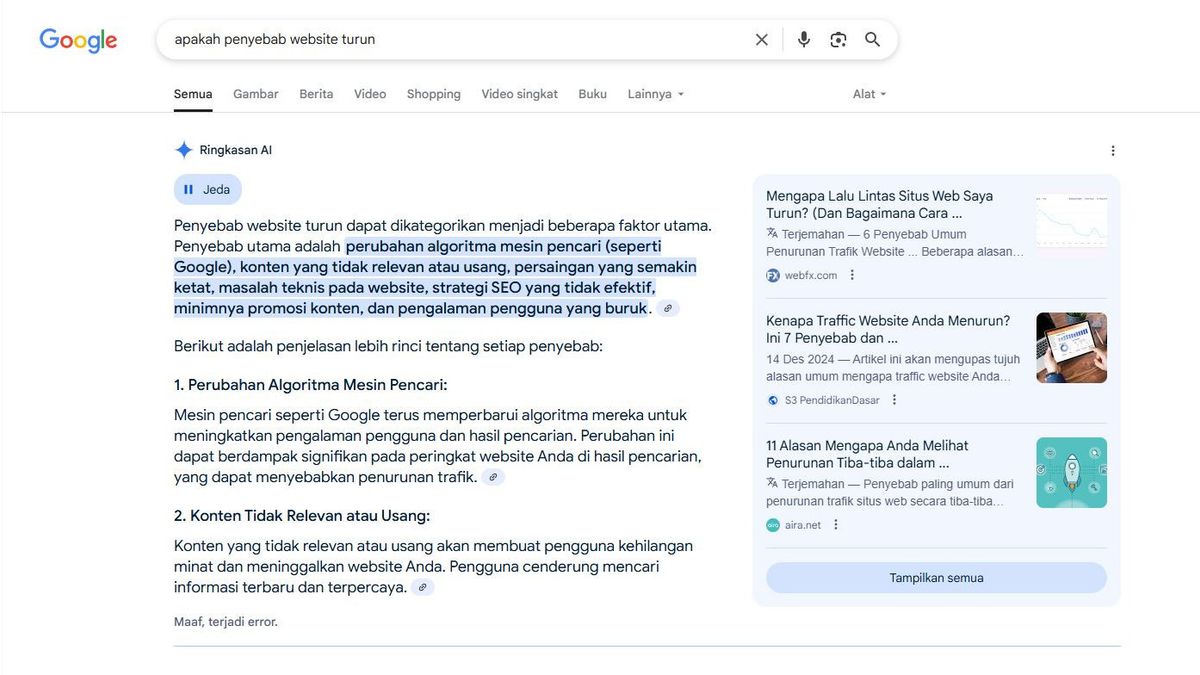


JAKARTA - A recent report raises serious concerns regarding Google's dominance in the world of digital search. Its latest feature, AI Overviews, is accused of drastically reducing the trajectory of independent websites.
Now it raises a big question: is Google through its AI technology 'censoring' websites? If true, then this is not just a business issue, but a threat to the diversity of information and the sustainability of the internet ecosystem.
Google introduced AI Overviews as a search feature that provides quick and concise answers directly in search results, without the need to click on other sites. For users, this can be seen as a fast, practical, and free service. However, for many independent publishers, this feature is a crushing blow.
Nate Hake, founder and CEO of the Travel Lemming independent travel platform, revealed that Google may have systematically removed small sites from search results.
In a lengthy report, he said Google carried out a series of algorithm updates between 2023 and 2024 which were not solely aimed at improving search quality, but to pave the way for AI-based searches that prioritize Google's own content.
Hake claims that many independent sites have lost more than 95% of their organic traffic, which is the main source of their revenue and sustainability.
From 'Human Content' To AI Domination
Google had campaigned for the principle of content by humans, for humans, but Hake noted that in September 2023, Google quietly removed the part written by humans' from its quality guidelines.
Shortly thereafter, the algorithm began to change drastically, and independent sites began to lose visibility. In 2024, after many sites experienced a massive drop in traffic, Google officially launched AI Overviews. This feature summarizes content from third-party sites and displays them directly in search results without the need to direct users to their original sources.
For content creators, this is a double blow: they lose traffic while seeing their content being used without compensation by Google's AI system.
Google Doubles Standard
What makes the situation even more controversial is the allegation of different treatment between large sites and small sites. According to Hake, several major media received warnings before being penalized, complete with the opportunity to correct and file an appeal. Meanwhile, small sites experienced a sudden decline in traffic without explanation, without a means of recovery.
Reddit cases are in the spotlight: when independent sites experienced a drastic decline, Reddit traffic actually jumped. Not long after, it was discovered that Google signed a US$60 million (Rp974 billion) content license agreement with Reddit. Hake suspects this is not a coincidence, but part of Google's strategy to secure content from big players for the needs of their AI model, while allowing small sites to sink.
Google Admits, But The Solution Is Zero
In a meeting with Hake and a number of other publishers in October 2024, Google publicly apologized and acknowledged that the drop in traffic was not the publisher's fault. However, Google also said that traffic will not return as the search system has 'varying permanently due to AI.' This means that the era of getting traffic from Google has ended for many content creators.
The main problem is not only about traffic or algorithms, but the continuity of the content ecosystem itself. Independent sites are the foundation of the open internet. They create original content that becomes the basic ingredient for AI, including Google's.
However, if they don't get traffic, they don't earn money. Without income, they stop producing content. As a result, information wells for AI can also dry up.
Hake warned of a grim future:
- AI Overviews will be the main source of answers, making users don't need to visit other sites.
- Google will monetize questions and answers through features such as "Adds that Answer."
- Only a handful of large media will survive and become the main provider of content for AI.
- Independent and alternative voices will erode or disappear completely from the internet.
SEE ALSO:





Threat To Information Democracy
The implications not only concern business models, but also information democracy. Millions of people use Google to seek information about work, health, religion, and even politics. If all answers are controlled by one entity and alternative sources of information are being silenced, then Google will not only dominate the market, but also public opinion.
The comfort of an instant answer from AI is indeed tempting. However, the question is: are we willing to pay a high price in the form of loss of diversity and independence of information only for the sake of speed?
Google calls this the evolution of the search. However, many began calling it a covert algorithmic sensor form.
The English, Chinese, Japanese, Arabic, and French versions are automatically generated by the AI. So there may still be inaccuracies in translating, please always see Indonesian as our main language. (system supported by DigitalSiber.id)
Most Popular Tags
#Prabowo Subianto #donald trump #firearm #8791 #giias 2026Popular


