
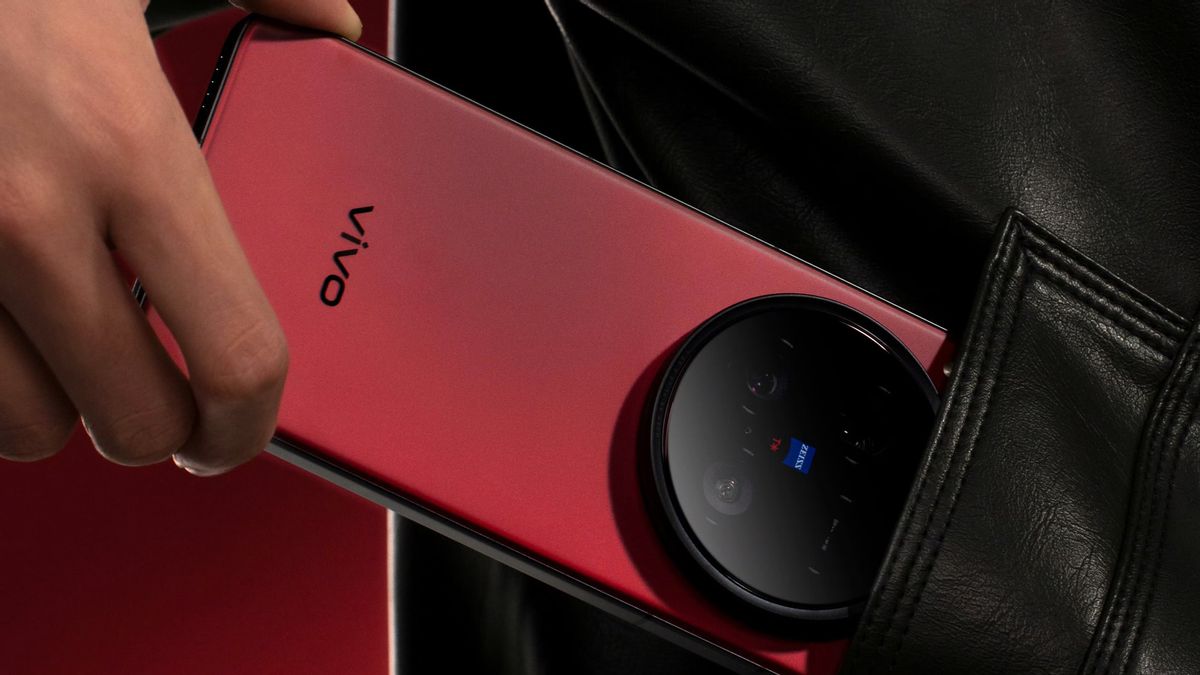


Vivo has finally officially shown off the full display of its newest flagship phone, the X200 Ultra, which will launch next week. After weeks of teasing the public with various teasers, Vivo is now showing the design of this device in three color variants, each equipped with a unique textured rear panel that gives a luxurious and futuristic impression.
But it's not just a matter of appearance. Vivo also released examples of portrait photo results from the X200 Ultra camera, which were taken with various focal lengths: 35mm, 50mm, and 85mm. This confirms that this phone is designed seriously for professional photography needs, especially in portrait shooting at various distances.
Vivo clearly expressed its ambition to make X200 Ultra a substitute for the DSLR camera, not only as a secondary camera from an ordinary smartphone. In its latest promotional video, Vivo shows the extraordinary ability of this phone to take landscape and portrait images, as well as its performance in minimal light conditions.
The X200 Ultra comes with a very impressive camera system. The main camera uses a Sony LYT-818 sensor and a Zeiss T-coated GLC 2.0* lens, which is equipped with CIPA 5.0 standard equivalent optical image stabilizer technology.
The special layer on the lens is capable of reducing the reflection of light to below 0.1%, while the third generation bionic spectral imaging technology from Vivo enriches the details and colors in each image catch.
For wide angle imaging, the ultra-wide camera on the X200 Ultra also uses a Sony LYT-818 sensor developed with Zeiss. The 14mm lens, dubbed the Hawk Eye, is capable of capturing 181% more light than the previous generation and has a 216% faster shutter speed. The system is also equipped with a two-axis image stabilizer to ensure the photo yield remains sharp and blur-free.
The one that stole the most attention was a 85mm telephoto camera that uses a 200MP Samsung HP9 sensor. Vivo claims this is the world's first APO-grade telephoto camera on mobile phones, with the design of six lens elements and a high-level OIS system. This combination promises 38% better performance in low-light conditions and 41% more stable when used.
SEE ALSO:
-
 | TEKNOLOGI
10 Bintang di Facebook Berapa Rupiah? Segini Nilai dan Cara Menghitungnya
19 April 2025, 16:35




Vivo also equipped X200 Ultra with its first AI-powered image processing chip, VS1. This chip is capable of processing up to 80 trillion operations per second (TOPS), and supports various advanced features such as real-time bokeh effects, dynamic HDR, and the merger of multi-frame images.
In addition, the camera system is able to handle various focal lengths ranging from 24mm to 100mm, as well as record 4K video portraits with the support of various night modes such as Supermoon and Starry Sky.
With all these technologies, Vivo X200 Ultra not only appears as an advanced smartphone, but also as a professional photography tool that is ready to replace DSLR in the hands of creative users and mobile photographers. The launch next week will be one of the most anticipated moments in the world of gadgets this year.
The English, Chinese, Japanese, Arabic, and French versions are automatically generated by the AI. So there may still be inaccuracies in translating, please always see Indonesian as our main language. (system supported by DigitalSiber.id)
Popular


