

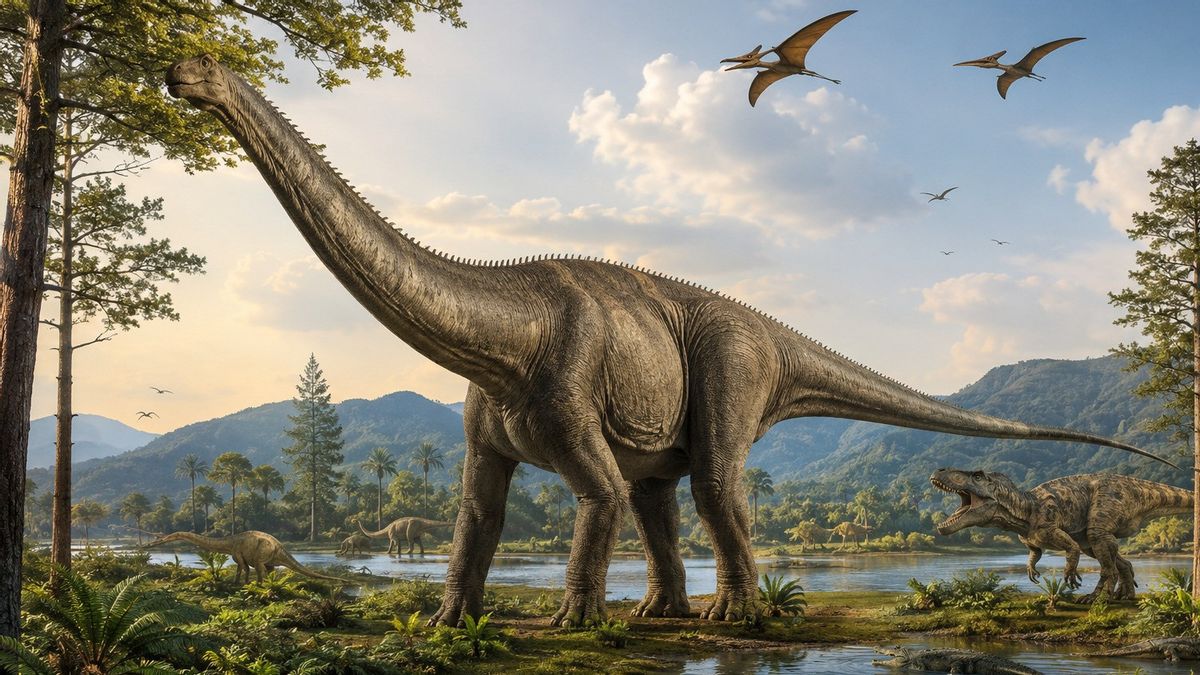


JAKARTA - Scientists have discovered the fossil Nagatitan chaiyaphumensis, the largest dinosaur ever known to have lived in Southeast Asia. The plant-eating giant is estimated to have lived in what is now Thailand about 113 million years ago.
Citing a Kyodo News report, Monday, May 18, Nagatitan is almost 27 meters long and weighs around 25 to 28 tons. With such a size, Nagatitan is estimated to be not much threatened by predators when it is an adult.
The Nagatitan fossil was first discovered by villagers in Chaiyaphum Province, northeast Thailand. After that, researchers excavated the spine, ribs, pelvis, and leg bones for several years.
One of the important findings was a humerus or forearm bone measuring 1.78 meters. From the size of the arm bone and femur, researchers estimate that Nagatitan's body weight reached tens of tons.
Nagatitan belongs to the sauropods, a group of long-necked, long-tailed, small-headed, four-legged dinosaurs like a pole. This group is known as the largest land animal in Earth's history.
The head and teeth of Nagatitan were not found. However, researchers estimated its diet from other sauropods.
"Nagatitan was likely a large plant-eater that focused on eating a lot of vegetation that required little or no chewing, such as conifers and possibly spiny seeds," said Thitiwoot Sethapanichsakul, a doctoral student in paleontology at University College London.
As reported by Kyodo News, this study was published last Thursday in the journal Scientific Reports.
When Nagatitan lived, the climate of the region was likely subtropical. There were forests, but also areas similar to savannas and scrublands. Nagatitan lived alongside various other dinosaurs, pterosaurs or flying reptiles, crocodiles, fish, and freshwater sharks.
The largest predator in the ecosystem was a relative of Carcharodontosaurus, a giant meat-eating dinosaur from Africa. It is estimated to be about 8 meters long and weighs 3.5 tons.
That size is still small compared to Nagatitan.
"With such a size, the predator seems dwarfed compared to Nagatitan. When it reaches full size, Nagatitan likely has almost nothing to fear from predators," said Sethapanichsakul.
Predators likely avoided healthy adult sauropods because of the risk of being crushed. More likely targets were babies, old individuals, or sick dinosaurs.
Paleontologist University College London, Paul Upchurch, said sauropods indeed grew very quickly after hatching. The sooner the body gets bigger, the greater the chance they will survive predators.
Although it is very large, Nagatitan has not yet matched South American sauropods such as Argentinosaurus and Patagotitan which are more than 30 meters long. However, for Southeast Asia, this finding is important. There are not many sauropod fossils in this region, and Nagatitan is the largest and youngest in terms of geology.
The name Nagatitan refers to Naga, a snake-like creature in a number of Asian religious traditions and appears in many Thai temples. So far, Thailand has 14 dinosaurs that have been given scientific names.
Sethapanichsakul said Nagatitan could be considered the last "titan" of Southeast Asia. Because, at the end of the Cretaceous Period, the area turned into a shallow sea so that it was no longer a place for sauropods to live.
Nagatitan also lived when carbon dioxide levels in Earth's atmosphere were rising and global temperatures were high. Researchers have not fully understood the relationship between hot temperatures and the body size of giant sauropod dinosaurs.
However, Upchurch said high temperatures likely affected the availability of plants, the main food of sauropods.
"Nagatitan gives us a glimpse of the period leading up to the peak in body size and temperatures about 10 to 15 million years later," said Upchurch.
The English, Chinese, Japanese, Arabic, and French versions are automatically generated by the AI. So there may still be inaccuracies in translating, please always see Indonesian as our main language. (system supported by DigitalSiber.id)
Most Popular Tags
#Prabowo Subianto #donald trump #firearm #8791 #giias 2026Popular


