



JAKARTA - Dante Alighieri's classic poem Inferno is now read from an unusual angle, namely, geology. Citing a report from The Independent, Friday, May 15, a new theory suggests that the depiction of hell in the 14th-century work may have been inspired by the concept of asteroid impact.
Inferno is the first part of The Divine Comedy. In it, Dante describes a journey through nine circles of hell, where sin, punishment, and divine justice are on display.
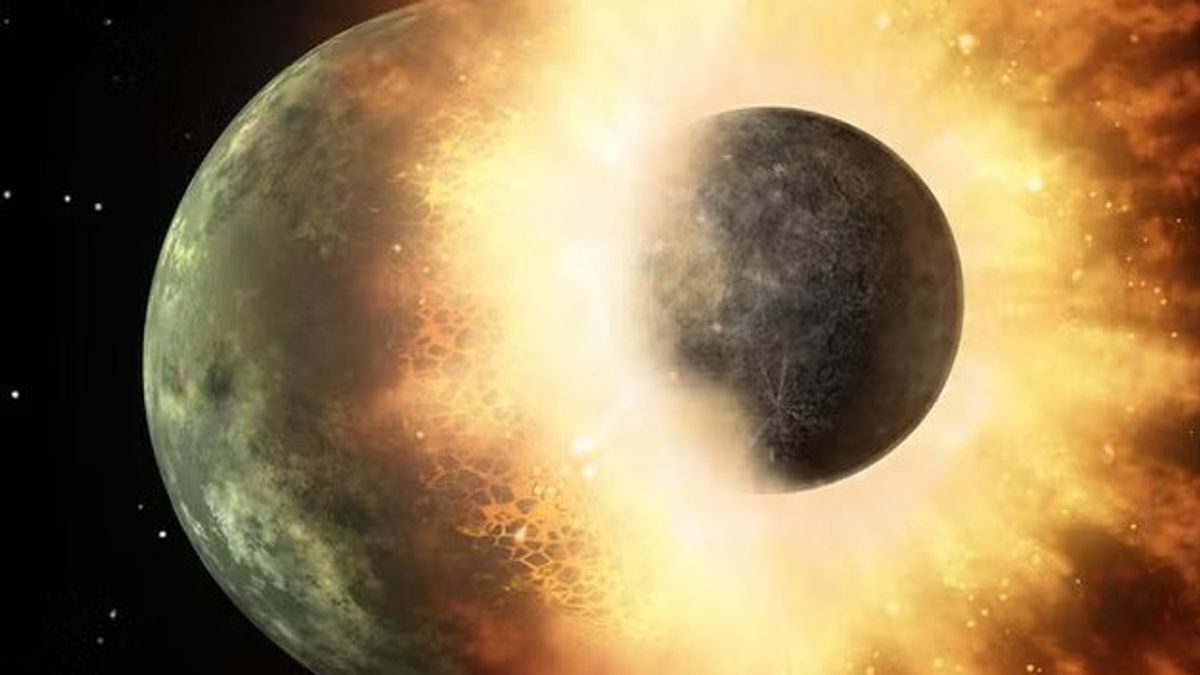
According to the theory presented at the 2026 European Geosciences Union General Assembly in Vienna, Satan in Inferno can be read as a giant high-speed object, similar to an asteroid, which hit the Southern Hemisphere and then penetrated to the center of the earth.
The impact is described as forming a hell as a large layered crater. The earth material that is pushed by the collision is said to form Mount Purgatorio or Mount Purgatory.
Timothy Burbery, professor of English literature from Marshall University, assessed that the image had similarities with the Chicxulub asteroid impact, an event believed to have ended the dinosaur era about 66 million years ago.
According to Burbery, Dante treats Satan not only as a symbol of evil, but also as a large physical object that falls to earth and changes the structure of the planet.
He assessed that the nine circles of hell in Inferno may not be just a religious symbol. According to The Independent report, the shape can be read as a depiction of a concentric crater, similar to the impact basins of asteroids found on the Moon to Venus.
"Although Dante was not a scientist, he was probably one of the first people in history to imagine the physical impact of a massive object hitting the earth at high speed," said Burbery.
In the theory, the arrival of Satan triggers a planetary-scale reaction, penetrating the earth's core and producing the peak of Mount Purgatorio. The image is considered parallel to the way modern scientists understand the impact of celestial bodies.
Burbery also said that Satan in Inferno was depicted as a flattened body the size of an asteroid. The shape is reminiscent of Oumuamua, an interstellar object that once passed close to the solar system and became the focus of scientists.
"In Dante's vision, the size and speed of the demon is so great that when it hits the earth, it immediately creates hell: a gigantic, multi-tiered circular crater that reaches the center of the earth," said Burbery.
This theory does not turn Inferno into a science book. However, he shows how ancient mythology and literature can contain shadows of the threat of celestial bodies long before the study of asteroids developed in modern science.
Modern studies of meteors only developed strongly in the 19th century. Previously, meteors were more often considered an atmospheric phenomenon, not rocks from the sky that could hit the earth.
The English, Chinese, Japanese, Arabic, and French versions are automatically generated by the AI. So there may still be inaccuracies in translating, please always see Indonesian as our main language. (system supported by DigitalSiber.id)
Most Popular Tags
#Prabowo Subianto #donald trump #firearm #8791 #giias 2026Popular


