

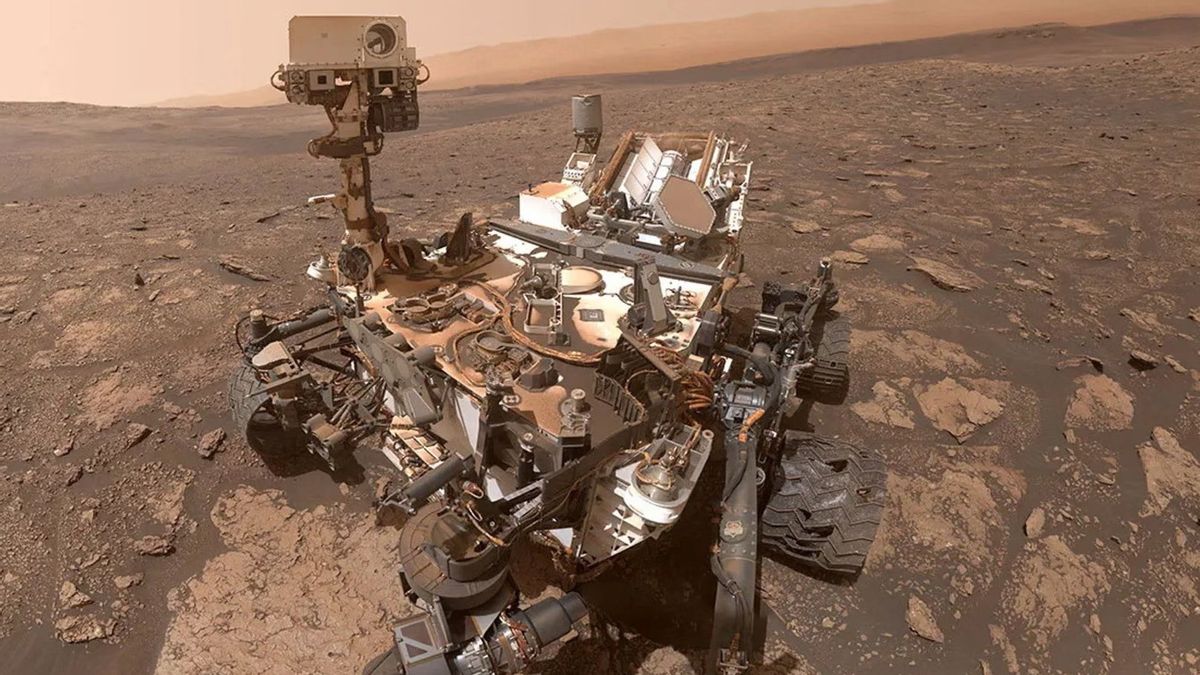


JAKARTA - NASA's Curiosity robot has found organic molecules on Mars, including compounds on Earth known to be part of the chemical building blocks of life. The findings are important, but scientists have not been able to conclude that Mars was once inhabited by living things.
Quoted from The Guardian report, Wednesday, April 22, the findings came from Curiosity's analysis of the bottom of a dry lake near the equator of Mars. Of the seven molecules detected, five of them have never been found before on the red planet. This finding opens up the possibility that chemical traces from Mars' past still survive to this day.
Prof Amy Williams from the University of Florida, a scientist on the Curiosity robot mission who led the study, said the organic material was thought to have been preserved on Mars for about 3.5 billion years. However, according to Prof Amy Williams, the available data is not enough to determine whether the compound is related to ancient life, brought by a meteorite, or formed through geological processes.
The Curiosity robot has been exploring Gale Crater and Mount Sharp since landing on Mars in 2012. The current conditions on Mars are very harsh. Night temperatures can drop to below minus 100 degrees Celsius, while the thin atmosphere makes the planet's surface constantly hit by solar radiation. Even so, scientists believe that in the past Mars once had liquid water and an atmosphere that was more capable of protecting its surface.
Prof Andrew Coates from University College London said Mars in the past had conditions that allowed life to begin to emerge, as it did on Earth. The question is, scientists have not been sure whether the chemical traces from the time when Mars was habitable could still survive until now.
In the study, the Curiosity robot detected benzothiophenes, sulfur-containing compounds often carried by meteorites. The study also provided clues to other nitrogen-containing organic compounds with structures similar to the initial materials that formed DNA. However, Williams cautioned that the findings only showed the existence of basic materials, not evidence of life.
This finding adds hope to the European Space Agency's Rosalind Franklin mission, which is scheduled to launch in 2028. The mission is designed to drill up to 2 meters deep and conduct more detailed tests to trace the origin of organic compounds on Mars.
The results of the Curiosity robot's research were published in the journal Nature Communications. The findings have not answered whether Mars was ever inhabited, but provide a new foothold for further research.
The English, Chinese, Japanese, Arabic, and French versions are automatically generated by the AI. So there may still be inaccuracies in translating, please always see Indonesian as our main language. (system supported by DigitalSiber.id)
Most Popular Tags
#Prabowo Subianto #donald trump #firearm #8791 #giias 2026Popular


