
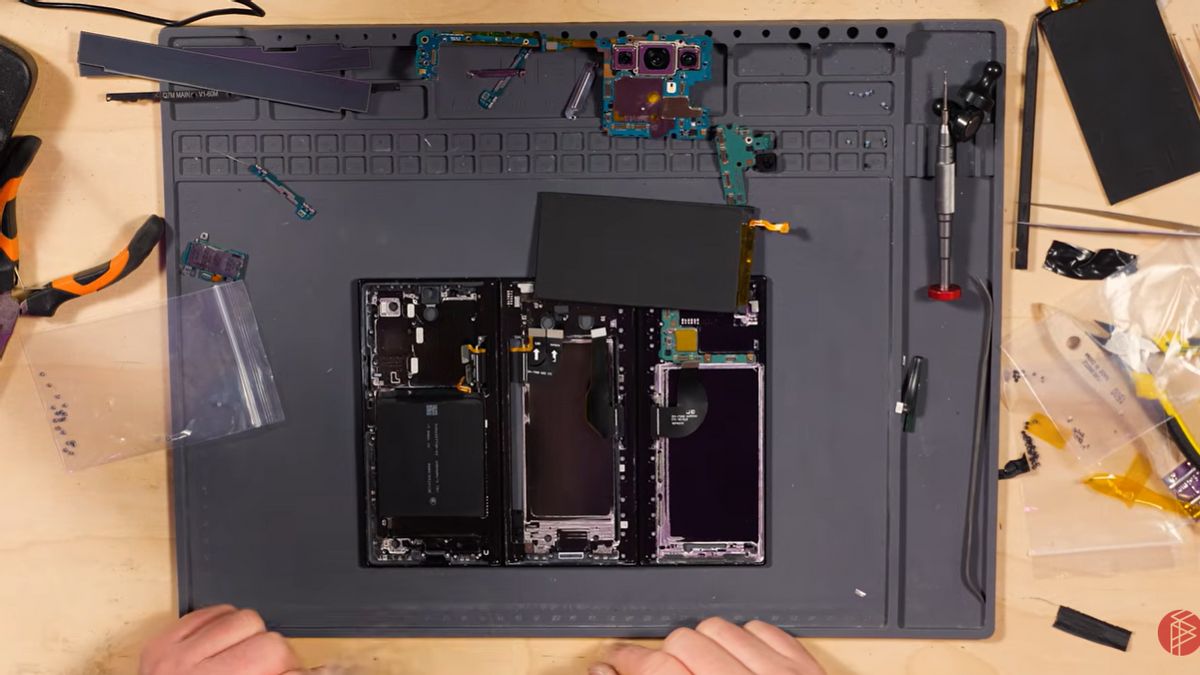


JAKARTA - Folding phones are like a god-level mechanical puzzle. The hinges are complicated, the internal space is super narrow, and every millimeter is counted. Then a YouTuber came along who thought, "What if we make the battery almost double?"
That's what Scotty Allen from the Strange Parts channel did. In his latest experiment, he disassembled the Samsung Galaxy Z TriFold and tried to replace its original battery with a high-energy silicon-carbon cell from a competing device.
By default, the Galaxy Z TriFold is equipped with a three-cell battery with a total capacity of 5,600mAh. For comparison, the Honor Magic V6 has a capacity of around 6,660mAh in a relatively similar body. Allen sees an opportunity: if the Honor battery cell has a higher energy density, why not just put it into a Samsung phone?
The theory sounds simple. The practice? Extreme surgery.
The cell size of Honor is slightly larger than the space available inside the TriFold. To make it fit, Allen had to modify the physical device. He did CNC milling on part of the frame, scraped the hinge components, even removed the bottom speaker to give extra space. This is not just a battery replacement, it's a level of "total home renovation for a new sofa."
The next problem is the power management system. Modern batteries are not just about cells, but also a battery management system that regulates charging, temperature, and power distribution. Allen replaced Honor's battery management system with Samsung's so that the device can still recognize and manage the new cell.
The end result is quite astounding: the capacity jumps to 9,600mAh. That's about 71 percent bigger than the original 5,600mAh configuration. In theory, battery life could increase drastically - something that has always been a major complaint of users of large-screen, high-power-consuming folding phones.
The modified phone even managed to turn on and work. But this experiment was not entirely without casualties. A white line is visible across the screen, allegedly due to pressure during the disassembly process. So yes, stamina is up, but the scars of the operation are visible.
This experiment also highlights the potential of silicon-carbon battery technology. Compared to conventional lithium-ion, this technology allows for higher energy density in the same volume. Physically, it means more energy is stored without making the device thicker.
Samsung is known to be cautious in matters of batteries, especially after past incidents that made the company prioritize stability and security over aggressive capacity surges. However, the latest report says Samsung is likely to start adopting silicon-carbon batteries in the upcoming Galaxy line, including thin devices such as the rumored Galaxy S26 Edge.
Allen's experiment is a kind of extreme demonstration: the room for capacity increase is there, but with design compromises and structural risks. In the world of folding device engineering, every increase is a negotiation between physics, safety, and aesthetics.
In the end, this modification is not a blueprint for mass production, but rather a proof of concept. But one thing is clear: if 9,600mAh can be squeezed into a tri-fold body through creative hands and CNC machines, then the future of mobile phone batteries may not be stuck.
The English, Chinese, Japanese, Arabic, and French versions are automatically generated by the AI. So there may still be inaccuracies in translating, please always see Indonesian as our main language. (system supported by DigitalSiber.id)


