

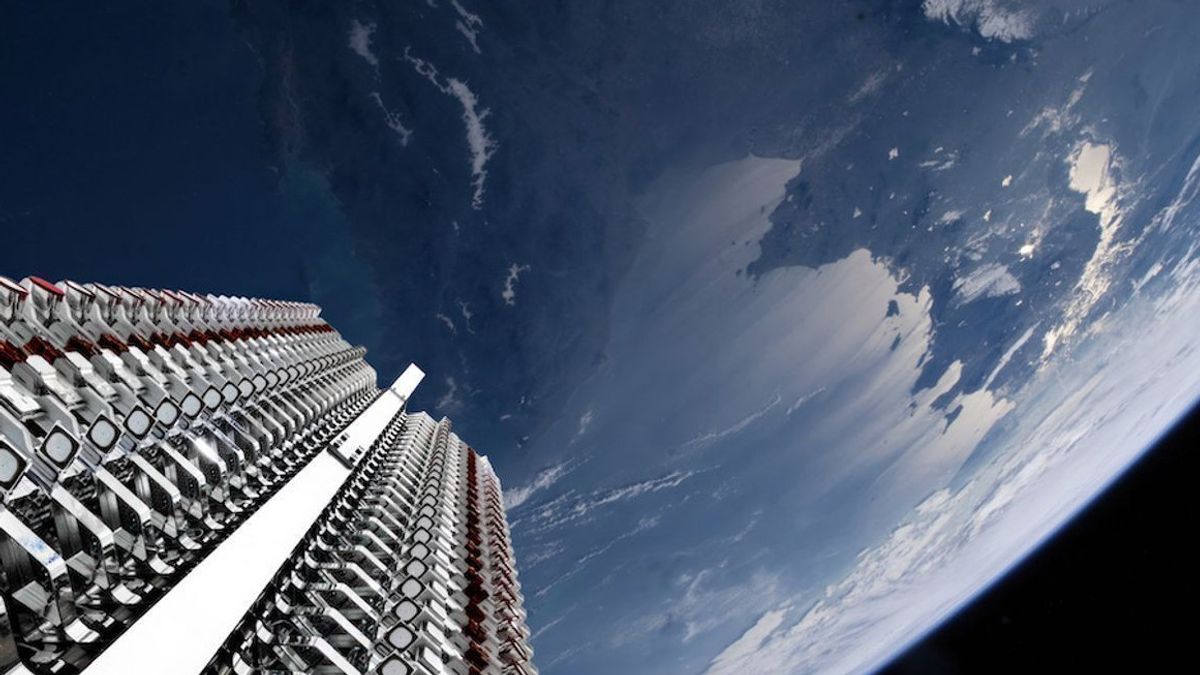


JAKARTA - A SpaceX executive stated that one of the newly launched satellites from a Chinese rocket risked colliding with Starlink. The satellite is known to come from CAS Space.
Vice President of Engineering Starlink, Michael Nicolls, discussed this problem on his X account on Friday, December 12. He said that CAS Space, a launch provider from China, was less coordinated.
"When satellite operators do not share ephemeris for their satellites, very close and dangerous approaches can occur in space," Nicolls wrote in his post.
CAS Space reported the successful launch of nine satellites using the Kinetica-1/Lijian-1 rocket on December 10. The payload included a Chinese satellite, two satellites developed jointly with UAE and Egyptian clients, and a student-made satellite from Nepal.
However, it seems that one of the new satellites turned close enough to the Starlink satellite that has been operating. Nicolls noted that the closest dangerous distance was 200 meters with the STARLINK-6079 satellite. This incident occurred at an altitude of 560 km.
"As far as we know, there is no coordination or deconfliction with satellites already operating in space," said Nicolls. "Most of the risks of operating in space come from a lack of coordination between satellite operators - this needs to change."
English:
Astronomer and Satellite Tracking Expert, Jonathan McDowell, confirmed the incident. Citing tracking data from the US Space Force, launching from PC Mag, McDowell said the closest approach occurred over the eastern Pacific Ocean.
McDowell identified the object involved as 'object 67001' based on public tracking data. However, McDowell did not know what the payload was identified as object 67001.
In response to the incident, CAS Space told PCMag that they were contacting Nicolls to learn more about the allegations. However, CAS Space emphasized that their responsibility actually ended after the satellite was launched.
CAS Space added that their main priority is to identify the exact chronology of the incident. They need to know which of the nine satellites were involved and whether the incident occurred during launch or orbit maneuvers. After that, they will provide as much assistance as possible to Starlink.
The English, Chinese, Japanese, Arabic, and French versions are automatically generated by the AI. So there may still be inaccuracies in translating, please always see Indonesian as our main language. (system supported by DigitalSiber.id)


