
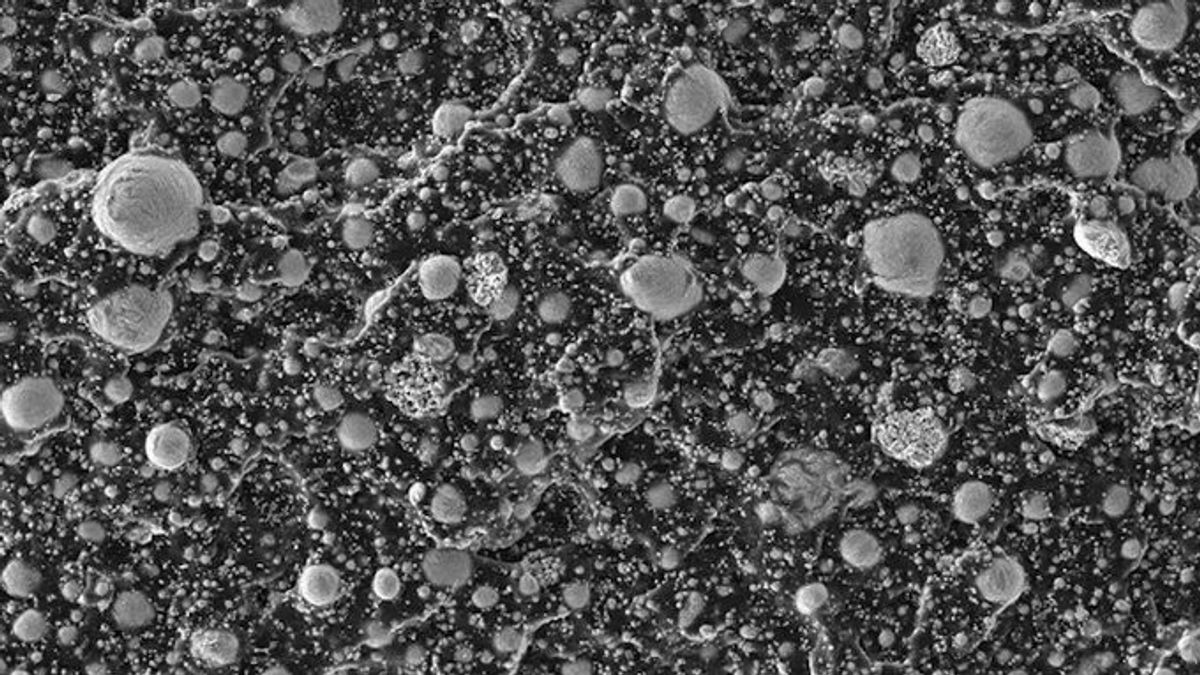


JAKARTA - Apple is back in the spotlight ahead of the presence of its first foldable product, the iPhone Fold, which is rumored to be the company's first major project in using futuristic material called Liquidmetal. This material is not just an ordinary metal and interestingly, Apple has been eyeing it for more than ten years.
Although its name sounds like a liquid metal dripped like mercury, Liquidmetal is actually an amorphous metal alloy, a metal type without a regular crystal structure. This material was first developed by a research team at the California Institute of Technology (Caltech) and later commercialized by Liquidmetal Technologies in 2023.
In contrast to conventional metals such as aluminum or steel whose atoms are composed in repeated patterns, the atomic structure of Liquidmetal is random and irregular. Precisely because of this irregularity, this material has extraordinary advantages: very strong, bending, anti-corrosive, and elastic.
Imagine a metal that can withstand high pressure without breaking, rolling back to its original shape like steel rubber, and not easily rusty despite exposure to moist air or chemicals. That's a privilege of Liquidmetal.
SEE ALSO:
-
 | TEKNOLOGI
Bikin Konten Unik, Begini Cara Pakai Fitur Reverse Video di Aplikasi CapCut
26 Oktober 2025, 19:15 -
 | TEKNOLOGI
Halo: Campaign Evolved akan Dirilis 2026, Remake Penuh dengan Visual 4K Baru
26 Oktober 2025, 18:15 -
 | TEKNOLOGI
Teknologi Robotika Kolaboratif dalam Manufaktur: Keunggulan dan Manfaat Penerapannya
26 Oktober 2025, 18:05 -
 | TEKNOLOGI
Instagram Luncurkan Fitur Watch History untuk Temukan Riwayat Tontonan Reels
26 Oktober 2025, 17:17 -
 | TEKNOLOGI
Kawasan Indo-Pasifik Hadapi Peningkatan Risiko AI pada Infrastruktur Penting
26 Oktober 2025, 16:24
In addition, this material can be heated and shaped like plastic, then cooled quickly without forming a crystal. With a force 1.5 times harder than stainless steel and 2.5 times stronger than titanium, Liquidmetal is the ideal ingredient for light but super resilient products.
No wonder this material has been used in various industries: ranging from medical equipment, defense technology, to professional golf club heads.
Apple's interest in Liquidmetal is nothing new. In 2010, the Cupertino company signed an exclusive license with Liquidmetal Technologies to research and develop its use in electronic devices.
However, despite having held exclusive rights for more than a decade, Apple has not actually implemented Liquidmetal on a large scale. The first product and so far the only that uses the material is a SIM card ejector that was sent alongside the iPhone and iPad 3G in 2010.
Many observers view the move as a "quiet trial", Apple's way of understanding how this material behaves in the mass production process. After that, various patents were filed by Apple and its subsidiary, Cruel Intellectual Property, including counter-gravity casting and floating glass processing methods similar to the glass-making process.
Unfortunately, all of these patents never really produce large Liquidmetal-based products.
Fresh air resurfaced in March 2025, when renowned analyst Ming-Chi Kuo revealed that Apple plans to use Liquidmetal for hinge components on the iPhone Fold.
According to the report, Apple will use titanium-based amorphous materials to make stronger and more resistant hinge pads. This material is said to be produced through the die casting process by Dongguan Yian Technology, a supplier who is said to have an exclusive contract with Apple.
Shortly after, a leak from a Weibo user named Setsuna Digital added that the iPhone Fold hinge will have a premium class stainless steel display with amorphous particle structure that increases resistance to deformation.
Engsel is the most fragile point of a foldable phone. If the folding mechanism is weak, the screen is easily dredged or even cracked. Therefore, Apple needs strong, lightweight, and flexible materials, and Liquidmetal looks like the perfect answer.
Compared to stainless steel, this material is much lighter, but still has high strength to withstand pressure when the device is folded repeatedly. In addition, Liquidmetal is most effectively used in a thin form, according to the design requirements of a ramp but sturdy hinge.
Even so, analysts consider it unlikely that Apple will make the entire iPhone Fold framework from Liquidmetal. More realistic if this material is only used on certain components such as hinges and internal pads, while the main frame remains using a combination of aluminum and titanium as mentioned in Jeff Pu's analyst report in October 2025.
Apple does have a long history of experimenting with new materials from aluminum unibody on MacBook, ceramic glass on Apple Watch, to titanium on the iPhone 15 Pro. But Liquidmetal is still a kind of hidden treasure that hasn't really been used yet.
If the iPhone Fold is really a big debut for Liquidmetal, then this is not just a launch of a new device, but a proof of Apple's decade-long determination to master future material technology.
But for now, it's all just a rumor and hope. Until Apple officially introduced the iPhone Fold to the public, Liquidmetal remained the subject of curiosity about the mysterious metal that might eventually find its home in the heart of the most awaited foldable phone hinge in the world.
The English, Chinese, Japanese, Arabic, and French versions are automatically generated by the AI. So there may still be inaccuracies in translating, please always see Indonesian as our main language. (system supported by DigitalSiber.id)
Most Popular Tags
#Prabowo Subianto #donald trump #firearm #8791 #giias 2026Popular


