
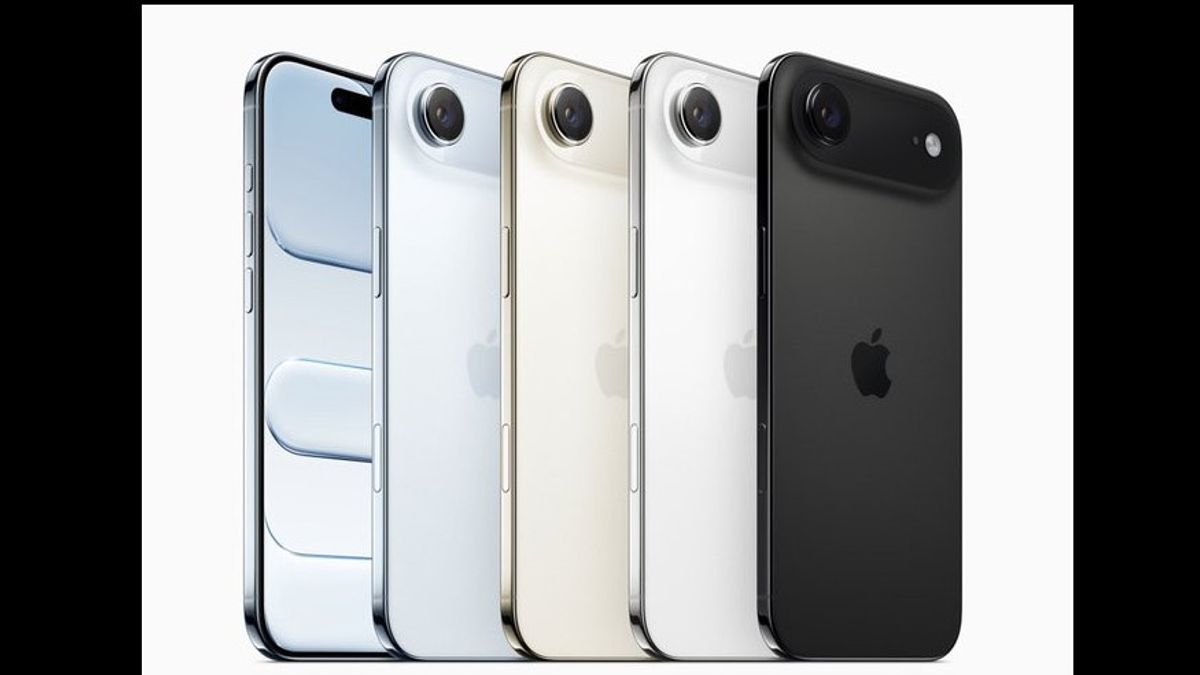


JAKARTA - Apple officially launched the iPhone Air, the latest and thinst variant of the iPhone 17, but still comes as a flagship smartphone with complete features.
The iPhone Air is the fourth model in the iPhone 17, replacing the iPhone Plus model from the previous generation. With a lineup that remains totaling four standard models and two Pro'Apple models, it is also predicted to release the iPhone 17e in early 2026.
Interestingly, even though it was launched at the same time as the other iPhone 17, Apple chose not to pin the numbers on the name iPhone Air.
SEE ALSO:
-
 | TEKNOLOGI
Mengangkasa, Satelit Nusantara Lima Jawab Kebutuhan Internet Wilayah 3T
09 September 2025, 22:05 -
 | TEKNOLOGI
Apple Store Ditutup Menjelang Peluncuran iPhone 17 "Awe Dropping"
10 September 2025, 05:05 -
 | TEKNOLOGI
Eli Lilly Meluncurkan Platform TuneLab untuk Penemuan Obat Berbasis AI
10 September 2025, 04:09 -
 | TEKNOLOGI
AS Sanksi Jaringan Penipuan Siber Miliaran Dolar di Myanmar dan Kamboja
10 September 2025, 02:05

As the name implies, the iPhone Air is the thinst model in the current iPhone line. With a thickness of only 5.6 mm, this phone is about two millimeters slimmer than the iPhone 16 and 16 Plus.
Apple reaches this thickness using titanium material, which was previously only available on the Pro line. On the back, Apple uses Ceramic Shield 2 which is claimed to be more scratch resistant, low reflection, and four times more resistant to cracks than ordinary glasses.
Although sleek, the iPhone Air still presents a large 6.5-inch OLED display with a resolution of 2,736 x 1,260 pixels, resulting in a 460ppi density. This screen supports ProMotion with an adaptive refresh rate of up to 120Hz' features that were previously only available on the Pro model.
The maximum brightness rate reaches 3,000 nits, with a contrast ratio of 2 million to 1. Other support includes Wide Color (P3), Haptic Touch, and True Tone.
The iPhone Air is powered by the A19 Pro chip, Apple's fastest chip so far and is also used on the iPhone 17 Pro. This chip is paired with a 5-core GPU with second-generation dynamic trapping and integrated image compression.
AI capabilities are enhanced with a neural accelerator that works directly in each GPU core.
Because the design is very thin, the iPhone Air is only equipped with a rear camera: a 48MP Wide camera with an OIS Shift Sensor feature. There is no Ultra Wide or Telephoto camera.
However, Apple still provides two "camera" options in the Camera app through the 2x digital zoom feature using image cropping, creating an experience as if it had an additional camera.
For the front camera, the iPhone Air still uses the TrueDepth system, now with a new 18MP sensor and supports the Center Stage. This front camera is also capable of moving automatically from portrait mode to landscape, as well as resetting (reframe) if more people enter the frame.
Video recording supports Dolby Vision to a resolution of 4K 60fps, as well as a slo-mo of up to 1080p 240fps.
Although thin, Apple claims the iPhone Air has up to 27 hours of battery life, and can be extended to 40 hours using the new MagSafe Battery.
In terms of connectivity, the iPhone Air relies on two chips: N1 for Wi-Fi 7, Bluetooth 6, and Thread; as well as Apple's C1X modem which is twice as fast as the previous generation.
Like Apple's latest trend, there is no physical SIM card slot, all users are required to use eSIM. By eliminating the SIM route, Apple claims to be able to leave additional space for the battery.
Charging ports use USB-C, but are still limited at USB 2.0 speeds, unlike Pro models that already support USB 3.0 for faster data transfer.
iPhone Air is available in four colors: blue, gold, silver, and black.
The price starts from 999 US dollars (around Rp. 16.4 million) for the 256GB variant, up to 1,399 US dollars (around Rp. 23 million) for the 1TB version.
Pre-order opens September 12, 2025
Officially Available From 19 September 2025
The English, Chinese, Japanese, Arabic, and French versions are automatically generated by the AI. So there may still be inaccuracies in translating, please always see Indonesian as our main language. (system supported by DigitalSiber.id)


