

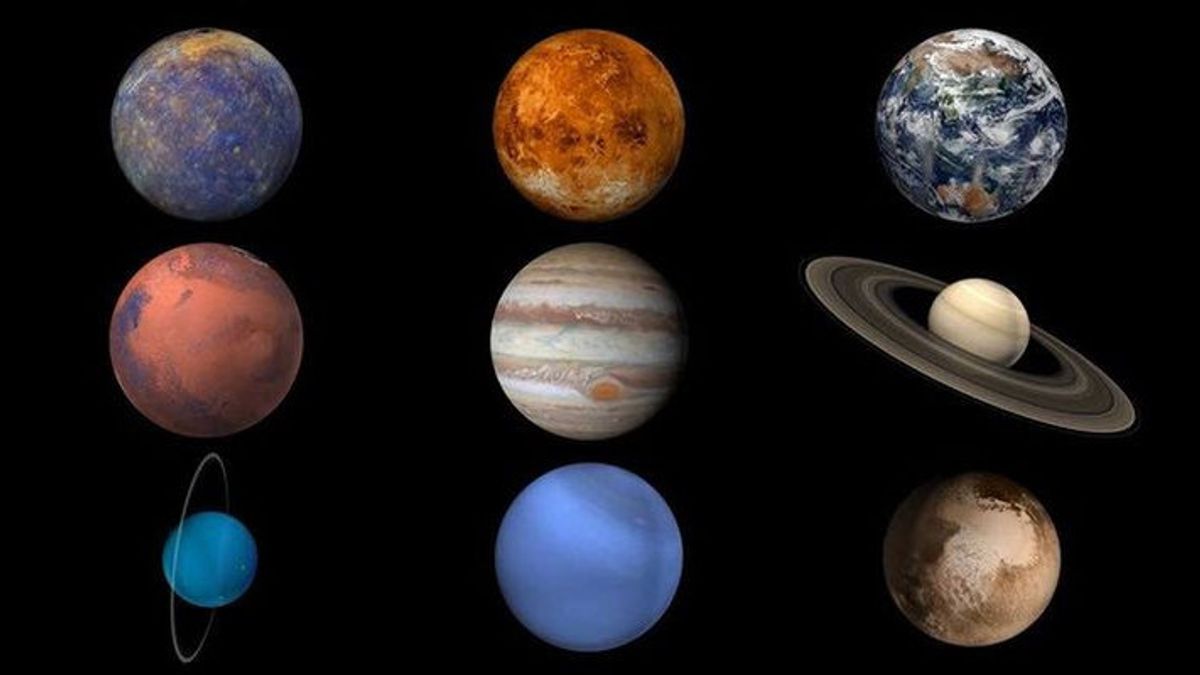


JAKARTA The solar system has eight officially recognized planets, including Earth. Although many know the order of the largest to smallest planet, you may be curious about its original size.
The size of planets in the solar system is quite diverse and is not affected from its distance to Earth. To find out the size of each planet, NASA calculates the size of the planet with an equatorial diameter.
Simply put, the equator is a circular line of joy in the middle of the planet and divides it into two parts. This line doesn't really exist, but is often used by astronomers.
The equator will help astronomers calculate the original size of Earth or other planets, both in the solar system and beyond. The following is a list of the sizes of planets from the largest to the smallest.
Jupiter
Jupiter is the largest planet with a size 11 times wider than Earth. The planet has an equatorial diameter of 142,984 kilometers. As the fifth planet of the Sun, Jupiter orbits with a distance of 778 million kilometers.
Saturn
The next second largest planet is Saturn. The planet has an equatorial diameter of 120,536 kilometers, nine times wider than Earth. As the sixth planet from the Sun, Saturn orbits with a distance of 1.4 billion kilometers.
Uranus
Uranus is the third largest planet with a size four times wider than Earth. The planet is 51,118 kilometers in diameter and is the seventh planet from the Sun in terms of distance.
Neptune
As the next largest planet, Neptune has an equatorial diameter of 49,528 kilometers. With a size not that different from Uranus, the planet is the farthest planet from the Sun.
Earth
Earth is the fifth largest planet in the solar system with a diameter of 12,756 kilometers, very small when compared to Neptune or other planets. This planet of humans orbits 149.7 kilometers away from the Sun.
SEE ALSO:
-
 | TEKNOLOGI
Ikuti Jejak Spotify, YouTube Music Akan Hadirkan Fitur Berbagi Lirik
23 April 2025, 11:35 -
 | TEKNOLOGI
Para Ilmuwan Perdebatkan Bukti Kehadiran 'Alien' di Exoplanet K2-18b
23 April 2025, 07:35 -
 | TEKNOLOGI
BSSN Dorong Sinergi Lintas Sektor untuk Mewujudkan Ketahanan Siber Nasional
23 April 2025, 08:33

Venus
The size of Venus is almost as big as Earth, which is 12,104 kilometers. Therefore, this planet is often called Earth's twin. Venus is the second planet from the Sun with an orbital distance of about 108 million kilometers.
Mars
With a smaller size than Earth, Mars is the seventh largest planet in the solar system. The equator's diameter of the planet is only 6,792 kilometers with an orbital distance of about 227.9 million kilometers from the Sun.
Mercury
Although closest to the Sun, which is about 58 million kilometers in orbit, Mercury is very small. The planet has an equatorial diameter of 4,880 kilometers.
The English, Chinese, Japanese, Arabic, and French versions are automatically generated by the AI. So there may still be inaccuracies in translating, please always see Indonesian as our main language. (system supported by DigitalSiber.id)


