

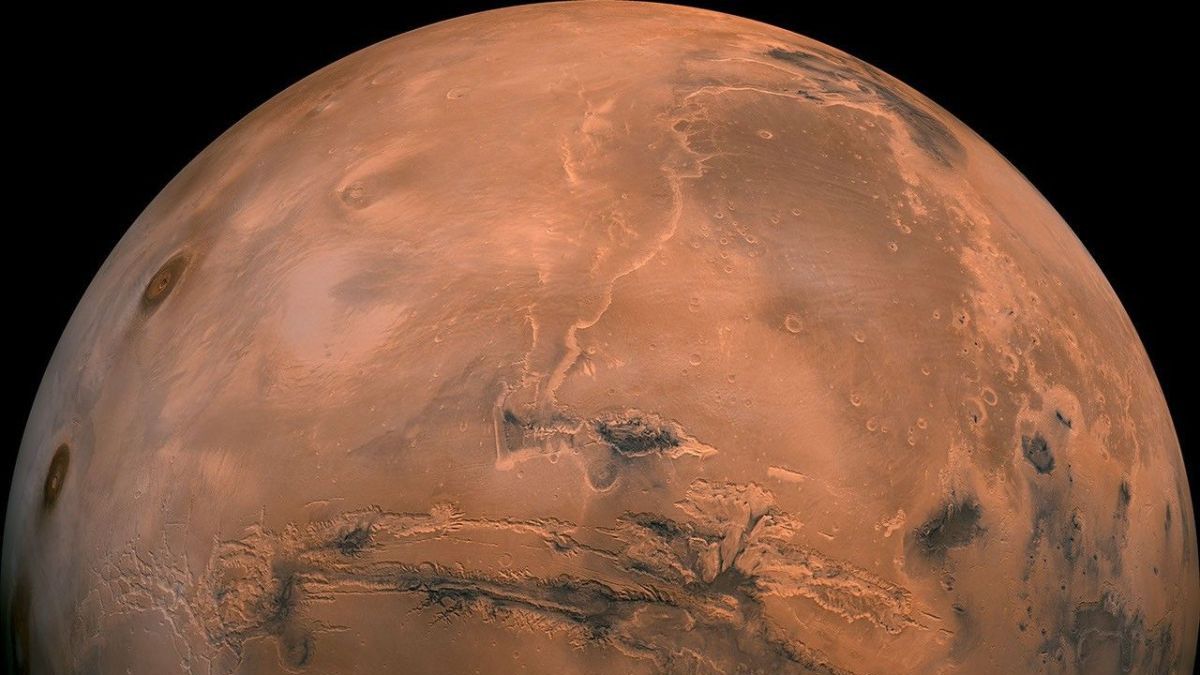


JAKARTA Scientists are still digging Mars' past to find out many things, one of which is whether Mars was once a habitable planet. In addition, the red color on Mars has not yet been resolved.
There has been a lot of research being done to find out how and what caused the surface of Mars to turn red. However, no one has found a definite answer yet. Therefore, a number of scientists are back in the analysis study.
NASA revealed that a group of researchers had released the results of their studies in the journal Nature Communications on February 25. In the research conducted, this group of scientists believes that the red color comes from ferrihidrit.
Ferrihidrit is an iron mineral rich in water. This is in line with the findings of elements in Martian dust, which is a combination of various minerals, one of which is iron oxide. Ferrihydrate is an iron oxide that is believed to be one of the elements in it.
From our analysis, we believe ferrihidrit is ubiquitous in dust and may also be in rock formation. We are not the first to consider ferrihidrit as the reason why Mars is red," said Adam Valantinas, a Brown University researcher.
To prove whether the ferrihidrites that cause the surface of Mars are red, scientists take advantage of the data from existing observations. They also use the latest laboratory method to make Martian dust.
SEE ALSO:
-
 | TEKNOLOGI
Tri Kembali Hadirkan Program Sedekah Kuota untuk Sekolah dan Pesantren di Daerah Rural
25 Februari 2025, 21:08 -
 | TEKNOLOGI
Simak! Begini Cara Cek Aplikasi yang Kuras Baterai di Windows 11
25 Februari 2025, 20:07 -
 | TEKNOLOGI
Masuki Tahap Finishing, Komdigi Minta BSSN Pastikan Keamanan Siber PDN Cikarang
25 Februari 2025, 19:05


They combine orbital observations of the Mars Reconnaissance Orbit and Trace Gas Orbit instruments from a number of NASA's Mars and Mars Express explorers belonging to the European Space Agency (ESA).
Furthermore, these findings are compared with laboratory experiments. Valantinas and colleagues test how light interacts with ferrihidrte particles and other minerals under the Martian conditions they simulate.
Based on observations, Valantinas stated that evidence leads to the formation of ferrihidrit, where oxygen or other sources and water can react to iron. That way, the surface of Mars can become red.
"This condition is very different from the dry and cold environment today. When the Martian wind spreads this dust everywhere, it creates a red look that characterizes the planet," explains Valantinas.
The English, Chinese, Japanese, Arabic, and French versions are automatically generated by the AI. So there may still be inaccuracies in translating, please always see Indonesian as our main language. (system supported by DigitalSiber.id)
Most Popular Tags
#Prabowo Subianto #donald trump #Febrie Adriansyah #8791 #giias 2026Popular


