
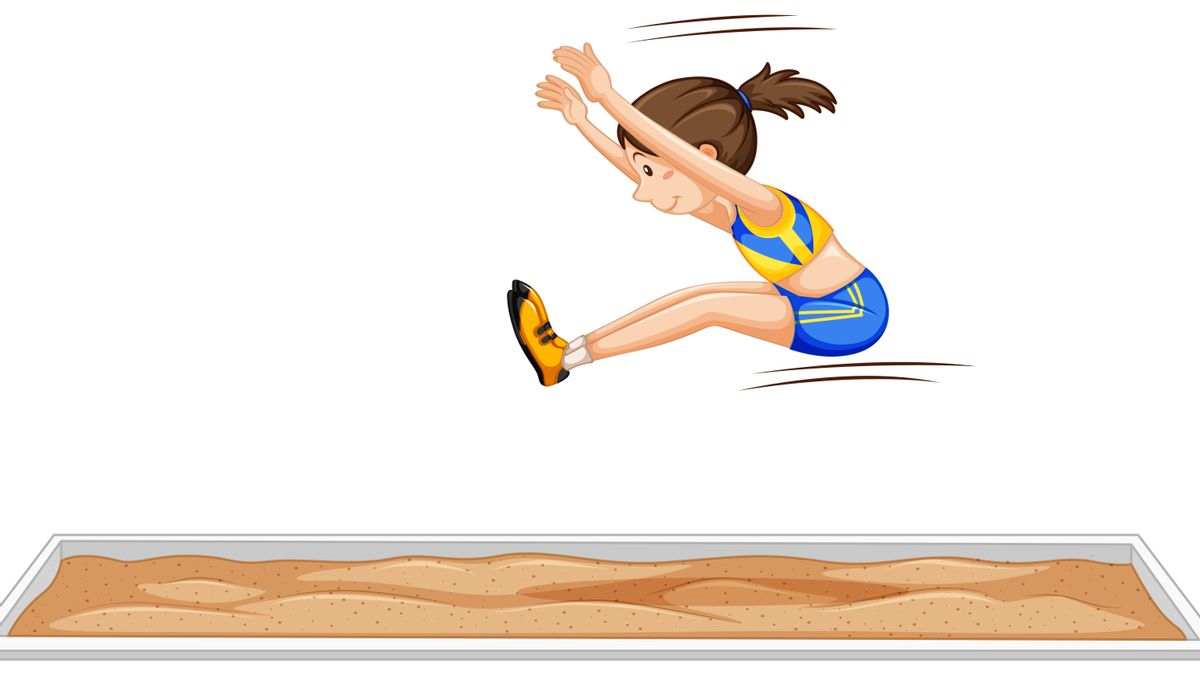


YOGYAKARTA - Understanding the right way to land at long jumps is very important to determine the final result of the jump. Given that many athletes lost their best distance just because of the inappropriate landing technique.
In a long jump, the moment of landing determines whether your jump is considered legitimate and optimal.
Therefore, every leaper needs to understand the technique of landing correctly, from the position of the legs, knees, to the swing of the hand that helps maintain the stability of the body in the air and when it touches the sand.
Reporting from the Track and Field Coach page, here are some tips for you to master landing techniques in long jumps:
Start by walking on the track while doing a three-step pop ups or light repulsion with a bulge leg barely lifting from the ground. After getting used to it, increase it with pop ups accompanied by high front knee swings and strong arm movements (arm swings opposite the knee).
A more specific jump movement exercise for long jumps includes a simple bounding, which is lifting the front knee with a focus on leap height, not distance.
Also read articles discussing Muscle Ability to Hold A Burden for a long time so that the Body remains Strong!
After that, continue training by running light and doing one-time rebound repeatedly along the track. If it is mastered, develop this exercise into light running with pop ups for 35 steps up to about 50 meters.
SEE ALSO:
-
 | OLAHRAGA
Barcelona Laporkan Kerugian setelah Pajak untuk Tahun Kedua Beruntun
09 Oktober 2025, 18:15 -
 | OLAHRAGA
Tuchel Sudah Tentukan Pemain untuk Dua Laga Tedekat, Tanpa Bellingham dan Foden
09 Oktober 2025, 17:15

The long jump exercise stands useful for understanding the base of repulsion and landing. Try to stand on the edge of the sand bath with your legs as wide as your shoulders, your knees are slightly bent, push your body forward with both legs while swinging your hands.
When landing in the sand, make sure the legs are level and the knees bend slightly, keep your hands straight forward.
Next, do a similar exercise, but add movement to kick your feet forward before landing. After that, try to jump long standing normally by landing with your heels first, then sliding your knees closer to the heel.
Add an approach with three steps, then five steps. For more experienced leapers, increase it up to 12 steps to get a consistent speed and rhythm before rejection.
Use a ramp board and jump into a high jump mattress to train the right landing technique with a lower risk of injury.
Do a rejection from a distance of 57 steps to a high jump mattress. Then stand on the mat, jump up while kicking your feet forward, and try to touch your hands to your feet. This exercise is effective for training body coordination when landing.
Developing the right sprint technique is very important to maintain speed and balance as you run on the track towards repulsion. You should know, stable speeds will help generate maximum jumps and more controlled landings.
By understanding basic techniques such as repulsion, landing, and correct approach, beginners can gradually increase their ability to jump away.
Routine exercise and focus on body coordination are key to getting a stable, secure jump, and producing the best distance at each trial.
In addition to discussing how to land properly in the long jump, follow other interesting articles on VOI, to get updated news, don't forget to follow and monitor all of our social media accounts!
The English, Chinese, Japanese, Arabic, and French versions are automatically generated by the AI. So there may still be inaccuracies in translating, please always see Indonesian as our main language. (system supported by DigitalSiber.id)


