

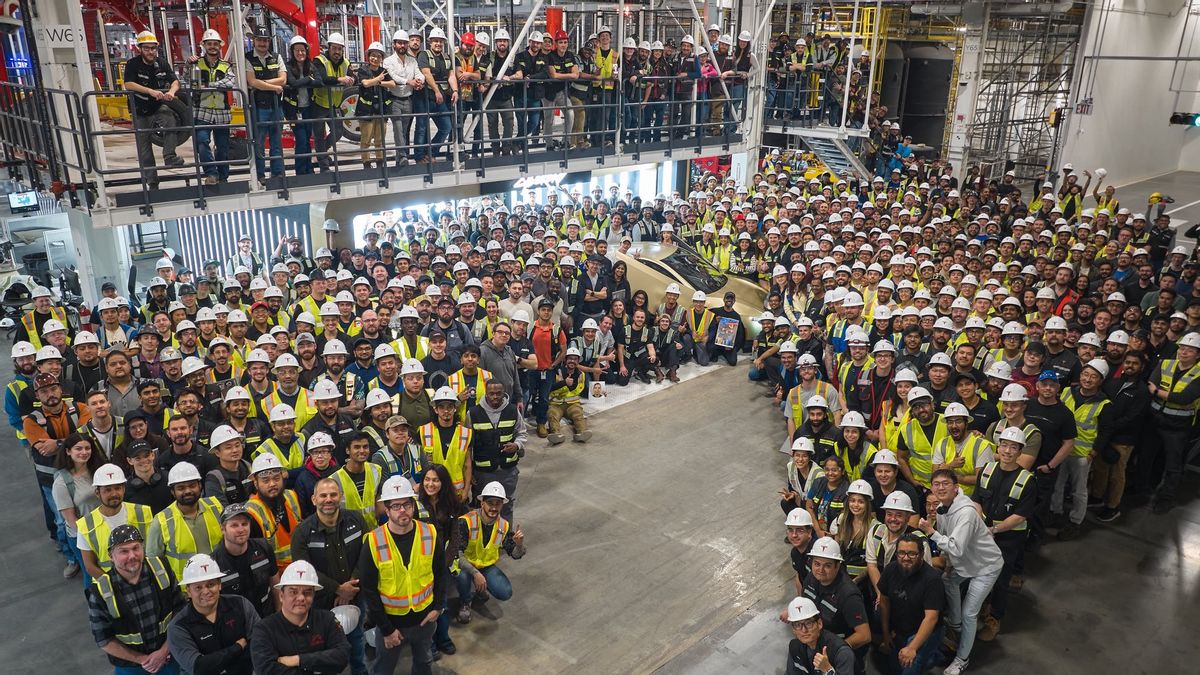


JAKARTA - Tesla seems to be moving faster than expected in the Cybercab project. The electric vehicle manufacturer from the United States announced that the first production example of the Cybercab had come off the assembly line last Tuesday local time.
Launching Carscoops, Thursday, February 19, if the company intends to sell it before the decade ends, there are still a number of technical and regulatory obstacles that must be resolved. In fact, a well-known YouTuber had promised to carry out extreme actions if the target was really achieved.
On February 17, Tesla shared a photo showing a team at the Gigafactory Texas surrounding the first production Cybercab unit. Although there is no certainty when mass production will begin, Musk previously said the new manufacturing process will begin in April.
The fact that the first unit was assembled in February is considered a fairly surprising development. However, the unit is almost certainly still a prototype, not a vehicle ready to be sent to consumers.
Even so, this step is still considered significant for Tesla, which has long been associated with changing launch schedules. It was this reputation that prompted YouTuber Marques Brownlee or MKBHD in 2024.
He said he would shave his hair in front of the camera if Tesla managed to launch the Cybercab before 2027 with a price tag of less than 30,000 US dollars. After Tesla's latest announcement, the bald version of the MKBHD meme also circulated widely on the X platform.
Musk responded with a comment, "It will happen", and on another occasion he reiterated Tesla's plan to sell a consumer version of the Cybercab before 2027 at a price of "30,000 dollars or less". Behind this optimism, Tesla still has to face major challenges.
The Cybercab is designed as a pure autonomous vehicle without a steering wheel and pedals. However, since its introduction, Tesla has also opened the possibility of reintroducing the controls if regulations require it.
The main question lies in the legal aspect, federal vehicle safety standards still assume the presence of a human driver, as well as the insurance framework. The United States highway safety authority may need to provide special exceptions.
Meanwhile, each state has the potential to implement different rules for autonomous vehicles on public roads. In other words, assembling a Cybercab may not be the hardest part, the real challenge is getting the green light from regulators.
The English, Chinese, Japanese, Arabic, and French versions are automatically generated by the AI. So there may still be inaccuracies in translating, please always see Indonesian as our main language. (system supported by DigitalSiber.id)
Most Popular Tags
#Prabowo Subianto #donald trump #2026 World Cup #Febrie Adriansyah #8791Popular


