

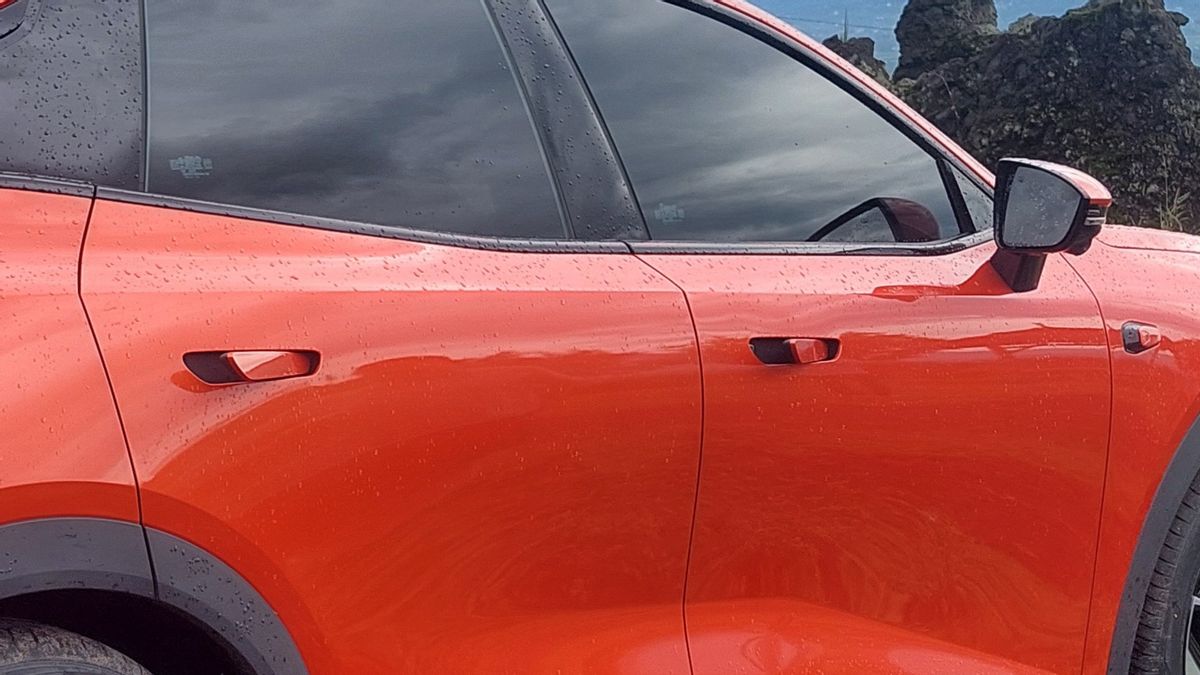


JAKARTA - After several studies, China officially banned the use of electronic door handles on electric vehicles starting in 2027. The minimalist design that was first popularized through this was previously considered futuristic, but is now seen as risky after a number of fatal accidents, including reports of children trapped inside vehicles because the doors could not be opened when the power failed.
Starting January 1, 2027, all manufacturers are required to install mechanical door handles on the outside and inside of electric cars sold in China. Models that have already received approval and are about to be launched are still given a transition period until January 2029 to adjust.
This policy emerged after a series of major incidents, including two electric car accidents that caught fire. In these cases, reports say passengers and rescuers have difficulty opening doors that are entirely dependent on the electronic system.
The safety authority then conducted a thorough review of vehicle emergency access standards. As reported by Carscoops, Tuesday, February 3, China's new rules are very detailed.
The exterior door handle must provide a hidden handle measuring at least 60 mm x 20 mm so that it can still be physically grasped after an accident. Inside the cabin, the door opening lever must be clearly labeled with a visual sign of how to open the door in an emergency.
The interior sign is also set to be at least 1 cm x 0.7 cm, while the position of the door handle, both inside and outside must be easy to recognize. With these guidelines, manufacturers are no longer allowed to rely entirely on electric-powered systems, even those equipped with a backup battery or a mechanical towing cable.
The impact is quite wide because of this new rule, at least about 60 percent of the 100 best-selling new energy vehicles in China as of last April were reported to still use hidden door handles, especially on premium models. The list of affected cars includes the Tesla Model 3 and Model Y, the Chinese version of the BMW iX3 that will be coming soon, as well as products from Nio, Li Auto, Xpeng, and Xiaomi.
A number of brands have even started to make amends, with the latest models from Geely and BYD quietly reverting to the traditional door handles that are visible. Tesla's head of design commented a few months ago, when the ban was first proposed, that the brand was already working on its solution.
However, the redesign process is not cheap, a source familiar with the development of electric vehicles in China told Bloomberg that adapting the door system to meet the new standards could cost more than 100 million yuan per model, or about 14.4 million US dollars. This ban has the potential to change the global automotive design landscape.
With China as the world's largest EV market, manufacturers are likely to choose a uniform approach so that they don't have to make different hardware for each region, while reducing costs and accelerating development. Interestingly, the rules only apply to electric cars.
Non-electric vehicles are still allowed to use electric door handles, although functionally many of them also rely on a 12V battery. For example, those that also use an automatic door handle based on electrical power and theoretically face a similar risk if the battery dies during an accident.
By limiting access to automatic doors on electric cars, China has the opportunity to stop this design trend before it spreads. If European or US regulators follow a similar move, it is not impossible that the rule will be expanded to all passenger vehicles.
The signs are already visible. Tesla is currently facing a formal investigation into its door system in the United States, while European regulators are beginning to explore their own restrictions. If this wave of regulations continues, the era of the invisible door handle in modern cars could soon come to an end.
The English, Chinese, Japanese, Arabic, and French versions are automatically generated by the AI. So there may still be inaccuracies in translating, please always see Indonesian as our main language. (system supported by DigitalSiber.id)


