

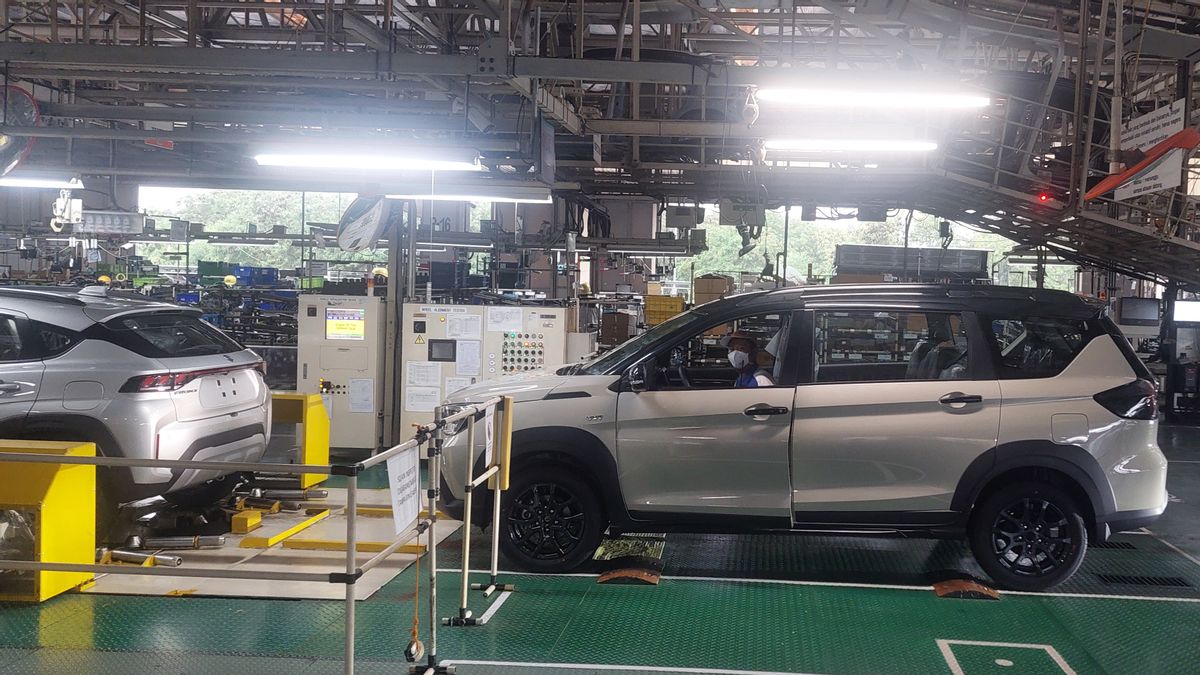


The dynamics of the automotive industry policy is "heating up" again after Coordinating Minister for Economic Affairs Airlangga Hartarto, said there is no plan to provide incentives for the automotive sector next year. On the other hand, the Ministry of Industry (Kemenperin) actually assesses that incentives are urgently needed to maintain the breath of the depressed industry.
The Ministry of Industry stated that the current condition of the automotive industry is not fine. Incentives are considered important to maintain production utilization, maintain investment, protect workers from the threat of layoffs, and increase the competitiveness of domestic products that are now facing intense competition.
The market situation does describe a weakening trend. Based on data from the Association of Indonesian Automotive Industries (Gaikindo), sales of wholesales cars in January 'October 2025 only reached 634,844 units, down 10.6 percent compared to the same period last year of 711,064 units.
Retail sales were not even better, slumped 9.6 percent to 660,659 units from the previous 731,113 units. Data from the Directorate General of ILMATE noted that the national vehicle output fell to 957,293 units from 996,741 units in 2024.
The pressure on demand is considered to make the automotive industry chain, from vehicle manufacturers to component suppliers, to feel the impact. Seeing this condition, the Minister of Industry Agus Gumiwang Kartasasmita emphasized that his party will fight for the presence of incentives for the automotive industry in 2026.
"This sector is a very important sector, it is too important for us to ignore it, it is impossible for us to ignore it. Forward, extraordinary feedback linkage, absorption of labor is also enormous, added value for the economy is also enormous. And therefore, we will continue to propose incentives or stimulus to the government for the automotive sector," Agus told reporters, quoted Wednesday, December 3.
SEE ALSO:
-
 | OTOINFO
Mobil di China Tak Lagi Wajib Punya Sambungan Kemudi Mekanis di 2026
03 Desember 2025, 17:50 -
 | OTOINFO
Sistem Berbahasa Inggris Terlihat, Huawei Aito M9 Masuk Pasar Global?
03 Desember 2025, 17:18 -
 | MOBIL
SUV Mewah BYD Yangwang U8L Disiksa dengan Ditimpa Pohon Raksasa, Hasilnya Mengejutkan
03 Desember 2025, 16:43
Agus emphasized that the condition of the industry is not good, purchasing power makes vehicle sales decrease, which automatically suppresses production in factories. If not handled immediately, this has the potential to reduce factory utilization, suppress new investments, and threaten the sustainability of millions of workers who depend on the automotive industry and components.
"Therefore, it is our responsibility. It is wrong if we do not fight for it," said Agus.
The Ministry of Industry hopes that the central government can consider the urgency of this incentive, considering that the automotive sector is still an important driver of the national economy, from contributions to manufacturing to supply chains that support thousands of small and medium industries.
The English, Chinese, Japanese, Arabic, and French versions are automatically generated by the AI. So there may still be inaccuracies in translating, please always see Indonesian as our main language. (system supported by DigitalSiber.id)
Most Popular Tags
#Prabowo Subianto #donald trump #Febrie Adriansyah #8791 #giias 2026Popular


