

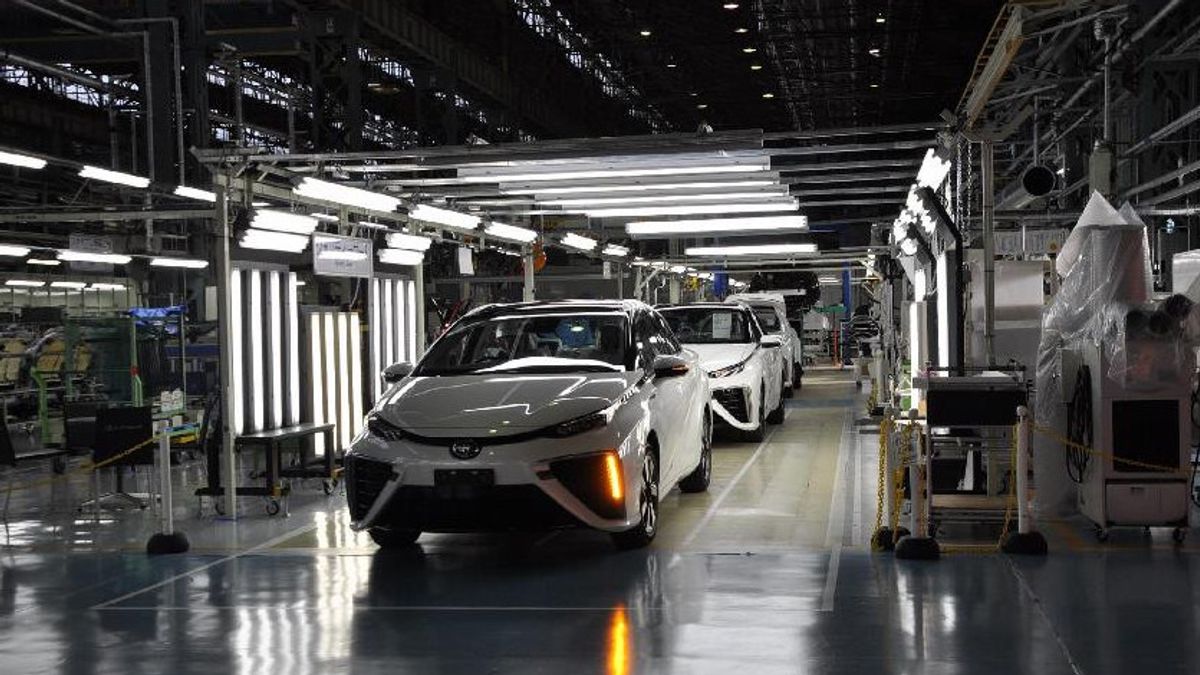


JAKARTA The Japanese automotive manufacturer has begun to shift the focus of its new car and factory production to India. This is a strategy to reduce dependence on China which is increasingly challenging on business.
Toyota Motor Corporation, Honda Motor Co., Ltd., and Suzuki Motor Corporation are reportedly preparing investments of more than US$11 billion, or around Rp180 trillion, to make India a center for global car production as well as a global export base.
Toyota and Suzuki themselves are Indian market leaders with a share of almost 40 percent. Toyota plans to expand its production capacity in India to more than one million units per year.
Meanwhile, Suzuki is targeting to increase production capacity from 2.5 million to 4 million units. Honda will also take advantage of facilities in India as a production and export base for one of its electric cars to launch in 2027.
This big step is driven by a number of factors. In addition to lower labor costs, India is now offering increasingly competitive manufacturing quality and strong support from the government through various industrial incentives.
SEE ALSO:
-
 | MOBIL
Wuling Buka Peluang MPV Elektrifikasi Darion Rakitan Cikarang untuk Diekspor
07 November 2025, 09:17 -
 | OTOINFO
Nissan Raih Laba Operasi Terbaik dalam Setahun, Strategi Pangkas Biaya Berbuah Manis
07 November 2025, 08:18

On the other hand, China's increasingly stringent market conditions due to price wars and aggressive expansion of local producers have made Japanese manufacturers look for more stable alternatives. The Indian government also plays an important role in tightening investment restrictions from China, opening up greater opportunities for Japanese companies to strengthen their positions.
Toyota targets the passenger car market share in India to rise from about eight percent to ten percent by the end of the decade. Even so, analysts think India remains a challenging market. Some of the country's previous global manufacturers were unsuccessful due to its unique market tastes and intense price competition.
The brutal price war between Chinese electric vehicle manufacturers has made it difficult for them to profit in the Bamboo Curtain country. Worse yet, Chinese car manufacturers are now expanding abroad and seizing market share from Japanese competitors in Southeast Asia.
"India is a good choice as a substitute market for China," said automotive analyst at Pelham Smithers Associates at London Julie Boote.
"For now, Japan considers it a much better market because they don't have to deal with Chinese competitors," he added.
Para eksekutif mengatakan, daya tarik lainnya termasuk peningkatan kualitas barang-barang manufaktur India dan insentif dari pemerintahan Perdana Menteri Narendra Modi. Toyota dan Suzuki masing-masing memegang kepemilikan mayoritas atas unit mereka di India. Honda memiliki 100% bisnisnya di sana.
As Japanese automakers increased investment in India, they began to lose interest in China: direct investment in China's transportation sector decreased 83 percent over the same period, to 46 billion yen last year.
The English, Chinese, Japanese, Arabic, and French versions are automatically generated by the AI. So there may still be inaccuracies in translating, please always see Indonesian as our main language. (system supported by DigitalSiber.id)
Most Popular Tags
#Prabowo Subianto #donald trump #Febrie Adriansyah #8791 #giias 2026Popular


