

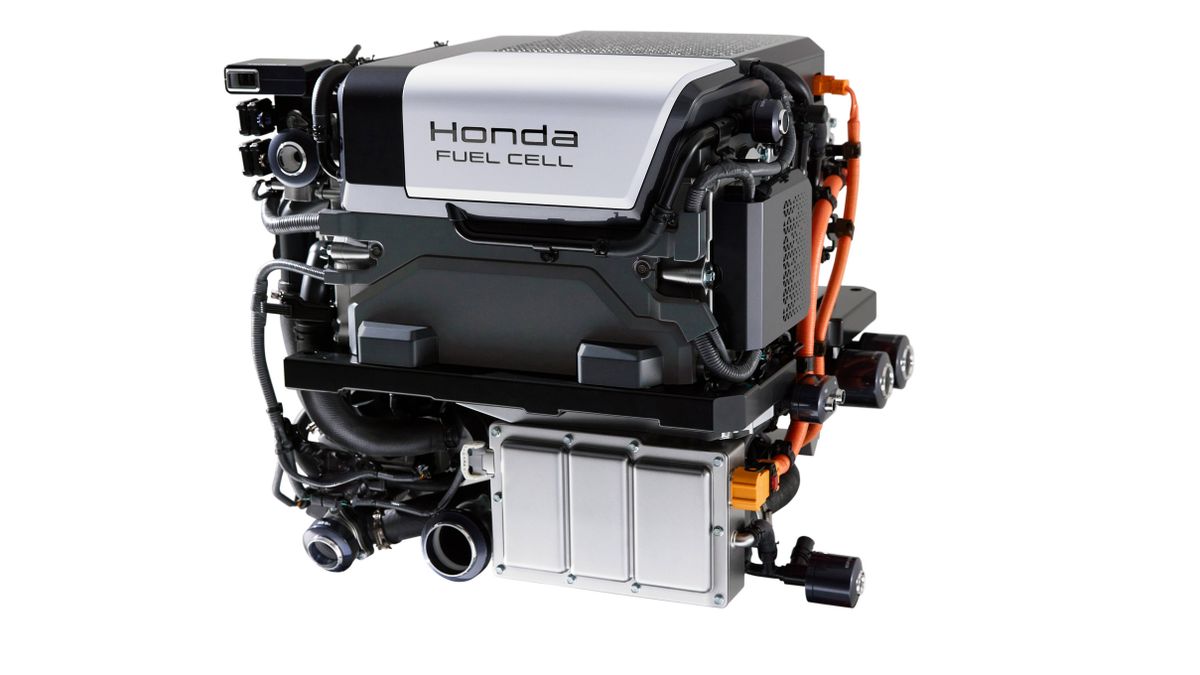


JAKARTA - Honda has introduced a new hydrogen fuel cell propulsion system that is developed independently for its future vehicles. Manufacturers claim this technology offers more power, resilience, and is cheaper than the previous version.
Launching from InsideEVs, Thursday, March 6, the technology is referred to as the 'Honda Next Generation Fuel Cell Module', which is claimed to have a power output of 150 kW.
Thus, this can provide almost twice the output of the power compared to the FCX drive unit which has been developed with General Motors (GM) of 78 kW.
This new generation module output voltage is increased to a higher range by producing between 450-850V, or potentially exceeding what electric vehicles (EVs) and plug-in hybrid (PHEVs) have, which only generates 800V.
As an illustration, its predecessor unit was only able to issue an output voltage of between 275-600V.
SEE ALSO:
-
 | MOBIL
Inilah Cadillac IQL 2026, SUV Listrik Mewah Super Besar yang Usung Ruang Ekstra
06 Maret 2025, 10:13 -
 | OTOINFO
Penjualan Honda di AS Turun Februari 2025, Model Elektrifikasi Tetap Tumbuh
05 Maret 2025, 21:43
Not only that, but the net efficiency level was also increased from 56.8 percent to 59.8 percent. Meanwhile, the volume of capacity from this unit was also reduced from 557 liters to 300 liters.
The reduction in size, coupled with an increase in power, causes a significant increase in volumetric power density from 0.14 kW/liter to 0.50 kW/liter with the weight of the fuel cell module rising from 206 kg to 250 kg.
Compared to the modules installed on Honda Clarity, the new unit is said to have spent a fifth of the production costs, while its durability has increased by more than 66 percent compared to Honda's first FCEV vehicle.
The manufacturer with the H logo is upright, saying that the latest fuel cell module will only be mass produced by 2027. However, Honda has not disclosed further information about this one system.
Currently, Honda offers CR-V e:FCEV as the only fuel cell production model to be presented to the United States (US) market. The SUV is available on rental systems provided at a number of dealers in California.
The model still uses a module developed with GM which is claimed to have a distance of 435 km according to the EPA cycle.
The English, Chinese, Japanese, Arabic, and French versions are automatically generated by the AI. So there may still be inaccuracies in translating, please always see Indonesian as our main language. (system supported by DigitalSiber.id)


