
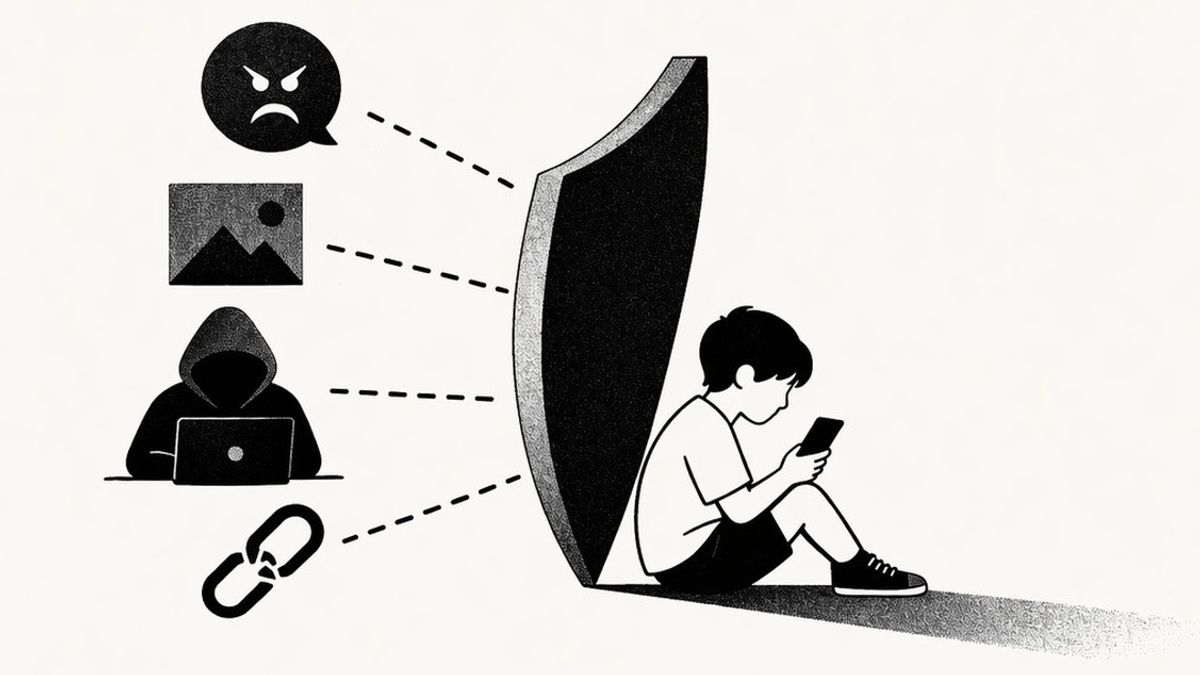


The state finally drew a firm line to protect children in the digital space. The line is called Government Regulation Number 17 of 2025 concerning the Governance of the Implementation of Electronic Systems in the Protection of Children, or PP TUNAS. This regulation was established and promulgated on March 27, 2025. The government also gave the most appropriate adjustment time of two years for the operator of electronic systems or digital platforms. This means that this rule is no longer a discourse. This rule is already in effect and must be implemented.
PP TUNAS is important because the state no longer considers children as ordinary users. In this regulation, digital platforms are required to adjust services to the age of the child, maintain the security of children's data, limit access to risky services, and implement stricter protections. The technical rules were then clarified again in the Regulation of the Minister of Communication and Digital Number 9 of 2026.
Why is this rule important? Because the use of the internet in Indonesia continues to rise. The Central Statistics Agency (BPS) in the Indonesian Telecommunications Statistics 2024 which was released on August 29, 2025 noted that 72.78 percent of Indonesians had access to the internet in 2024. This figure shows that the digital space has become part of everyday life. Children grow up in that space. Therefore, protection can no longer rely solely on advice to parents. The state needs to be present with clear rules.
The digital space is now not even a complement, but has dominated daily life. In the official document of the Ministry of Communication and Digital, it is stated that around 143 million people in Indonesia are social media users by 2025. In the midst of such a flow, the question is simple. Are we willing for children to grow too close to gadgets and social media, then slowly depend on it from an early age? Of course not. Children need to be introduced to technology. That's okay. But we certainly don't want that closeness to turn into dependence from an early age. Therefore, PP TUNAS is important as a fence so that children do not enter the digital space too quickly, the risks of which are often greater than they understand.
The problem is, the digital space is not always safe for children. The risks that often arise are not only exposure to pornography, but also cyberbullying, online fraud, screen addiction, and misuse of personal data. Therefore, PP TUNAS is not enough to be seen as an administrative rule. This rule must be understood as the state's effort to make the digital space safer for children. The goal is not to limit children excessively, but to prevent them from entering too early into digital services that are not yet appropriate for their age and stage of growth and development.
The concern is not without basis. The Chairman of the Indonesian Association of Pediatricians (IDAI), Dr. dr. Piprim Basarah Yanuarso, assessed that children are not mature enough neurologically and psychologically to face the risk of social media without accompaniment. Therefore, the age limit of 16 years is considered safer. This assessment is in line with the child protection approach used in the PP TUNAS.
Official data also shows that the threat in the digital space is not small. The Indonesian Child Protection Committee (KPAI) in its official statement on November 13, 2024 highlighted the case of children who were victims of online-based sexual exploitation. In the release, the KPAI said that in the six months Bareskrim Polri uncovered 47 cases of dissemination of pornographic content, securing 58 suspects, and applying for the blocking of 15,659 pornographic sites containing child content to Komdigi. This data shows that child protection in the digital space is indeed urgent.
However, rules alone are not enough. The government can make a fence, but the fence must really stand. Here is the challenge for PP TUNAS. This regulation will be meaningful if the digital platform is compliant, the government is consistent in supervising, and parents remain involved. Komdigi also emphasized that platforms are required to implement child access restrictions according to the level of risk of the service. This means that responsibility should no longer be imposed only on families. Digital platforms must also take responsibility for the safety of children in their services.
Therefore, PP TUNAS should be seen as an important step, even though it comes after the digital problems of children are increasingly visible. This rule gives a clearer legal basis for the state to act. But the measure of its success does not lie in the sound of the article, but in its implementation in the field. What is being tested is not only the compliance of the platform, but also the seriousness of the state in supervising and enforcing the rules. If it is enforced seriously, PP TUNAS can be the beginning of a safer digital space for children. If it is loose, it will only be a good rule on paper, while children still face the same risks every day. Because we have to protect our children.
The English, Chinese, Japanese, Arabic, and French versions are automatically generated by the AI. So there may still be inaccuracies in translating, please always see Indonesian as our main language. (system supported by DigitalSiber.id)
Most Popular Tags
#Prabowo Subianto #donald trump #firearm #8791 #giias 2026Popular


