
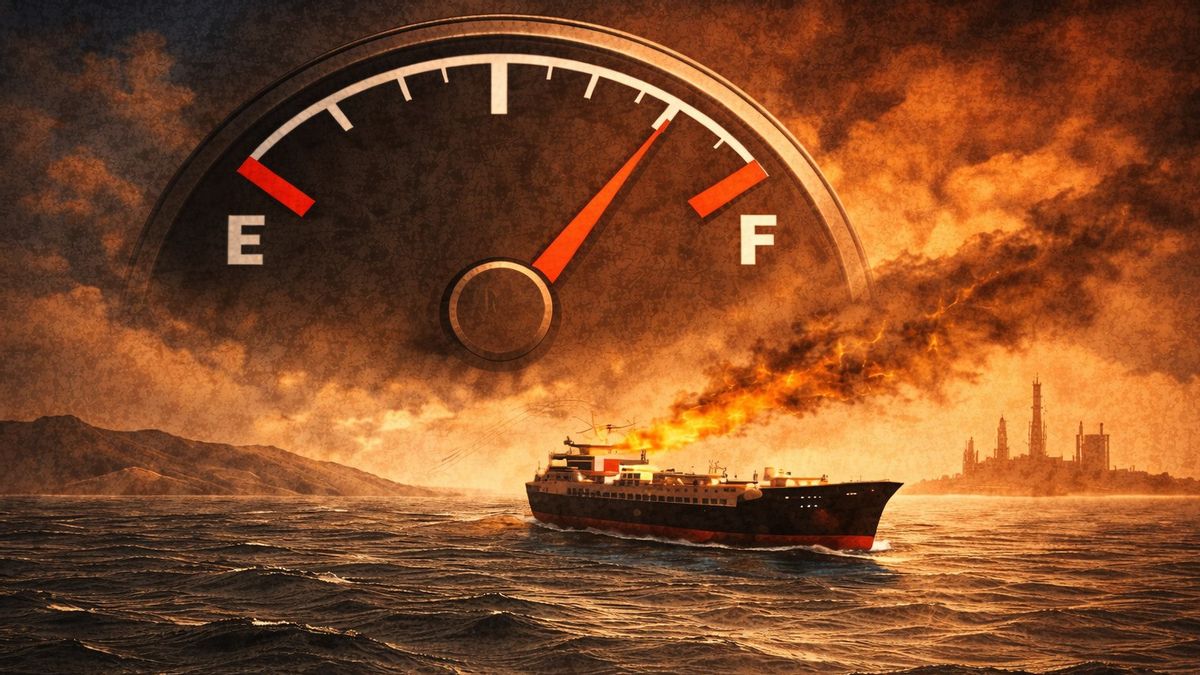


The conflict between Iran and the United States and Israel is indeed far from Jakarta. But the impact is felt close to Indonesia. Not only on world oil prices, the rupiah exchange rate, or the financial market, but also on one very basic thing. National energy resilience. When the threat in the Strait of Hormuz is growing, Indonesia is forced to assess itself. From there, a reality that causes discomfort is seen. Energy reserves, especially fuels, are still thin.
Energy and Mineral Resources Minister Bahlil Lahadalia said Indonesia's current maximum fuel storage capacity is only around 25 days. In another explanation, he also said that the national stock resilience is in the range of 20 to 23 days. The statement may be intended to calm the public. But that's where the problem lies. For a country as big as Indonesia, a safe energy space for about three weeks is clearly too narrow.
The comparison with other countries is sad. Japan, for example, has an emergency oil reserve equivalent to about 254 days of domestic consumption. This figure is far above Indonesia's position. This comparison cannot be read in black and white because the consumption structure, logistics system, and energy policies of each country are different. However, the difference still shows that Indonesia does not have a strong enough reserve cushion to face major shocks.
Here is the root of its vulnerability. Indonesia is still dependent on energy supplies from abroad. Bahlil himself admitted that Indonesia is still importing oil. This means that the security of national energy supply is still influenced by international shipping routes, global prices, and geopolitical conflicts that are beyond our control. When an important route such as the Strait of Hormuz is disrupted, Indonesia is also uneasy because the foundation of its supply resilience is not solid.
The government then prepared emergency measures. One of them is to divert some crude oil imports from the Middle East to the United States. Reuters on March 3, 2026 wrote that the Indonesian government would increase crude oil imports from the US to replace part of the supply from the Middle East amid the escalation of the conflict. In the article it was mentioned that about a quarter of Indonesia's crude oil imports and 30 percent of LPG imports come from the Middle East region. This step makes sense as an effort to reduce supply risks. However, emergency measures should not be read as evidence that our energy resilience is strong.
The main problem is not just whether or not there are ships that are stuck in the shipping lane. The main problem is that Indonesia does not have adequate storage capacity, thick reserves, and a sufficiently diverse supply source. Therefore, every major upheaval abroad quickly turns into anxiety in the country. Big countries should not only rely on statements that stocks are safe. Big countries must have real reserves, sufficient storage infrastructure, and supply strategies that are ready to be used before a crisis comes.
This conflict could subside. Even if it's not known when. Oil prices could fall again. Shipping lanes in the Strait of Hormuz could also return to normal. But the main point should not be lost. Energy resilience is not tested when things are calm. Energy resilience is tested when the world is shaken.
Therefore, Indonesia must not continue to live from thin energy resilience. The government and Pertamina are not enough to calm the public with statements that fuel stocks are still safe. More importantly, strengthen strategic reserves, increase domestic oil production, and reduce dependence on imports. Otherwise, any turmoil abroad will continue to turn into unrest at home.
The English, Chinese, Japanese, Arabic, and French versions are automatically generated by the AI. So there may still be inaccuracies in translating, please always see Indonesian as our main language. (system supported by DigitalSiber.id)
Most Popular Tags
#Prabowo Subianto #donald trump #firearm #8791 #giias 2026Popular


