
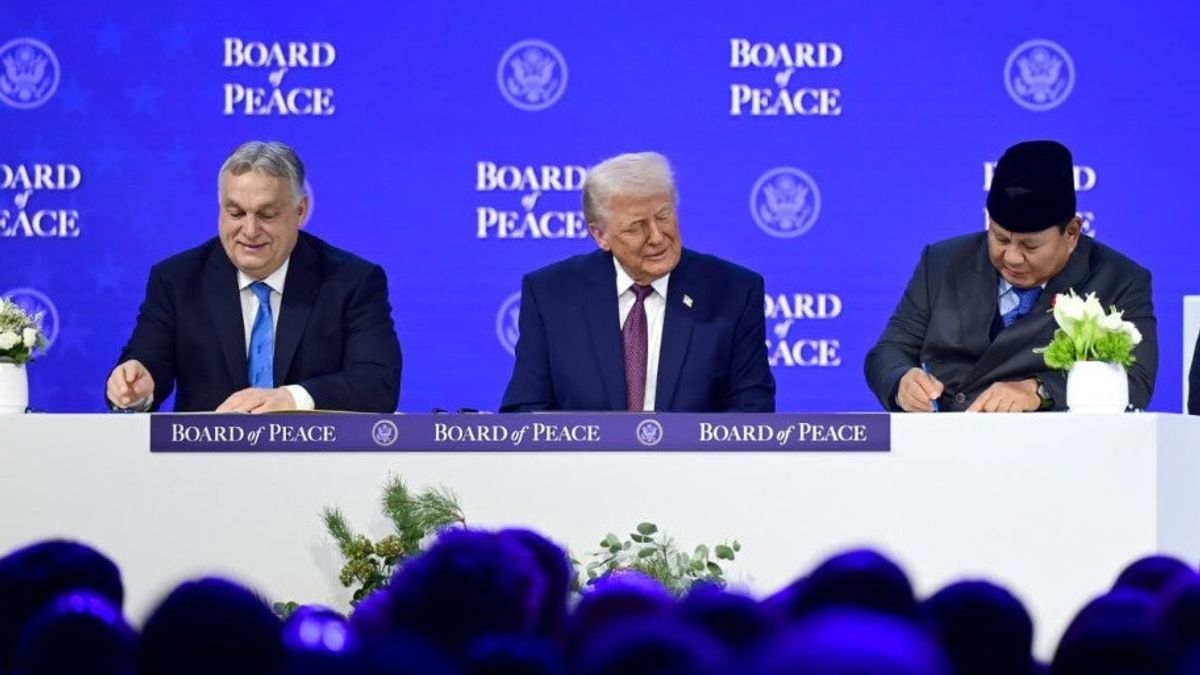


The debate about the Board of Peace (BoP) is still hot. As soon as people hear the word "dues", what comes to the minds of some of the public is a blank check. When you see "new forums", what comes up is suspicion. Maybe this is just a stage of diplomacy. In fact, the Palestinian issue is not a matter of style. This is a constitutional mandate. The opening of the 1945 Constitution is clear. Independence is the right of all nations, colonialism must be abolished, and Indonesia participates in maintaining world order. So, the question is not "pro or against BoP". The question is how Indonesia participates without losing the principle of free-active and non-bloc?
The BoP also needs to be read from its origins. This forum was born from the strong encouragement of the United States in the era of Donald Trump to supervise the post-conflict plan for Gaza - from maintaining a fragile ceasefire to regulating reconstruction. The scheme links aid and development to security preconditions on the ground. Here lies the risk. This path can be a realistic step to open up space for peace, but it is also prone to being drawn into a new architecture that serves the interests of big countries rather than the needs of civilian residents of Gaza. Therefore, from the beginning the BoP has provoked debate. Is it really towards a two-state solution, or is it turning the conflict in a new format that serves the interests of big countries rather than the needs of civilian residents of Gaza. Moreover, suspicions of Trump are great because this idea emerged after the US kidnapped the Venezuelan President, Maduro.
The government seems to be aware that decisions like this are not sufficiently explained through releases. President Prabowo Subianto opened a layered dialogue. Minister of Religion Nasaruddin Umar said the President routinely invited Islamic organizations to dialogue - the government explained, the ulama gave input. BoP was discussed because there were indeed differences in attitudes in some organizations.
From the meeting, the outline is clear. Support is allowed, but do not deviate from Palestine. The Indonesian Ulama Council emphasizes Palestinian independence as a constitutional mandate. MUI Chairman Anwar Iskandar said support for BoP is conditional. As long as it brings benefits. If not, it can be abandoned. Nahdlatul Ulama General Chair Yahya Cholil Staquf assessed the President's move as realistic. The moral value is the same, what is being tested is the policy that really helps Palestine, not just a symbol. Muhammadiyah figure Muhadjir Effendy also emphasized - according to him - the President's explanation closed the prejudice that Indonesia is slack in the Palestinian issue and the two-state solution.
Then came the explanation that was "colder" from senior diplomats. Former Deputy Foreign Minister Dino Patti Djalal described the meeting at the Palace as open, two-way, and discussed many risks. Dino called BoP the "only option on the table" at the moment. But he was also honest. BoP is an "experiment" with a "high risk of failure". Many things can fail. Among other things, the American factor, Trump, Israel, the situation on the ground, Hamas, and others. In other words, this is not a comfortable path. This is a path that must be guarded.
But here is where the principle of free-active and non-bloc must be seen to be in place. "Free" means that Indonesia does not become a tool for the interests of any big country. "Active" means that Indonesia does not stop at speeches, but also encourages real assistance and solutions. Foreign Minister Sugiono said Indonesia chose to be at the "process table", not outside, so that it has influence. The direction, he said, is clearly towards a two-state solution. Even about the plan for troops, the government emphasizes the task corridor to focus on protecting civilians.
However, participating in the process table also has dangers. Dino reminded. BoP must remain within the UN mandate corridor. If the track shifts, legitimacy collapses. And Indonesia can be dragged along, not only politically, but also in terms of image and national interests.
The most sensitive part is certainly about the dues. The Minister of Foreign Affairs, Arif Havas Oegroseno, said that the technical payment was still long and was still being discussed with other countries. The form of contribution is not yet Single. It can be chosen, for example through a health or food program. Former Foreign Minister Hassan Wirajuda also emphasized that it had not been decided when Indonesia would contribute. This means that the government still has room to design the most reasonable contribution: not a floating figure, but a clear and measurable program.
In the midst of that support and risk, Alwi Shihab, Minister of Foreign Affairs in the era of President Gus Dur, gave an important signal. There is "advantage", but he also has "reservations". This marks that the decision has been made, but the homework is not yet complete. The calculation of profit and loss must be sharpened. And the main measure must be firm: whether the BoP is approaching the path to the two-state solution and Palestinian independence, or rather turning in place.
Therefore, we should support BoP - but this support must be paid for with neat work, not with big words. The government needs to regularly give simple public explanations. What is Indonesia's goal at BoP, what is the limit of its role, and which parts are still being discussed. This is not about opening up diplomatic secrets, but about preventing the information gap from being filled by prejudice. At the same time, the government must confirm the red line from the beginning. BoP must not go beyond the UN mandate, and if the direction is detrimental to Palestine or conflicts with Indonesia's principles, the exit option must be ready to use, not just jargon.
The issue of dues must also be treated as a policy that can be measured, not just a number that provokes debate. If Indonesia's contribution is formed as a program - for example, health assistance, food, or civil reconstruction - then the public can assess the results, not guessing its intentions. Beyond that, Indonesia's strength lies in collective work. Building a common position with large Muslim-populated countries as bargaining chips, but still keeping Indonesia from being dragged into a new political bloc. And most importantly, every step must always return to the constitutional mandate. Defending a colonized nation and helping to maintain world peace.
The point is, BoP is not the most comfortable way. But in Indonesia's current situation, sometimes the completely safe choice is not available. The important thing is, Indonesia enters in the Indonesian way. Free-active, non-bloc, loyal to the 1945 Constitution - and still measure every step with a benchmark that must not change. Two-state solution and Palestinian independence.
The English, Chinese, Japanese, Arabic, and French versions are automatically generated by the AI. So there may still be inaccuracies in translating, please always see Indonesian as our main language. (system supported by DigitalSiber.id)


