
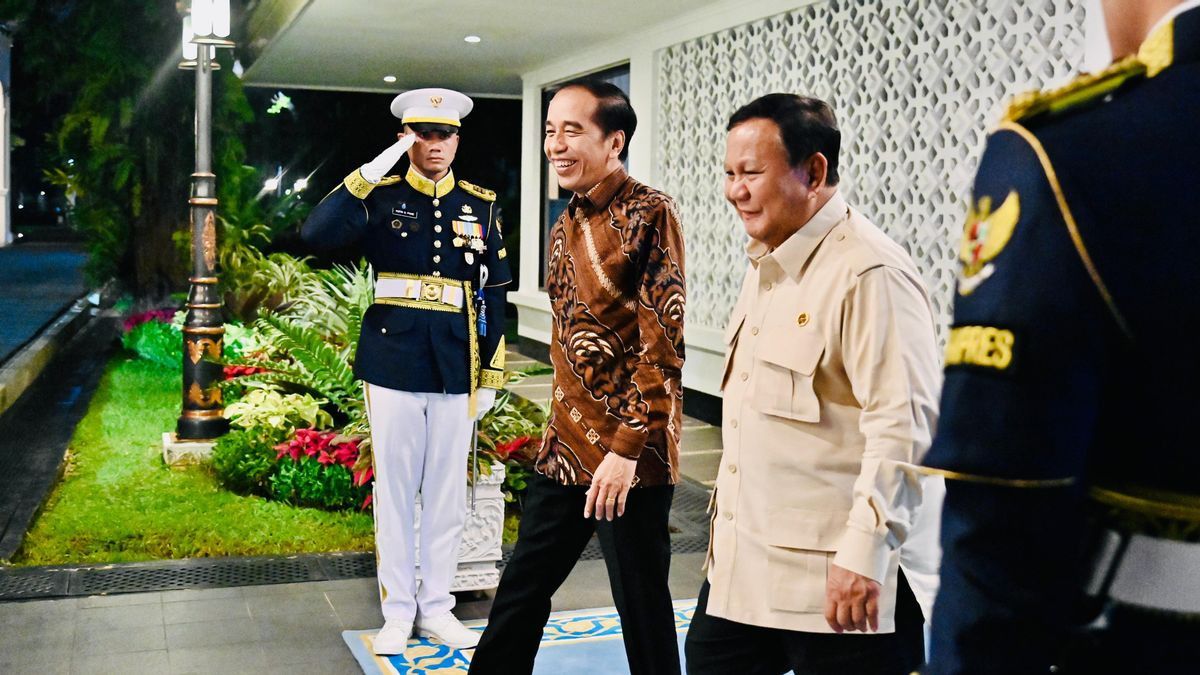


President Prabowo Subianto hadn't even been in office for a year when several of his ministers began to stir up trouble. It wasn't because of any strategic policy or grand maneuver, but rather because of a simple, yet profound, political gesture: They were paying a visit to former President Jokowi.
One by one, the ministers departed for Solo. Among them were Zulkifli Hasan, Bahlil Lahadalia, Sakti Wahyu Trenggono, and even Budi Gunadi Sadikin. All in the name of Eid al-Fitr gatherings. It was all normal at first. Until, during the visit, they heard the term "boss" for Jokowi. The public immediately began to question who was their superior? Jokowi or Prabowo?
In a presidential system, the chain of command should be single. But politics is often more complex than just formal structures. In reality, as Prabowo began his leadership, the loyalty of some of his cabinet members began to be questioned.
Rebuttals quickly emerged. The ministers claimed it was simply a spontaneous remark, a slip of the tongue. But the public had already read the deeper message. This brings to mind former President Susilo Bambang Yudhoyono's statement about "twin suns" — two centers of power in one sky, the seeds of chaos that could slowly grow.
The history of these ministers cannot be erased. Several ministers in the Red and White Cabinet are Jokowi loyalists, having grown up alongside him in politics. The digital footprint proves it.
Former Vice President Ma’ruf Amin tried to calm the situation. "If the heart is pure, there is no threat," he said. But this issue is not just about the heart. It's about the ethics of power. About who truly leads, who truly works.
Bahlil Lahadalia, now Chairman of Golkar and Minister of Energy and Mineral Resources, emphasized that all ministers submit to President Prabowo. But the reality on the ground is not that simple.
Recently, a group of officers from the Indonesian National Police's Sespimmen (Men's Leadership and Leadership Development) also visited Jokowi. Officially, they sought input. But in the public eye, this was more than just a friendly gathering. There was symbolic power to be maintained.
Amidst all this, Ganjar Pranowo, a PDIP politician who once ran against Prabowo Subianto in the presidential election, joked: "Is Mr. Prabowo hurt?" A joke that actually highlighted the reality. Loyalty isn't just about position, but also about the heart, history, and who is considered to remain influential.
The Speaker of the People's Consultative Assembly (MPR) and Gerindra Party leader, Ahmad Muzani, quickly declared that Prabowo was not disturbed. But public interpretations have already run wild.
In politics, the presence of two suns can be a serious problem. This is no longer a matter of visiting etiquette. It's a matter of who truly runs the government.
Amidst elite maneuvers, the people want only one thing: firm and clear leadership. Not two sources of light that dim each other, but a single source that provides direction.
The issue of twin suns may have subsided. But not because the problem is resolved. Rather, it's because there are signs. Twin moons could emerge, or even a new sky without the same ethics.
And this is the biggest problem. It's not about the number of suns. It's about when none truly shines. When everyone is busy protecting symbols, the people just want a simple answer: who is truly working?
Because ultimately, power isn't about who shines the brightest. But who can light the way.
If dual loyalties truly exist and are allowed to persist, Indonesia will not be on the road to stability. In the midst of an economic situation that is not going well, we are floating without direction—in a sky full of light, but without a true leader.
The English, Chinese, Japanese, Arabic, and French versions are automatically generated by the AI. So there may still be inaccuracies in translating, please always see Indonesian as our main language. (system supported by DigitalSiber.id)


