
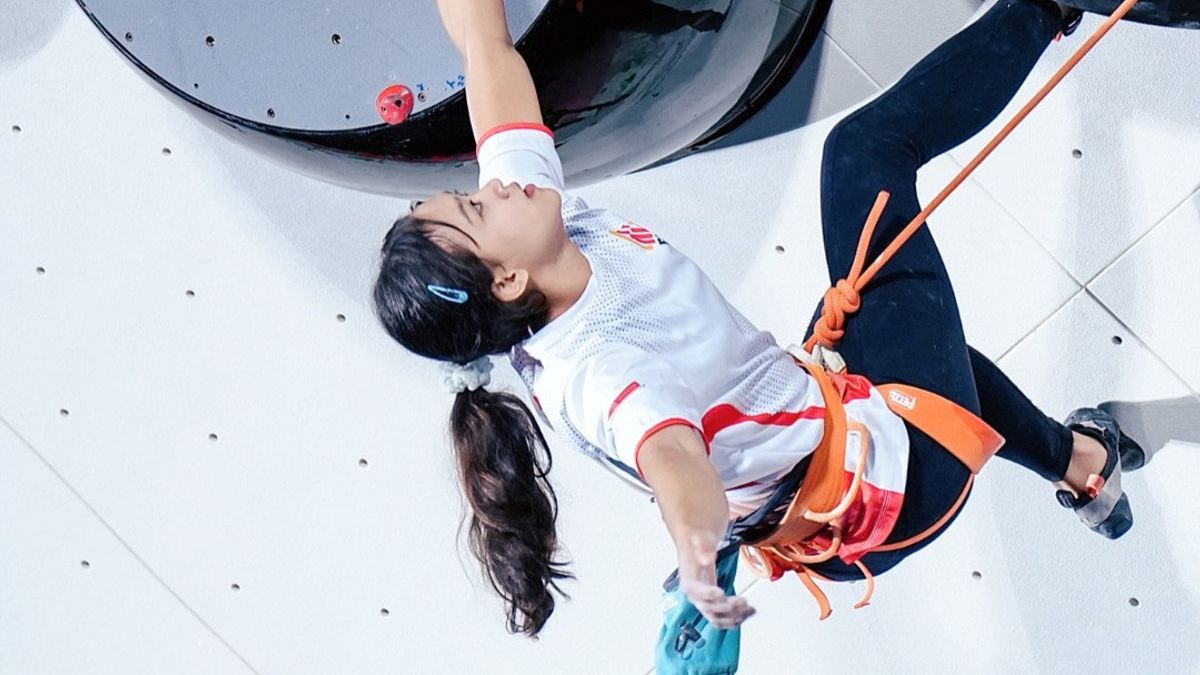


YOGYAKARTA - The achievements of the Indonesian Bouldering Team at the 2025 Thailand SEA Games are making this sport increasingly attracting public attention. Bouldering often features athletes who look like Spider-Man while climbing vertical walls at high speed. This uniqueness makes many people curious about what is bouldering as a sport. Reported from SI, the following will be discussed what is bouldering and its three main disciplines, namely speed, lead, and boulder.
What is Rock Climbing?The sport of rock climbing originated in the Soviet Union in the 1940s. Its popularity increased rapidly in the 1980s until it finally entered the 2021 Tokyo Olympics.
Cliff length refers to the height of the climbing track that athletes must conquer according to the discipline being competed in. This sport tests muscle strength, endurance, technique, and mental strength.
In official competitions, rock climbing is done on artificial walls with international standards. Each track has a different length of cliff, difficulty level, and scoring system. It is this difference that distinguishes each discipline in the sport of rock climbing.
Rock climbing has three different disciplines, namely speed, bouldering, and lead. Here's the explanation.
Speed in Rock ClimbingSpeed climbing is a discipline of rock climbing that prioritizes speed. Athletes compete one-on-one climbing a 15-meter-high wall with a 95-degree slope, in the fastest possible time.
Unlike Boulder or Lead, Speed prioritizes speed over technical skill. The length of the cliff and the lines used are also identical for all athletes.
The climb is completed when an athlete touches a touchpad, which stops the clock, at the top of each lane. The assessment is simple. The fastest time wins. In the qualifying round, 14 athletes got two chances to climb the wall and were sorted by the fastest time of their two times.
Boulder in Rock ClimbingBoulder is a discipline of rock climbing with shorter cliff lengths, usually about four meters. Athletes climb without a safety rope and are only protected by a mat below. The main focus of the boulder is technique, strength, and problem solving.
Each boulder track is called a boulder problem that must be solved by the athlete. This track is only shown when the competition starts so the athlete has to think fast. Speed is not the main priority, but rather the efficiency of the movement.
Athletes have four minutes to reach the top of the boulder. A climber is considered to have reached the top of the boulder after they place both hands on the top grip and maintain control long enough for an official to deem them successful.
Climbers can reach a maximum score of 100 points. 25 points are given for each boulder that successfully reaches the top. 10 points are given if the climber reaches the second checkpoint and five points if the first checkpoint is reached. If the climber fails to reach the zone or the top of the boulder, then it is reduced by 0.1 points.
Lead in BoulderingLead is similar to Boulder but the length of the cliff reaches 15 meters or more. Unlike Boulder, Athletes use safety ropes that they hook to something called a quickdraw, a piece of equipment that allows the rope to move freely while leading the climb.
Unlike Boulder, Lead allows climbers to make observations where they can observe the climbing route, while Boulder (in the semifinals) does not allow athletes to see the route before the competition.
In Lead, each climber has six minutes to observe the unique route before the competition begins. Each athlete uses a rope and quickdraw to advance. If the climber does not hook the rope to the quickdraw, the forward movement is canceled.
There are at least 40 holds on each wall, but only the top 40 holds have point values. If the top hold is reached, the climber reaches a maximum score of 100 points.
Four points are awarded when reaching any individual hold of any of the top 10 holds (40-31), three points for any of the next 10 highest holds (30-21), two points for any of the third highest holds (20-11) and one point for any of the lowest holds (10-1). If a climber moves towards the next hold but does not complete it, they are given 0.1 points.
In addition to discussing rock climbing as a sport, follow other interesting articles at VOI.ID. So as not to miss the latest news, follow and monitor our social media accounts!
The English, Chinese, Japanese, Arabic, and French versions are automatically generated by the AI. So there may still be inaccuracies in translating, please always see Indonesian as our main language. (system supported by DigitalSiber.id)
Most Popular Tags
#Prabowo Subianto #donald trump #firearm #8791 #giias 2026Popular


