
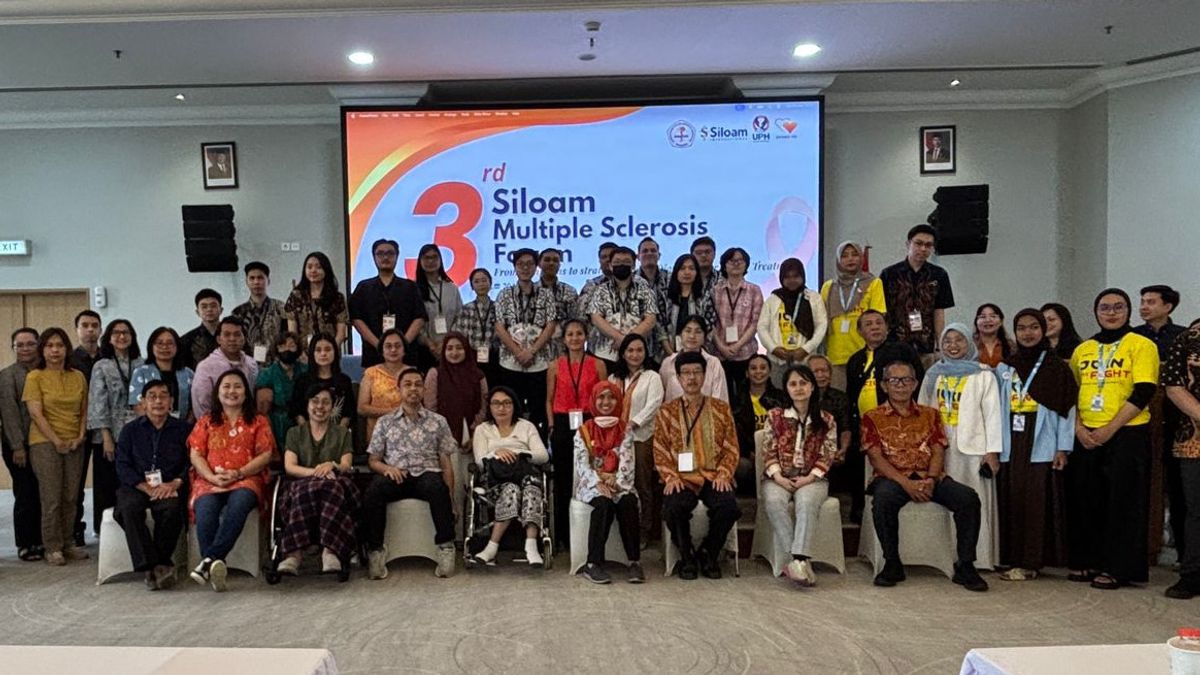


TANGERANG - Multiple Sclerosis (MS) is a neurological disease that attacks the central nervous system and can affect a person's ability to move, see, balance, energy levels, and cognitive functions. However, many MS symptoms are not visible to the naked eye so that sufferers often look healthy in the eyes of others, even though they are facing various physical and mental challenges.
This phenomenon was conveyed by Jessy, founder of Sahabat MS, in the 3rd Siloam Multiple Sclerosis Forum which took place at Siloam Lippo Village, Tangerang, Saturday, May 30, 2026.
"Living with Multiple Sclerosis made me realize that many people with conditions that are not physically visible often feel misunderstood, ignored, or alone. Not only because of the disease, but also because the people around them often don't understand what they can't see," said Jessy.
According to Jessy, the experience of living as a person with MS became the foundation for the birth of Sahabat MS, a foundation that focuses on increasing awareness, education, and social initiatives to help the Indonesian people understand conditions that are not visible to the naked eye.
For Jessy, this is just the beginning. This problem is much bigger than just one person.
"I learned to look good on the outside, while secretly fighting the conditions I was experiencing." he continued.
Jessy founded Sahabat MS, an initiative formed to help the Indonesian people better understand the conditions that are not visible to the naked eye and the people who live with them.
What Sahabat MS does is focus on increasing awareness, education, and social initiatives through creative and collaborative approaches.
Meanwhile, a neurologist from the Department of Neurology at Dr. Soetomo Hospital and the Faculty of Medicine at Airlangga University, Dr. Paulus Sugianto, dr., Sp.N, SubSp.NKI(K), F. Neurovascular, F. Movement Disorder, FAAN, explained that Multiple Sclerosis is a demyelinating disease. The exact cause is still unknown.
"MS is one of the demyelinating diseases. The problem is, the etiology is still unclear. Diagnosis is also often not immediately established in the first attack, unless the MRI examination shows a very typical picture," said Paulus.
He said that the diagnosis of MS is often a challenge because the initial symptoms are often not specific and the findings on imaging tests do not always show a clear picture. Many new patients can be confirmed as having MS after experiencing a second or third attack.
Paul reminded that MS that is not handled properly can cause progressive disability. Any attack that occurs has the potential to cause permanent damage to nerve tissue.
"Every time there is an attack, there must be damage to the nerve network. If the attack continues to recur and is not prevented, patients can experience increasingly severe disabilities, even to the point of being unable to work," he said.
Unlike a stroke, which generally occurs once and then enters the recovery phase, in MS patients can experience repeated relapses with additional symptoms or disabilities in each episode of attack.
"If a stroke can improve and we prevent it from happening again. In MS, the attack can improve, but usually there are still residual symptoms. When it recurs, the symptoms can increase and the disability also increases," said Paulus.
For treatment, he said, there is therapy during an acute attack and long-term therapy to prevent recurrence. However, the biggest challenge today is the limited access to high-efficacy drugs because their prices are still expensive and not fully affordable by the health financing system.
"The current recommendation is to use drugs with high efficacy because they can significantly reduce the risk of recurrence. However, these drugs are not yet available evenly and the cost is still very expensive," he said.
Paulus explained that the course of MS disease is different in each patient. Some sufferers can survive for years without relapse, while others experience repeated attacks in a shorter time.
"If we talk about recovery, only a small percentage of people actually do not experience a recurrence again. Some people relapse after 10 years, five years, two years, and even some people experience a recurrence every month," he said.
The symptoms of MS itself are very diverse, ranging from weakness or paralysis of the limbs, vision disorders, headaches, speech disorders, to difficulty walking. The symptoms that appear depend on the part of the nervous system that is damaged.
Although the exact number of MS sufferers in Indonesia is not known because there is no national registry, Paulus believes that MS cases are in various regions. However, the ability to diagnose is still facing obstacles because the main examination in the form of MRI is not yet available evenly throughout Indonesia.
"Currently we are still developing the registry. MS cases are certainly in Indonesia, but for diagnosis adequate MRI is needed. In large hospitals this is available, while in the region it is still a challenge," he said.
In the midst of the challenges of diagnosis and treatment of MS in Indonesia, increasing public literacy is one of the important steps to reduce stigma against those who have it. People who want to get more information about MS and various education programs run by the survivor community can visit the MS Friends Instagram account via @sahabatms.id
The English, Chinese, Japanese, Arabic, and French versions are automatically generated by the AI. So there may still be inaccuracies in translating, please always see Indonesian as our main language. (system supported by DigitalSiber.id)
Most Popular Tags
#Prabowo Subianto #donald trump #firearm #8791 #giias 2026Popular


