

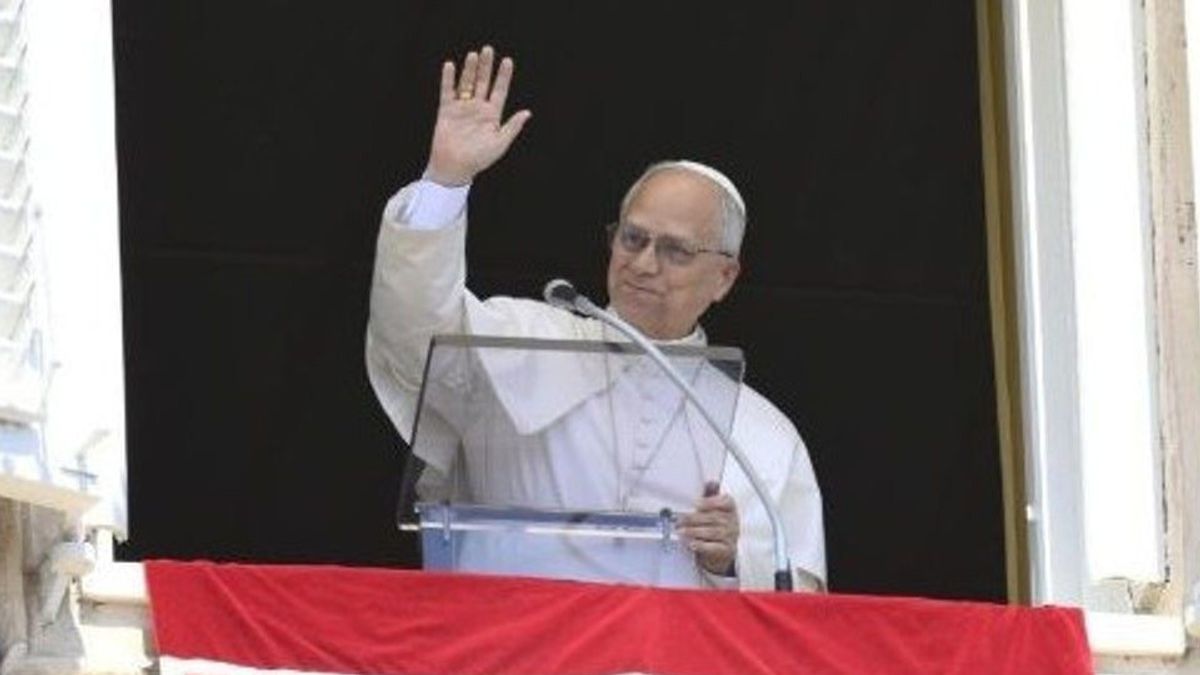


JAKARTA - Pope Leo warns that the development of artificial intelligence or AI should not be allowed to run only following the ambitions of power, business, and technological competition. He asked AI to be subject to strict ethical rules, especially when it starts to enter the world of work, data, to war.
Quoted from The Guardian, Tuesday, May 26, the warning was delivered by Pope Leo in his first encyclical on the protection of humanity, Magnifica Humanitas or Great Humanity.
Encyclicals are important documents containing the Pope's teachings to Catholics. Usually, this document shows the big direction of a Pope's leadership in seeing the world's problems.
In the document, Pope Leo condemned the "culture of power" that contributed to the rapid development of AI. He assessed that the technology must be controlled so as not to degrade human dignity.
"The development and use of AI in war must be subject to the strictest ethical limits," Pope Leo wrote.
He also called for the "disarmament" of AI. The point is not to reject technology, but to free AI from the way of thinking that makes it a tool for armed competition.
"To ridicule does not mean to reject technology, but to prevent technology from dominating humans," he wrote.
Pope Leo highlighted the use of AI in war. According to him, some autonomous weapons systems are now almost beyond the reach of humans to control. He warned that AI could make war seem more normal as an international political tool.
The Pope also alluded to the great power of technology companies. He said control over digital systems, infrastructure, and data is now not only in the hands of the state, but also in the hands of large economic and technological actors.
If power is concentrated in the hands of a few, the Pope said, the risk of inequality, manipulation, new dependencies, and social exclusion can grow.
The statement was read as a strong message to Silicon Valley, the center of the American technology industry. At the event in the Vatican, Christopher Olah, one of the founders of Anthropic, an American AI company, was also present.
Olah said that the development of AI cannot be left to technology companies. According to him, religious leaders, governments, and civil society also need to supervise.
He cautioned that there is a "real possibility" that AI will replace human labor on a very large scale. If that happens, helping displaced workers will be a great moral obligation.
In addition to AI, Pope Leo also apologized for the slowness of the Catholic Church in condemning slavery. He called slavery a "wound in the memory of Christians".
"On behalf of the Church, I sincerely ask for forgiveness," Pope Leo wrote.
The Guardian noted that a number of previous popes had apologized for the involvement of Christians in the transatlantic slave trade. However, Pope Leo is said to have gone further by referring to the role of the popes themselves in authorizing European rulers to conquer and enslave "infidel people".
The Vatican in recent years has been actively discussing AI with major technology companies, including Microsoft and Google. Pope Leo said the Catholic Church wants to dialogue with AI developers so that the technology is used correctly.
Christopher White, author of Pope Leo XIV: Inside the Conclave and the Dawn of a New Papacy, believes Pope Leo wants to put the Church in a serious conversation with technology giants.
According to White, the Pope does not claim that the Church has all the answers about AI regulation. However, he emphasized that the development of AI should not be left like a wild area without supervision.
Christine Allen, CEO of the Catholic aid agency Cafod, said the Pope's message affirmed human dignity. According to him, humans are not just a means of production, but living beings with a moral compass.
Pope Leo emphasized that AI must remain under human control, open to oversight, and not be used to magnify inequality, manipulation, or suffering.
The English, Chinese, Japanese, Arabic, and French versions are automatically generated by the AI. So there may still be inaccuracies in translating, please always see Indonesian as our main language. (system supported by DigitalSiber.id)


