

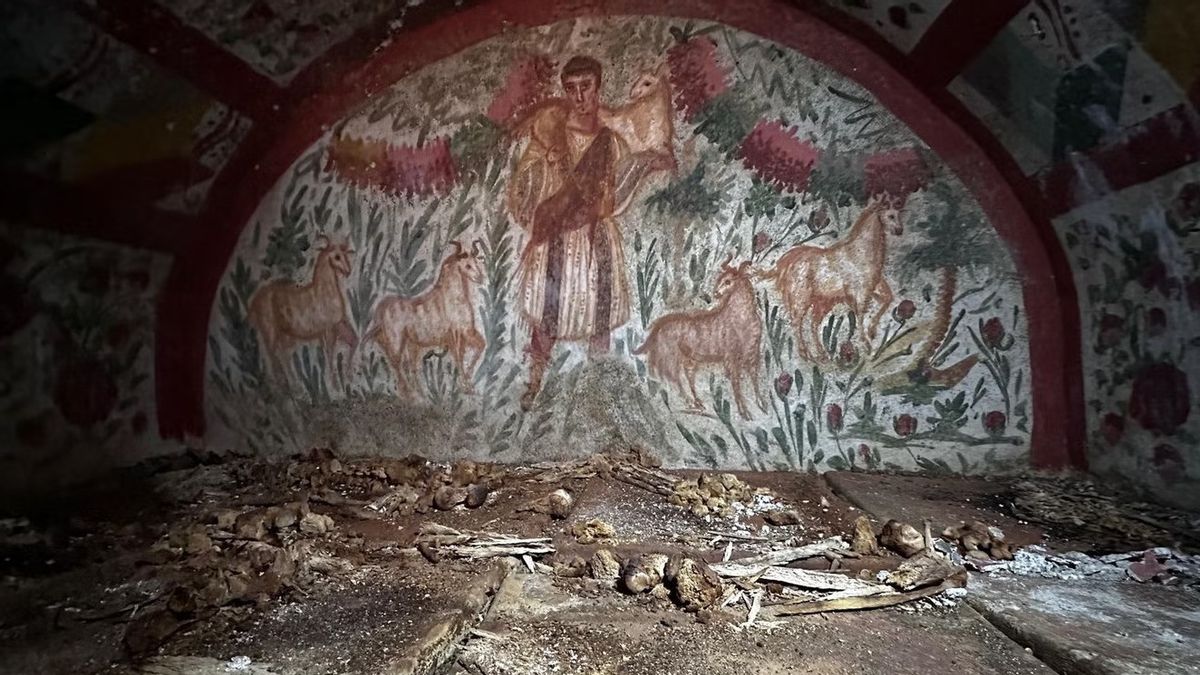


JAKARTA - New archaeological findings in Turkey have reopened an important chapter in the history of early Christianity. One of the most eye-catching is the image of Jesus as the Good Shepherd in Iznik, which is called the earliest and best preserved image of Christ ever found.
Quoted from The Independent, Tuesday, May 26, the painting dates back to the early to mid-3rd century AD. The image was found in a sealed and oxygen-poor underground family tomb. This condition makes the fresco pigments remain almost intact for about 1,800 years.
The details are still clear. The face of Jesus, the folds of the tunic, the hands, even the ram on his shoulders. This finding gives clues to how early Christians imagined Jesus: without a beard, short hair, and wearing high-class Roman clothing.
In the past two years, archaeologists in Anatolia, the region that is now Turkey, have discovered at least a dozen previously unknown churches. The buildings date back to the 4th and 5th centuries AD.
Other findings include ancient Christian tombs, inscriptions, church houses, to one of the earliest depictions of Saint George in Pergamon. Saint George would later be known as the patron saint of England.
The abundance of these findings reinforces Anatolia's position in the history of Christianity. The region quickly became one of the centers of the Christian faith, just a few decades after the crucifixion of Jesus in Jerusalem in the early 30s AD.
New historical research also provides a broader picture. Christianity developed from a small group that was persecuted to become the official religion of the Roman Empire in three centuries. Researchers assess that growth was influenced by many factors, ranging from martyrdom, the early Christian social care system, the Roman political-economic crisis, to the possibility of a lower early death rate than the pagan community.
Archaeologists also found new evidence about the worship of Roman emperors in the Turkish region. In Syedra, traces of a 3.5-meter-tall statue of Emperor Marcus Aurelius were found. In Bubon, the remains of a 2.1-meter-tall statue of Aurelius were also identified. Other statues of Hadrian and Marcus Aurelius were found in Alabanda and Sagalassos.
The cult of the emperor is important because it helps explain the background of the Book of Revelation. The book was written around AD 90 by John of Patmos. In the text, the Roman Empire is coded as "the Beast", while the Devil is coded as "the Dragon".
The Independent reported that excavations in a number of cities mentioned in the Book of Revelation produced important evidence of early Christian life. In Laodicea, archaeologists found a 4th-century church house. The church house was a place of worship for Christians before a special church was built.
In Sardis, researchers investigated a large church building of the early 6th century that may have been the prototype of the architectural tradition associated with the Hagia Sophia in Constantinople, now Istanbul.
In Smyrna, or modern Izmir, experts examined coded Christian graffiti from the mid-2nd century on the walls of a Roman shopping center. One of them contains the word Logos, the title of Christ which means "Word".
In Pergamon, archaeologists found an early 5th-century ceramic pilgrimage bottle that appears to depict Saint George slaying a dragon. They also examined an amphitheater where at least three Christians are believed to have been burned alive at the end of the 2nd century. The amphitheater is estimated to have been able to accommodate at least 25,000 spectators.
In Ephesus, one of the world's largest Roman cities, archaeologists have discovered an area buried in ash from a massive fire. The ash layer preserved traces of the early Byzantine Christian world of the 6th and 7th centuries, including thousands of vessels, charred food, and souvenir shops for Christian pilgrims.
Professor Candida Moss from the University of Birmingham said the large number of early Christian finds in Turkey had great significance.
"Anatolia, which is now Turkey, in many ways was the birthplace of early Christianity," Moss said.
According to Moss, the region is important because it was visited by the apostles Peter, Paul, and other early missionaries. When Christianity became the official religion of the empire, the Romans then moved the capital from Rome to the area that is now Istanbul.
The English, Chinese, Japanese, Arabic, and French versions are automatically generated by the AI. So there may still be inaccuracies in translating, please always see Indonesian as our main language. (system supported by DigitalSiber.id)
Most Popular Tags
#Prabowo Subianto #donald trump #firearm #8791 #giias 2026Popular


