

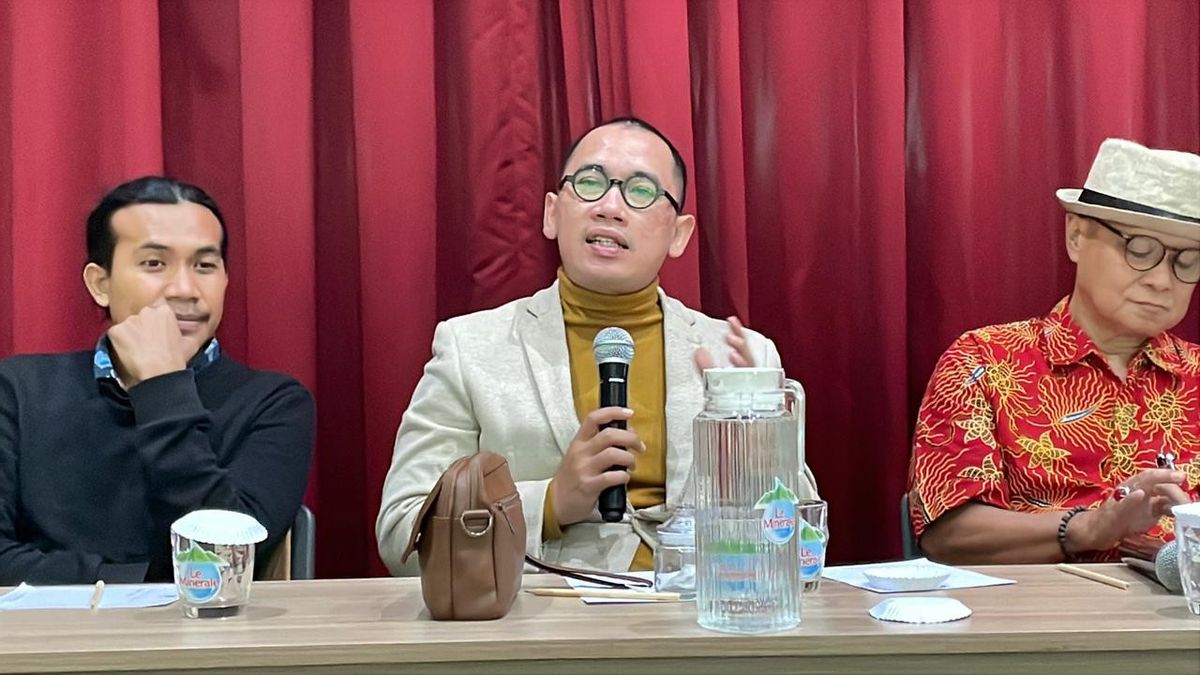


JAKARTA - Public Policy and Governance researcher, Gian Kasogi, highlighted the existence of the National Defense Council (DPN) which was considered to have the potential to cause serious problems in the governance of the country's defense. According to him, the institution which was formed in the name of strengthening the national defense system was at risk of giving birth to a new center of power which could slowly shift the executive function of the President.
Gian made the statement in a discussion titled "Questioning the National Defense Council: The Danger of Shifting the President's Executive Functions in the Design of State Defense" which was held on Wednesday, May 20.
During the forum, Gian questioned the urgency of the establishment of the DPN in the midst of the existence of a number of state institutions that have been carrying out strategic coordination functions in the defense sector.
According to him, the problem of the DPN does not only lie in the institutional design which is considered not entirely clear, but also the potential for overlapping authority, multi-interpreting articles, to the risk of politicization of the defense institution.
"The defense sector is not only about state security, but also concerns the governance of power which must remain within the corridors of democracy and the constitution," said Gian.
He also highlighted the possibility of the emergence of a strategic policy-making duality between the President, the Minister of Defense, the TNI, and Lemhannas if the DPN were given too much authority.
According to Gian, the shift of power in the system of government does not always occur formally, but can take place through the strengthening of institutional influence which slowly reduces the authority of the main mandate holder of the government.
In this context, the position of Defense Minister Sjafrie Sjamsoeddin is of special concern. With the strategic mandate as Chairman of the DPN, Sjafrie is considered a potential dominant actor in determining the direction of national defense policy.
Gian reminded that this condition can be problematic if it is not accompanied by strict supervision mechanisms and clear authority limits.
He also assessed that the public needed to pay attention to the possibility of an electoral political dimension behind the strengthening of the institution. According to him, the influence in the defense sector can be an effective instrument to build political popularity towards the 2029 Presidential Election contest.
"DPN can be formed in the name of strengthening national defense. However, if in practice it opens up room for concentration of power, politicization of institutions, and shifting the functions of the President's executive, then the public has the right to question and even correct it," said Gian.
Meanwhile, Syaiful Hidayatullah, a researcher on legal and strategic litigation, assessed that the establishment of the DPN actually prolonged the issue of overlapping authority of state institutions after reform.
"The emergence of this DPN will extend the overlapping authority of state institutions in the Indonesian constitutional system. If you look at the mandate assigned, this DPN will shift the function of Lemhannas," said Syaiful.
According to him, the reason for the formation of the DPN to study geopolitics, geoeconomics, and geostrategy has actually been carried out by various institutions such as the Ministry of Defense, the Ministry of Foreign Affairs, the TNI Headquarters, BIN, to Lemhannas.
He also questioned the position of Defense Minister Sjafrie Sjamsoeddin who also served as the Acting Chairman of the DPN.
"The Minister of Defense Sjafrie has served as Minister of Defense, why should he lead the Defense Council again. This is very strange," he said.
Syaiful assessed that this condition could be read as an effort to expand the legitimacy of the role of the Minister of Defense in various national development agendas, including through the involvement of the TNI in the civilian sector.
"I think only President Prabowo can stop the expansion of the role carried out by Defense Minister Sjafrie, because all the authority carried out remains a political power sharing from the President," he concluded.
The English, Chinese, Japanese, Arabic, and French versions are automatically generated by the AI. So there may still be inaccuracies in translating, please always see Indonesian as our main language. (system supported by DigitalSiber.id)
Most Popular Tags
#Prabowo Subianto #donald trump #2026 World Cup #Febrie Adriansyah #8791Popular


