

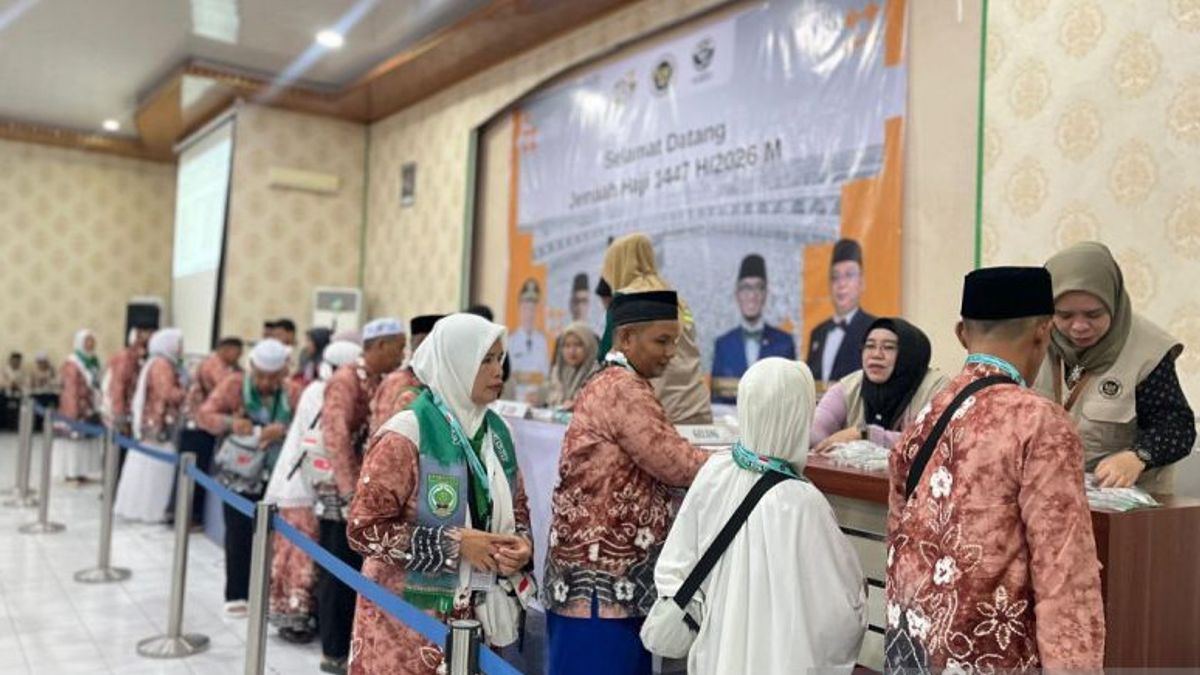


JAKARTA - Deputy Chairman of Commission VIII of the Indonesian House of Representatives from the Golkar Party Faction, Singgih Januratmoko, appreciates the smooth implementation of the 1447 H/2026 M Hajj which until now has shown positive and controlled performance. According to him, this smoothness reflects the readiness of a more mature systemic system in the implementation of the national Hajj.
Based on field reports, more than 80 percent of Indonesian Hajj Pilgrims (JHI) have arrived in Mecca in good general condition. Transportation, accommodation, and consumption services run relatively smoothly without significant disruptions.
"This is an achievement that we should be grateful for together. Solid coordination between Hajj officers, the government, and Saudi authorities shows an improvement in the quality of services from year to year," Singgih told reporters, Saturday, May 16.
He also assessed the government's move under the leadership of Prabowo Subianto who established the affairs of Hajj in a separate ministry, namely the Ministry of Hajj and Umrah of the Republic of Indonesia, as a right and strategic policy.
According to the Golkar legislator from the Central Java V constituency, the existence of the KHU allows for a stronger focus, more professional governance, and faster and more coordinated decision-making. This also creates an equal and more effective position in establishing working relationships with the Saudi Ministry of Hajj and Umrah.
"With an equal institution, the process of negotiating quotas, services, to operational techniques becomes more efficient. This has a direct impact on the quality of service to worshipers," said Singgih.
Singgih emphasized that the next crucial phase is the implementation of the peak of the hajj in the Arafah, Muzdalifah, and Mina (Armuzna) areas. He appreciated the proactive steps that have been prepared, including such as strengthening the scheme for transporting pilgrims from Mecca to Arafah and movement between Armuzna locations, providing tents that are friendly to pilgrims, including cooling and sanitation facilities, timely distribution of consumption and according to the needs of pilgrims and the preparation of health services, especially for elderly and high-risk pilgrims.
"Data shows that the majority of Indonesian pilgrims are in the age category above 50 years, so they need special attention in terms of health and mobility," he said.
In facing the potential density and extreme weather in Armuzna, Singgih assessed that the mitigation steps that the government needed to take were on the right track. Some important steps that need to continue to be strengthened include cluster-based management of the movement of pilgrims to avoid the accumulation of pilgrims, the optimization of preventive-based health services and early detection approaches, the use of information technology and the increase in the capacity of health workers.
"Mitigation approaches must be the top priority. We not only ensure the smoothness, but also the safety of the pilgrims as a whole," he said.
As a working partner of the government, said Singgih, Commission VIII of the DPR RI will continue to carry out the function of supervision constructively to ensure that all stages of the haj are carried out according to the service standards set.
"The implementation of the hajj is a global public service that requires high professionalism. We must continue to make continuous improvements so that pilgrims get the best service," he concluded.
The English, Chinese, Japanese, Arabic, and French versions are automatically generated by the AI. So there may still be inaccuracies in translating, please always see Indonesian as our main language. (system supported by DigitalSiber.id)


