

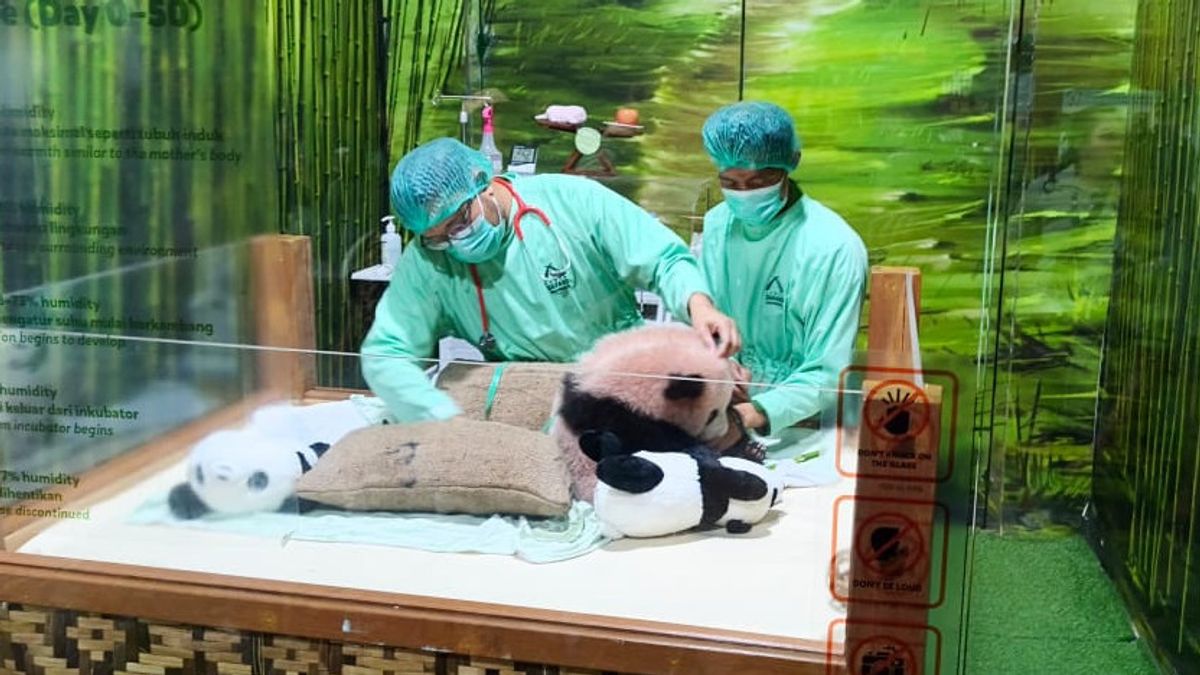


BOGOR - Taman Safari Indonesia (TSI) Cisarua, Bogor, will introduce the first giant panda baby born in Indonesia to the public starting May 30, 2026. The male panda baby named Satrio Wiratama or Rio was born on November 27, 2025 and became the first panda birth in the country.
The President Director of Taman Safari Indonesia, Aswin Sumampau, said that the public could see Rio directly gradually with strict supervision to maintain the health and safety of the panda baby.
"On May 30, we hope that Rio can start to be shown to the public periodically. However, the time is still limited because the supervision and adaptation process is still ongoing," said Aswin at the TSI Bogor Panda Palace, Friday, May 15.
According to him, the initial stage of introduction was carried out carefully because the baby panda is still vulnerable to exposure to viruses, bacteria, and other environmental contamination. In addition, Rio is also undergoing training and adjustment to the environment in the Safari Park.
In the initial stage, Rio will likely only appear for a certain duration each day. However, as his condition grows and develops, the time to appear to the public will be added gradually in the following months.
Aswin said Rio's birth was a historic moment because giant pandas are very difficult to breed, especially in conservation institutions outside China. In the last three years, Rio has even been said to be the only panda baby born in a zoo outside China.
"This is a very rare experience, not only for visitors, but also for the entire Safari Park team. We want the Indonesian people to feel the happiness of Rio's birth," he said.
Veterinarian and Vice President of Life Sciences TSI, drh. Bongot Huaso Mulia, said the adaptation process was an important part of Rio's growth and development before being introduced more widely to the public.
"Rio is currently in the process of training and adapting to the environment at the Safari Park. Therefore, it will be shown to the public gradually while continuing to monitor its development," said Bongot.
He explained that the team of doctors and keepers continued to monitor Rio's physical condition and behavior to ensure that the panda baby grew healthy and comfortable with its new environment.
According to Bongot, Rio's development so far has shown very good results. At 110 days old, Rio's weight has even exceeded the average growth of panda babies of his age.
In addition to health monitoring, the TSI team also trained Rio to get used to activities around the cage and the presence of humans before it was later introduced more widely to visitors.
Bongot said the process was carried out carefully because baby pandas have a high sensitivity to changes in the environment. Therefore, public introduction is carried out gradually.
In monitoring Rio's development, the medical team uses a number of parameters, ranging from tooth growth, motor skills, vision, mobility, to concentration levels.
He revealed that Rio's development even appeared faster than the average panda baby. One of them is the growth of teeth which is considered earlier than expected.
"There are several parameters of Rio's development that appear faster than the average, although they are still within the normal range. For example, tooth growth that appears earlier," he said.
All of these data are then used as a reference to ensure that Rio's development remains in accordance with the growth stages or milestones of baby pandas in general.
The English, Chinese, Japanese, Arabic, and French versions are automatically generated by the AI. So there may still be inaccuracies in translating, please always see Indonesian as our main language. (system supported by DigitalSiber.id)
Most Popular Tags
#Prabowo Subianto #donald trump #firearm #8791 #giias 2026Popular


