

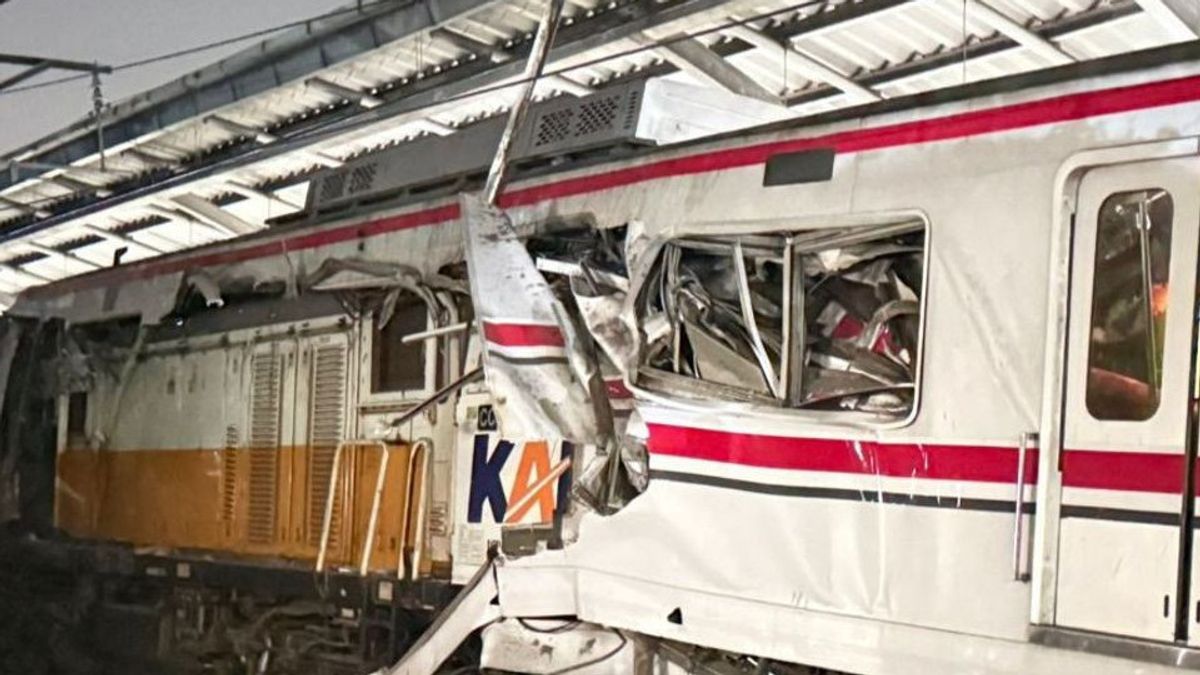


JAKARTA - The Indonesian railway world is in mourning. A major train accident (KKA) occurred at the Bekasi Timur Station (BKST) on Monday evening, April 27, 2026, at 20.55 WIB. This fatal incident involving the Argo Bromo Anggrek train and the Commuter Line KRL resulted in 4 people dying and at least 70 people injured.
This accident triggered the total suspension of cross-Jakarta train traffic to Cikarang, creating a domino effect that paralyzed the mobility of residents.
Chronology of the Incident: Starting from the Electric Car Strike
This tragedy began 35 minutes before the big collision. An electric taxi was reported to have broken down in the middle of a crossing of a piece of JPL 85 Ampera. The car was then tempered by the Jakarta-Cikarang (PLB 5181) CRRC KRL.
As a result of the accident at JPL 85, KRL TM 5568A (PLB 5568a) which was behind it was forced to make an emergency stop at platform 2 of Bekasi Timur Station. Unfortunately, KA 4 Argo Bromo Anggrek relationship Gambir-Surabaya Pasar Turi which came from behind failed to stop and hit the back of the stopped KRL (rear-end collision).
Dejavu Petarukan Tragedy 2010
This "sodomy" or rear-end collision incident reminded the public of a similar tragedy at the Petarukan Station, Pemalang, on October 2, 2010. Ironically, both incidents involved the same train series, namely the Argo Bromo Anggrek train.
The provisional suspicion points to the negligence of the driver who did not see the stop signal (red color). In fact, the Jatinegara-Cikarang crossing has been using an open block system that automatically turns on the red signal if there is a train in front of it.
Sharp Spotlight on Automated Train Protection (ATP)
This accident opened the veil of the slow implementation of the Automatic Train Safety System (SKKO/ATP) as mandated by PM No. 52 of 2014. Based on the rules, all state-owned lines and facilities should have been equipped with ATP devices within 5 years of the rules coming into force.
"The fact is, our infrastructure has not been fully upgraded. If the ATP works, the train will stop automatically when it violates a red light, regardless of whether there is human negligence or not," said the expert in the evaluation release.
10 Strategic Recommendations and Mitigation
In response to this tragedy, there is a strong demand for a total audit and reform of national railway safety:
Track Segregation: Accelerate the construction of the Bekasi-Cikarang Double-Double Track (DDT) to separate the KRL and long-distance train lines. Technology Reform: The use of Automatic Train Protection (ATP) and ETCS Level 1/2 or CBTC signals is a must-do to prevent human error. PPKT Audit: A thorough examination of the Central Railway Travel Controller in monitoring the position of the train in real-time. Fatigue Management: Risk-based evaluation of the working hours of the driver and the use of simulators for emergency scenarios. Safety Culture Over Punctuality: Prioritize safety over punctuality of travel schedules. RSMS Implementation: Requiring a predictive and preventive Railway Safety Management System, not just reactive after the incident. Regulator & Operator Integration: The synergy between the Ministry of Transportation and PT KAI in the maintenance of infrastructure (IMO) must be strengthened. Strike Vehicle SOP: The Ministry of Transportation needs to socialize emergency SOP for road users if vehicles break down on the tracks. Electric Taxi Reliability Investigation: The KNKT is urged to audit the technical reliability (reliability) of electric vehicles that have the potential to break down suddenly at crossings. Fail-Safe System Audit: Ensure that all field technicians meet the standards of a fail-safe safety system.The accident at Bekasi Timur Station became a loud alarm for the government and operators that passenger lives should not be sacrificed to pursue investment and development targets alone.
The English, Chinese, Japanese, Arabic, and French versions are automatically generated by the AI. So there may still be inaccuracies in translating, please always see Indonesian as our main language. (system supported by DigitalSiber.id)
Most Popular Tags
#Prabowo Subianto #donald trump #2026 World Cup #Febrie Adriansyah #8791Popular


