
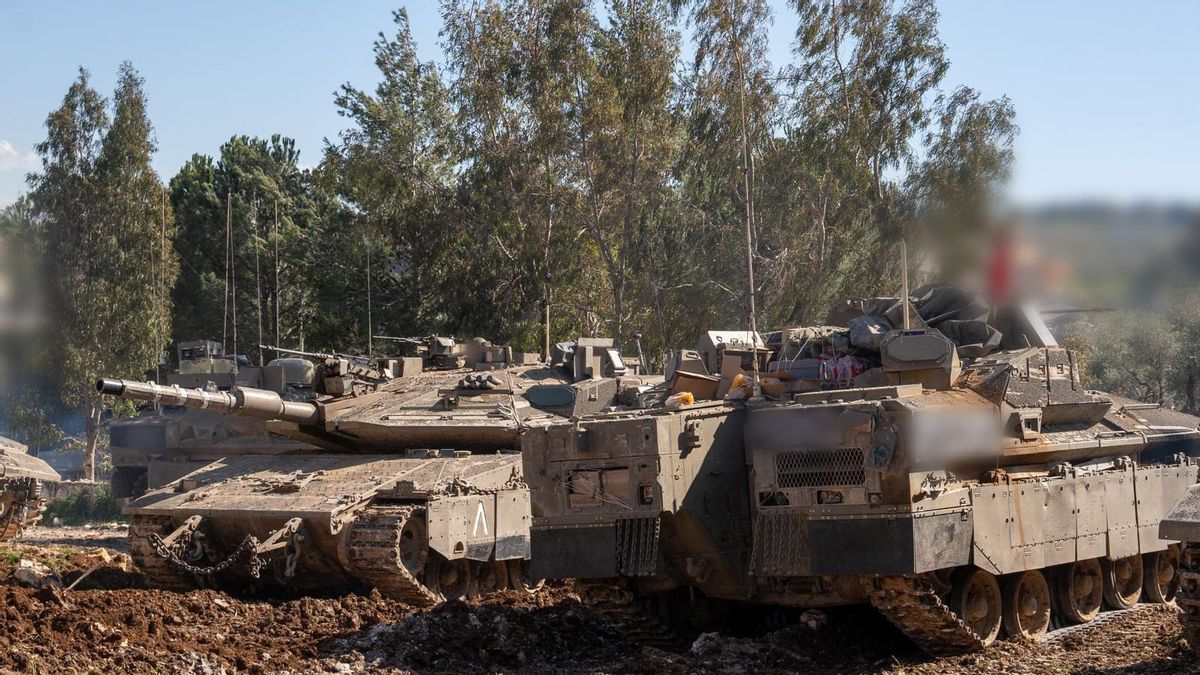


Israel and the militant group Hezbollah have blamed each other for violating a ceasefire in Lebanon on Sunday, with Prime Minister Benjamin Netanyahu saying the military "aggressively" targeted the Iran-backed militia, while both sides claimed new attacks.
The accusations came as both sides said they had carried out fresh attacks in southern Lebanon, with reports of civilians stuck in traffic heading north to avoid Israeli warnings and strikes, while the Israeli army reported one of its personnel killed.
However, claims by both sides of having violated a 10-day ceasefire agreed to earlier this month continued even after US President Donald Trump announced a three-week extension last Thursday.
"The violations committed by Hezbollah, in practice, undermine the ceasefire," Netanyahu said at a weekly cabinet meeting, launching Al Arabiya and AFP (27/4).
"We act decisively in accordance with the agreement that has been approved with the United States and, incidentally, also with Lebanon," he added.
Meanwhile, Hezbollah released several statements on Sunday saying its fighters targeted Israeli forces and positions in response to Israeli violations of the ceasefire and attacks on Lebanese villages, and vowed to continue its attacks.
"The continued violations of the enemy's ceasefire and especially the continued occupation of Lebanese territory and its sovereignty violations will be met with a response and resistance to defend the land and its people," Hezbollah said in a statement.
The Israeli military said late Sunday one of its soldiers was killed "during fighting" in southern Lebanon, and six others were wounded, four of them seriously.
Previously, the Israeli military issued evacuation orders for residents of seven villages in southern Lebanon, and promised to take "firm action" after what it called Hezbollah violations.
Shortly afterwards, Israeli warplanes "launched an attack" on Kfar Tibnit - one of the villages - causing casualties, Lebanon's National News Agency said.
Israeli attacks on Zawtar al-Sharqiyah, another village marked, destroyed a mosque and other religious buildings, the news agency said.
Earlier, the news agency said an "Israeli drone hit a motorcycle" there.
"Shooting was also reported in several border villages," he said.
Elsewhere, gray smoke billowed over Nabatieh al-Fawqa and several other locations after the Israeli attack.
The Israeli military said in a statement that during Sunday's operation, it had attacked "terrorist cells of rocket launchers and weapons storage facilities."
They have also carried out "artillery and air strikes targeting terrorists and military infrastructure sites" used by Hezbollah "north of the front defense line" - the so-called yellow line.
Shortly after Netanyahu's statement, the military said it had intercepted three drones heading towards Israeli territory.
Under the terms of the ceasefire, which was recently extended, Israel is entitled to respond to "planned, imminent or ongoing attacks" and has attacked targets in southern Lebanon almost daily.
"This means freedom of action not only to respond to attacks but also to prevent immediate threats and even emerging threats," Netanyahu claimed.
It is known that Tehran-backed Hezbollah dragged Lebanon into the Middle East war on March 2 by firing rockets at Israel in retaliation for the death of Iran's supreme leader Ali Khamenei in a US-Israeli attack, which Israel then retaliated with an attack and a ground invasion.
Meanwhile, the Lebanese Ministry of Health said the number of deaths from Israeli attacks since the war broke out on March 2 has risen to 2,509 dead and 7,755 injured.
The English, Chinese, Japanese, Arabic, and French versions are automatically generated by the AI. So there may still be inaccuracies in translating, please always see Indonesian as our main language. (system supported by DigitalSiber.id)
Most Popular Tags
#Prabowo Subianto #donald trump #Febrie Adriansyah #8791 #giias 2026Popular


