


Gaza has been the target of Israeli aggression under the pretext of fighting the Hamas group that opposes efforts to hand over part of Palestinian territory to the Zionist government.
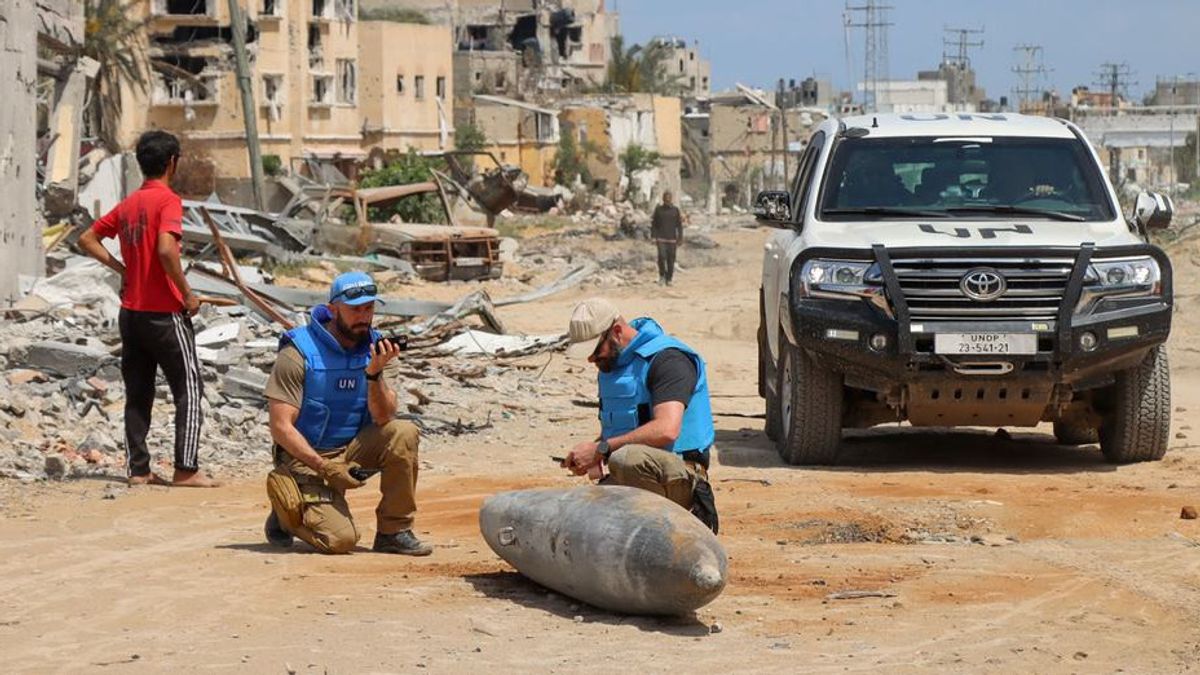
Since the attack, the United Nations has recorded the Gaza Strip contaminated with unexploded ammunition, which often kills and injures civilians and potentially threatens recovery efforts for a long time.
AFP reported on Sunday, April 26, unexploded ammunition, ranging from bombs or grenades to gun bullets, has become a common sight in the Gaza Strip since the start of the Israeli aggression in the Palestinian territory.
Based on data from the UN Mine Action Service, UNMAS, since the beginning of the Israeli attack, more than 1,000 people have died in Gaza due to "indirect conflict" from the remnants of the war.
The head of UNMAS in the occupied Palestinian territory, Julius Van der Walt, stressed that the figure was clearly a much lower estimate than the actual figure.
Speaking alongside Van der Walt at a press conference on mine clearance work to recovery around the world, Narmina Strishenets of Save the Children UK, also highlighted the devastating impact it has on children.
A report from the UK-based Save the Children organization published last year found that by 2024, the use of explosive weapons in Gaza would cause an average of 475 children each month to suffer lifelong disabilities, including amputations.
Currently, Strishenets continued, Gaza has the "largest group of [victims] of amputation" in the world.
Van der Walt added that UNMAS has so far been unable to conduct an extensive survey of the overall problem, but "the available evidence indicates that the entire Gaza Strip is highly contaminated with explosive munitions [scattered],"
So far, UNMAS has identified "more than 1,000 explosive ammunition items" in Gaza during missions carried out over the past 2.5 years.
"Compared to Gaza's small geographic size, that means there is about one explosive ammunition item "every 600 meters," he said.
Van der Walt emphasized that the comparison was only on items that had been found. "We only understand the level of contamination a little," he added.
The danger is increasing because of the very high population density in Gaza.
Before the Israeli aggression, Van der Walt explained, Gaza was already one of the most densely populated areas on Earth, with about 6,000 people per square kilometer.
He pointed out that the Israeli military operation had effectively reduced the space available for a decent life in Gaza by half and doubled the population density.
Van der Walt said that explosive ammunition scattered or planted by the Israeli military in Gaza was in densely populated areas. He said this referring to a recent case where explosive ammunition was found inside a refugee tent that had been standing for several weeks.
"Explosive weapons are being used across the whole of [Gaza], including in densely populated refugee camps," he said.
At the same time, he continued, "humanitarian convoys [of aid or health care workers] are at risk of being blown up as they travel in the Gaza Strip, and early recovery efforts are essentially halted even before they can begin," said Van der Walt.
Van der Walt estimated that, in the best-case scenario, it would cost around 541 million US dollars to address the threat of explosive ammunition in Gaza. With that in mind, he said, if the necessary equipment is available and permission is granted by the Israeli occupation authorities that tightly grip the Palestinian territory.
He warned that contamination of explosives, including within the debris pile, was so widespread and varied that "it is almost impossible to ... conduct a full assessment," he said.
In fact, Van der Walt said the potential for explosive munitions scattered or planted by the Israeli military in Gaza will remain a problem for decades to come.
He said this based on the case of World War II bombs that continue to be found during construction projects in the UK.
"We can anticipate it in Gaza referring to something that has happened," he said.
The English, Chinese, Japanese, Arabic, and French versions are automatically generated by the AI. So there may still be inaccuracies in translating, please always see Indonesian as our main language. (system supported by DigitalSiber.id)
Most Popular Tags
#Prabowo Subianto #donald trump #Febrie Adriansyah #8791 #giias 2026Popular


