

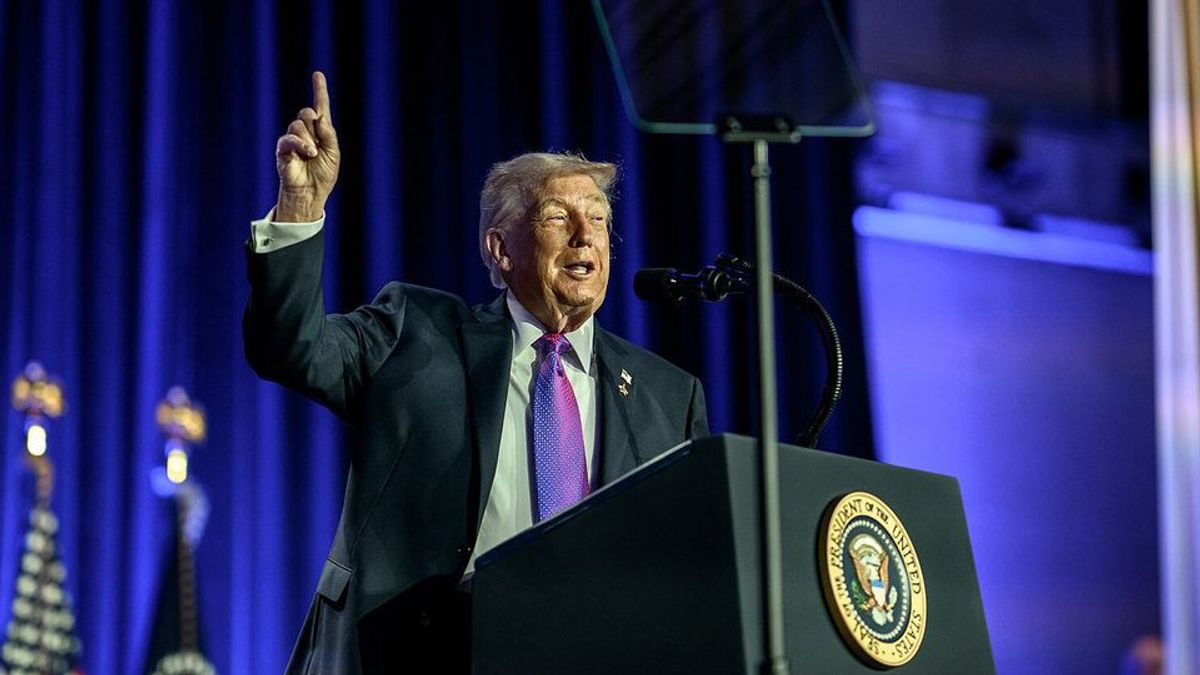


JAKARTA - US President Donald Trump extended a ceasefire with Iran just hours before it expired on Wednesday, April 22. This move is considered to open up room for diplomacy and reduce the risk of conflict escalation amid a deadlock in negotiations between the two countries.
Iranian state media called the decision a "unilateral ceasefire" because Tehran has not yet made an official statement. Unlike before, Washington no longer set a deadline, but rather stopped hostilities until Iran submitted a proposal and the negotiation process was declared complete.
Trump said the decision to delay the attack was also influenced by Pakistan's request, including Army Chief Asim Munir and Prime Minister Shehbaz Sharif, to give Iran time to prepare a unified proposal.
This decision is somewhat a change from the previous attitude. Hours before the announcement, Trump had stated that he would not extend the ceasefire and threatened a major attack if there was no agreement.
Analysts assess that the change in tone reflects Washington's caution amid global economic pressures and US domestic political dynamics.
"President Trump is now facing economic and political pressure, but has not offered a solution to the root of the crisis," said Middle East Institute researcher Brian Katulis.
Previously, the US and Iran had held talks for about 21 hours in Islamabad on April 11, but had not reached an agreement, especially regarding control of the Strait of Hormuz and Iran's uranium enrichment program.
Tensions have escalated after the US imposed a blockade on Iranian ports since April 13. Iran considers the move a violation of the ceasefire and threatens to respond in the Strait of Hormuz.
Pakistan then pushed back for further negotiations and has presented a new proposal from Washington to Tehran. Iran confirmed that it had received the proposal, but had not responded and confirmed that it would not make concessions.
In the midst of this situation, the extension of the ceasefire is considered the most realistic option to prevent open conflict.
The founder of the Quincy Institute, Trita Parsi, assessed that the current condition shows that both parties are not ready to reach a final agreement.
"The US wants to get out of the conflict, while Iran has not yet received the lifting of sanctions. This situation is still unstable," he said.
Similarly, Stimson Center researcher Barbara Slavin called Trump's move a "step back" that was necessary to open up room for compromise.
Meanwhile, Iranian President Masoud Pezeshkian stressed that his country would continue to reject excessive demands from the US, but acknowledged that a prolonged conflict was not beneficial to all parties.
With this condition, analysts assess that the continuation of diplomacy in the next few weeks will be very decisive in the direction of US-Iranian relations, whether it is towards an agreement or returning to heating up.
The English, Chinese, Japanese, Arabic, and French versions are automatically generated by the AI. So there may still be inaccuracies in translating, please always see Indonesian as our main language. (system supported by DigitalSiber.id)
Most Popular Tags
#Prabowo Subianto #donald trump #2026 World Cup #venezuela #konflik timur tengahPopular


