

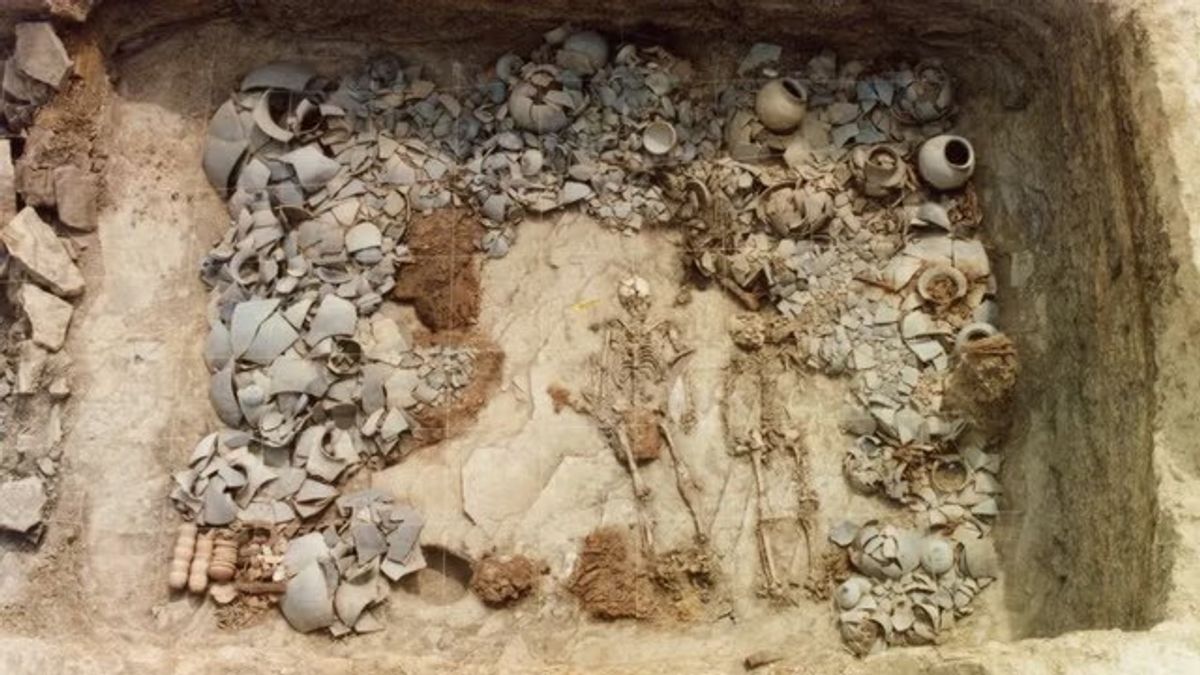


JAKARTA - New findings from an ancient burial complex in South Korea have opened up the possibility of a social group prepared to be sacrificed in death rituals in the Silla Kingdom era. The suspicion arose after scientists analyzed dozens of human skeletons from the Imdang-Joyeong site in Gyeongsan.
Quoted from The Independent, Sunday, April 12, the study published in the journal Science Advances examined genomic data from 78 human bodies found in 44 tombs. Of that number, at least 20 tombs showed traces of sunjang, which is a practice when a person is sacrificed and buried with the deceased.
Researchers found at least three cases when people who had close family ties were buried in the same tomb, including a parent-child couple. In one tomb, researchers even found both parents and their children buried together.
"Our genetic findings are the first to confirm the practice of sunjang against a single intact household," the researchers wrote in the study.
The findings raise new questions about slavery, social mobility, and institutionalized violence in the ancient kingdom of Korea. Jack Davey, Director of the Early Korean Studies Center at Cambridge, said the findings could change the way we understand the Silla society.
"If true, the existence of a group that seems to be a caste of victims in this region, outside the center of Silla, has major implications for the way we understand the Silla society," Davey told Live Science as quoted from The Independent report.
The cemetery complex was first discovered in 1982. The site is estimated to have been built between the 4th and 6th centuries and is suspected to be the burial area of local rulers. There are more than 1,600 tombs and the remains of nearly 260 individuals at the site.
Until now, the relationship between them, the way the funeral was carried out, and the social structure at that time have not been completely clear. This latest study gives a new picture.
Researchers assess that people chosen for the sunjang ritual likely inherit the role from generation to generation. This suspicion arises because there is a genetic relationship between the sacrificed individuals across generations.
The five individuals buried, both from the elite and non-elite circles, were also known to have parents who were closely related. This finding suggests that close-relatives marriages occurred among the Silla elite, and also among those who were allegedly sacrificed.
Based on the available evidence, researchers suspect that there may have been a "caste of victims" in the region, outside the core political circle of Silla, whose role was passed down to be buried with the deceased nobles.
Scientists estimate that those sacrificed were servants, followers, or people who depended on the nobility. This reflects the belief that the dead still need companions in the afterlife.
Overall, the study provides the first large-scale scientific evidence of social and customary structures during the Silla Kingdom, which lasted from 57 BC to 935 AD. The findings also show that the kinship structure in the region differs from the pattern that has long been found in ancient Europe.
The English, Chinese, Japanese, Arabic, and French versions are automatically generated by the AI. So there may still be inaccuracies in translating, please always see Indonesian as our main language. (system supported by DigitalSiber.id)
Most Popular Tags
#Prabowo Subianto #donald trump #firearm #8791 #giias 2026Popular


