

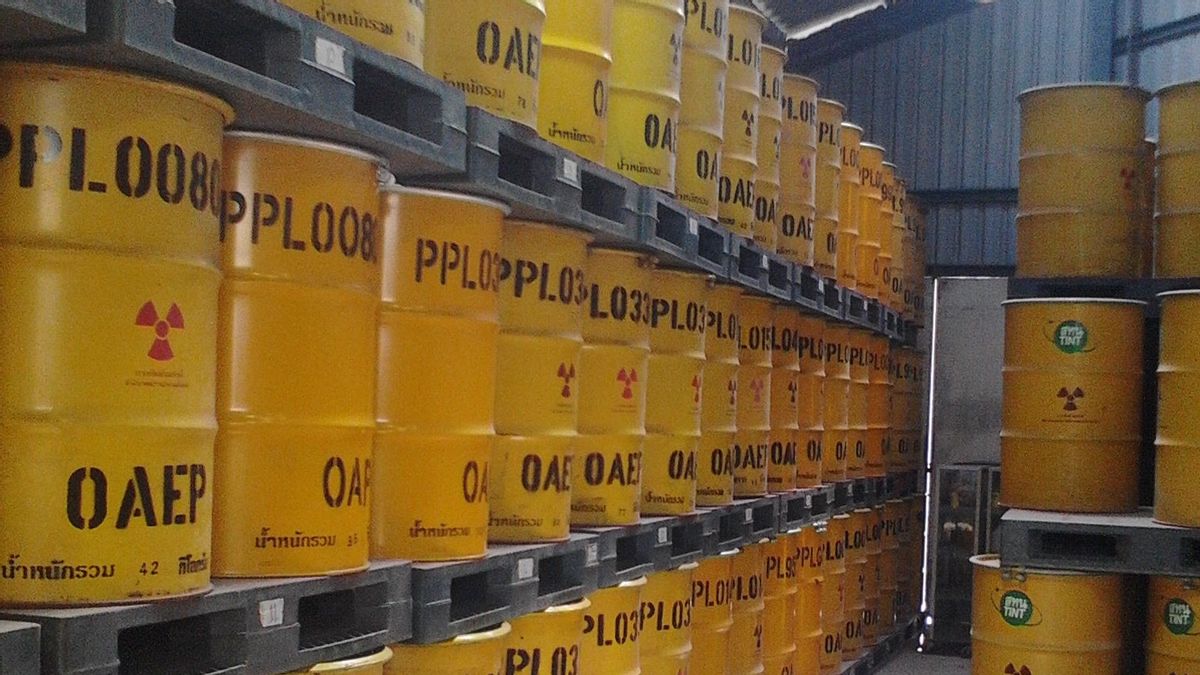


JAKARTA - Finland is preparing to operate Onkalo, the world's first underground facility for the permanent disposal of spent nuclear fuel. The location is more than 400 meters underground. This is where thousands of tons of radioactive waste will be buried for a very long time.
Onkalo has been under construction since 2004 on the island of Olkiluoto, a remote area on the west coast of Finland. The 1 billion euro project is said to be able to start operating in the next few months after the permit is issued. In an ABC News report quoted on Thursday, April 9, this location was chosen because the underlying rock is very old, stable, and low-risk for earthquakes.
The project manager, Posiva, said the facility can accommodate 6,500 tons of spent nuclear fuel. Waste will be put into copper tubes, then buried in underground tunnels and covered with bentonite clay, a water-absorbing material used as an additional shield.
For Finland, this is the answer to the long-standing question of nuclear energy: where its waste must be disposed of. Posiva calls this facility an important part that has not been in sustainable nuclear energy use.
However, the problem is not as simple as burying it and then finishing. Still launching ABC News, Posiva estimates that the radioactivity of the waste will only drop to natural levels after hundreds of thousands of years. This means that this storage site must remain safe far beyond the life of modern states, even the civilization we know today.
International Atomic Energy Agency data in 2022 showed that the world had produced nearly 400,000 tons of spent nuclear fuel since the 1950s. Most are still stored temporarily in reactor cooling pools or dry casks on the ground. So far, there is no commercial permanent nuclear waste disposal facility in operation in any other country.
Nuclear safety expert from the Union of Concerned Scientists, Edwin Lyman, reminded that the geological disposal of waste is still full of uncertainty. Copper tubes, he said, will eventually corrode. What is still debated is how fast the process occurs. As quoted by ABC News, Lyman assessed that storage far underground is still better than letting radioactive waste continue to be on the surface which is more vulnerable to sabotage.
Other problems are also not small. The main risk of facilities like this, said Lyman, will eventually fall to future generations. Therefore, scientists are even thinking of ways to make warning signs that humans can still understand 10,000 years from now. One of his ideas is to spread ceramic plates containing "nuclear messages" around the storage location.
The Finnish government insists that this policy is in line with the rules since 1994, namely that radioactive waste produced in the country must be handled by itself. Even so, Finnish Environment Minister Sari Multala did not rule out the possibility of receiving nuclear waste from other countries in limited quantities, as long as it is allowed by international regulators.
The English, Chinese, Japanese, Arabic, and French versions are automatically generated by the AI. So there may still be inaccuracies in translating, please always see Indonesian as our main language. (system supported by DigitalSiber.id)
Most Popular Tags
#Prabowo Subianto #donald trump #firearm #8791 #giias 2026Popular


