
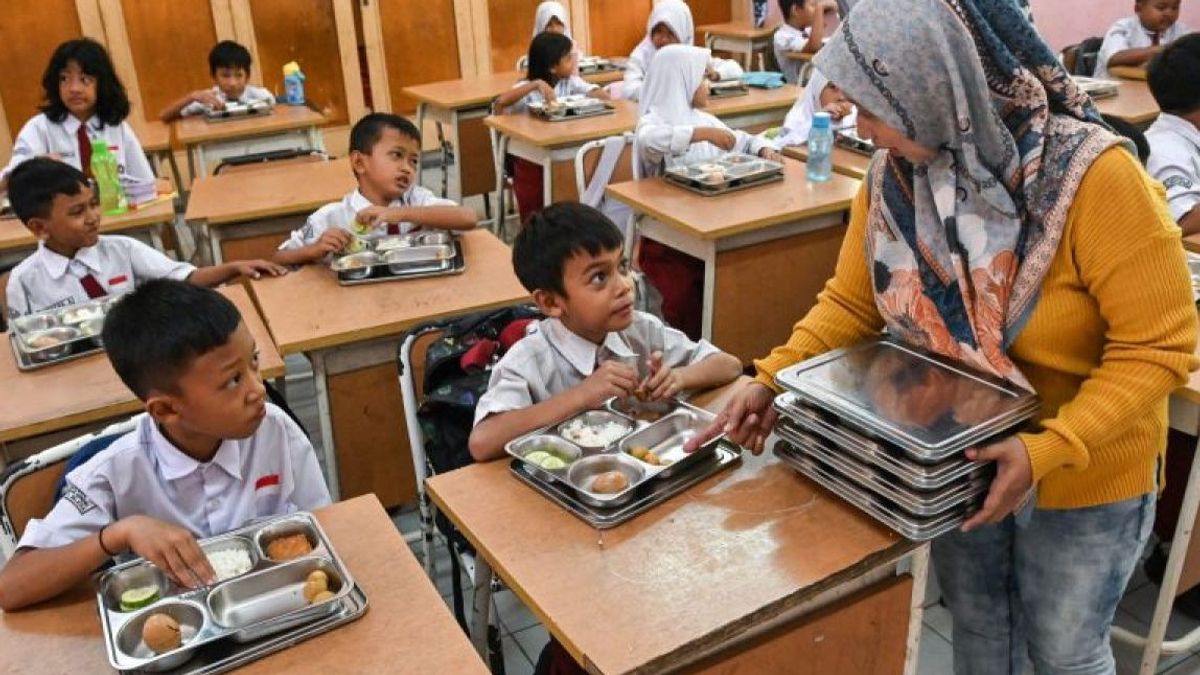


JAKARTA - The Free Nutritional Meal (MBG) program, which is currently being revised by the government, is one of the policies that is most widely discussed by all circles. On several occasions, MBG was accused of being a mere imaging program, considered useless, to other biased accusations. Nevertheless, a new reality is beginning to emerge from the field. More than just a regular program, people are now beginning to see how this MBG program works at the grassroots level.
A similar view was also expressed by the Youth Figure and Secretary General of the Association of Village Business Actors of Indonesia, Ahmad Alimudin. "Now there are starting to emerge field research reports that see the direct initial impact of MBG from the parents of students as beneficiaries. The report (RISED) which conducted a study in several areas such as Cilacap, Semarang, Surakarta, involving around 1800 parents of students who receive MBG.
"From the results there are interesting findings. Some families feel that their daily expenses are lighter. Parents are less likely to prepare school supplies and children's pocket money is also starting to be adjusted. From this data it seems that MBG is indeed needed. Especially for families who are less able to afford it," he said, quoting the results of RISED's recent findings.
Alimudin sees the majority support from the grassroots, especially in small cities, as a sign that the MBG program has a real impact on the community. According to him, the focus of MBG at this time will also target the poor families as priority recipients, as directed by the President conveyed by the Deputy Head of BGN, Nanik S. Deyang, recently.
"The program (MBG) is applicable and has an impact. And as we know, now MBG is starting to focus on the poor families as priority recipients because in the end the most important thing is not the political narrative war. But whether Indonesian children really get access to better nutritious food or not," he added, quoted Friday, April 2.
Adding Alimudin's statement above, the results of the RISED report which surveyed parents of students recently in three cities in Central Java stated that more than 80% of low-income families support that the MBG program continues. Their reason is fundamental: a sense of calm because their children are guaranteed to eat at school. That way, they are no longer anxious. In addition, about 8 out of 10 parents admit that their children have become more regular in consuming nutritious food and rarely miss meals after the MBG program runs at school.
MBG portrait in the Eastern Indonesia RegionThe MBG program in South West Sumba also raises the economy of residents who work in the MBG kitchen. Kristina Lende, after six months working as a pre-cleaner at SPPG Watu Kawula, Kota Tambolaka District, South West Sumba Regency, East Nusa Tenggara (NTT).
"Now I can buy 20-50 kilograms of rice, meet the needs of my children's school, even buy a motorcycle from the work," he said.
Previously, Kristina only relied on her husband's income who worked sporadically and had an income of around Rp. 50 thousand per day. With this income, Kristina's family had difficulty even buying 1 kilogram of rice.
Still in South West Sumba, the Head of the Extraordinary School (SLB) Negeri Laura, Maria Dolorosa, conveyed the positive story of the acceptance of MBG at her school.
"During the implementation of the MBG Program, I saw significant changes: children are more enthusiastic, more eager to attend and stay in class, their mood is more stable, especially for students with grahita and Down Syndrome. In addition, the burden of dormitory consumption is reduced because students have nutritious lunch," said Maria.
The State SLB Laura itself has a total of 68 students (59 officially recorded). There are 5 classes of deaf such as deaf, deaf, autistic, to grahita, including down syndrome and slow learning. The SLB also opened a class far in North Kodi since 2025. About 40 students live in the dormitory alternately, with the majority coming from families of economic desil 1 (very poor) and 2 (poor).
The government's move to start correcting governance and plans to focus MBG on pre-prosperous families as a priority is a right step in terms of target. Beyond the pro and con narratives related to MBG, we need to look at this program from a positive side, especially to provide access for children from families who have not been able to provide adequate nutrition and nutrition every day.
"Discussions about MBG must start to rise in level. Not just about failure or success. But we talk based on data. Evaluate the implementation and improvement of SPPG that is problematic. The most important thing is to ensure that the benefits really reach children who need it," concluded Alimudin.
The English, Chinese, Japanese, Arabic, and French versions are automatically generated by the AI. So there may still be inaccuracies in translating, please always see Indonesian as our main language. (system supported by DigitalSiber.id)
Most Popular Tags
#Prabowo Subianto #donald trump #firearm #8791 #giias 2026Popular


