

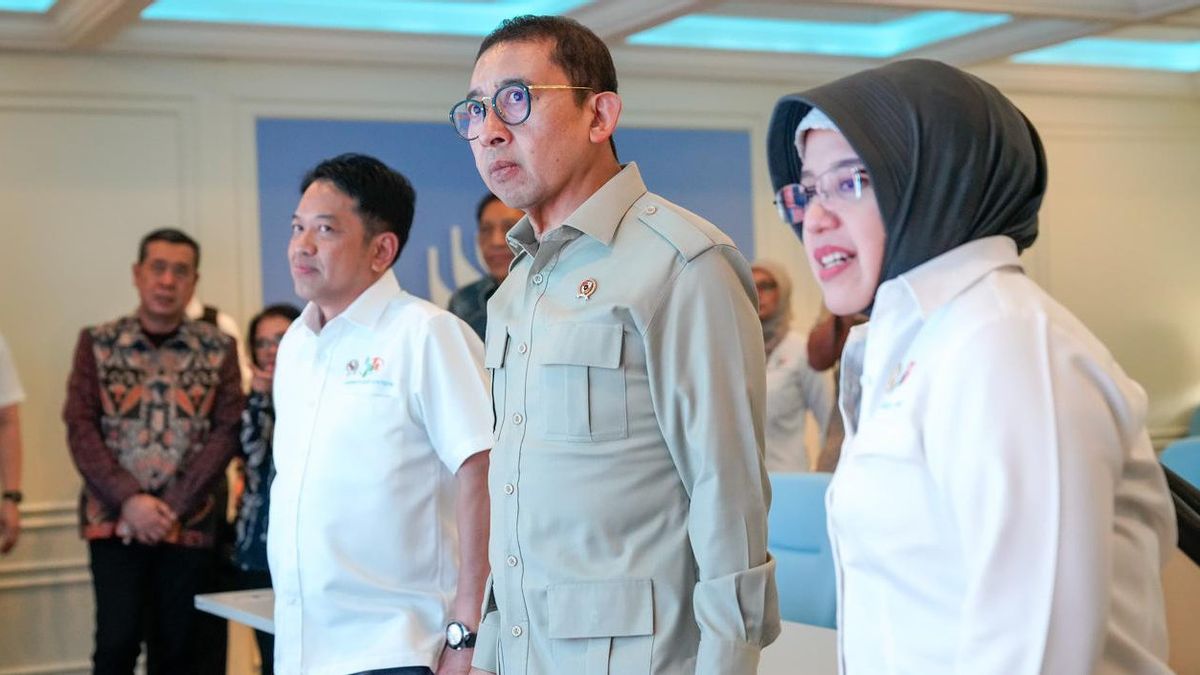


JAKARTA - The Ministry of Culture (Kemenbud) has started to fix an old job that is often scattered, namely cultural data. Through cooperation with the Central Statistics Agency (BPS), the Ministry of Culture wants the 2026 Economic Census to be used to read more clearly how much the contribution of culture to the national economy.
In a meeting held at the Ministry of Culture Office, Jakarta, Tuesday, April 7, the Minister of Culture (Menbud) Fadli Zon emphasized that culture cannot continue to be understood as art. According to Fadli, the cultural space is much wider and includes 10 Cultural Development Objects.
"Culture is often correlated with art, although its scope is much wider," said Fadli.
He said that the direction of cultural development was carried out comprehensively, ranging from protection, development, utilization, training, to cultural diplomacy. This step, said the Minister, was in line with the mandate of Article 32 paragraph (1) of the 1945 Constitution and Law Number 5 of 2017 concerning the Promotion of Culture.
Therefore, Fadli considers strengthening data to be important so that policies are no longer drafted roughly. He hopes that the 2026 Economic Census, which took place from April to August, can provide a more complete picture of the economic contribution of culture. "With the right data, the resulting policies will also be more appropriate," he said.
BPS Head Amalia Adininggar Widyasanti said the potential data from the Economic Census could be used to support more measurable cultural policies. "The potential of the Economic Census can be utilized by the Ministry of Culture," said Amalia.
From the BPS exposure, there are several interesting notes. Based on the Susenas Social Cultural and Education Module 2024, as many as 47.56 percent of people aged 5 years and above watch performances or exhibitions in person. The type of music or sound art is the most sought after, namely 52.55 percent. BPS also noted that knowledge of fairy tales and folk stories is higher in urban areas than in rural areas. Meanwhile, new cultural tourism contributed around 13.19 percent of the total number of commercial tourist visits, still below nature tourism.
At the same time, BPS is also updating the 2025 KBLI to be more sensitive to changes in economic activities, including the cultural sector. Fadli considers this step important because there are still many cultural actors, cultural professions, to intellectual property or intellectual property that have not been mapped in detail. Therefore, he asked his staff to coordinate with BPS so that data collection can be adopted into the KBLI and KBJI.
The Ministry of Culture also stated that it would support the implementation of the Economic Census through socialization, dissemination of information, and encouragement of public and cultural actors' participation. The goal is that culture is not only talked about, but also calculated more neatly.
The English, Chinese, Japanese, Arabic, and French versions are automatically generated by the AI. So there may still be inaccuracies in translating, please always see Indonesian as our main language. (system supported by DigitalSiber.id)
Most Popular Tags
#Prabowo Subianto #donald trump #2026 World Cup #Febrie Adriansyah #8791Popular


