

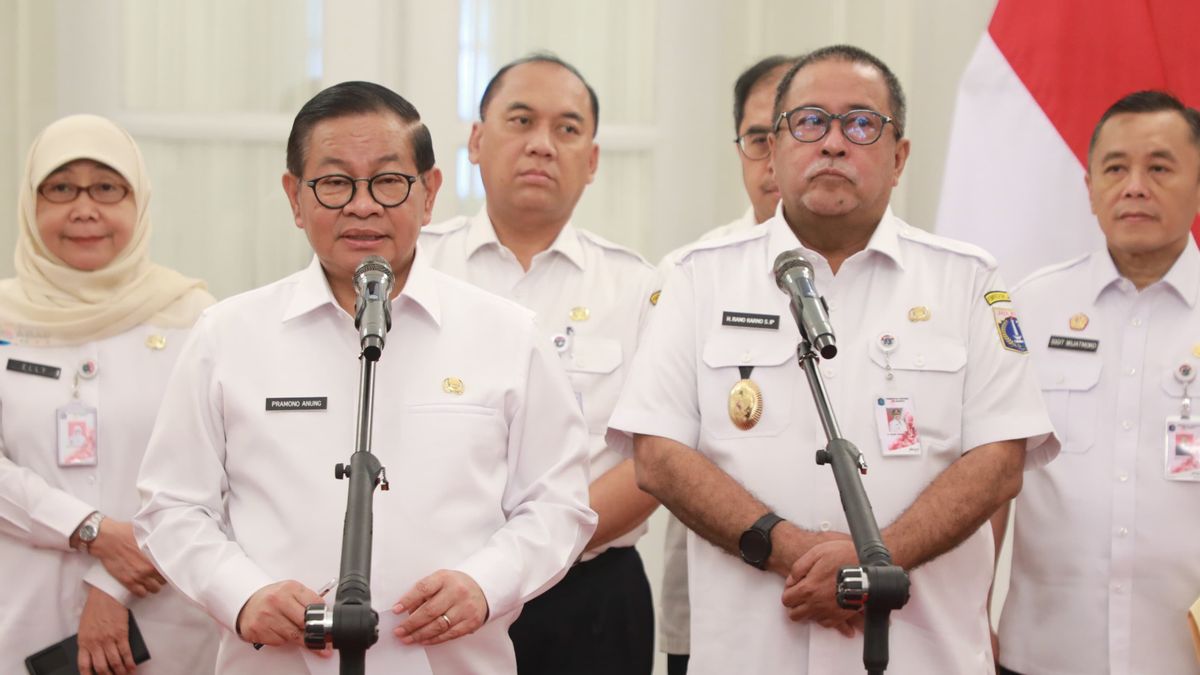


JAKARTA - DKI Jakarta Governor Pramono Anung ensures that the one-day work from home (WFH) policy for state civil servants (ASN) in the DKI Provincial Government environment does not apply to all employees.
Pramonk said that a number of ASN who serve in the public service sector are still required to work as usual. The excluded groups include health workers, firefighters, and other field officers who come into direct contact with public services.
"There are some exceptions that are not included in work from home, for example, officials at the madia level, Pratama, then also things related to public services such as Satpol PP, Transportation, Health, Gulkarmat/damkar, so they will continue to serve as usual," said Pramono at the DKI Jakarta City Hall, Wednesday, April 1.
Apart from public service officers, structural officials are also not included in the WFH scheme. Pramono emphasized that the leadership position must be present to ensure that the wheels of government run.
"They are still those who do not get the privilege to work from home. Including us, no one is affected by working from home, we still work as usual," said Pramono.
For ASN working in the field of administration, the implementation of WFH will be regulated by a percentage scheme. The DKI Provincial Government has prepared a minimum and maximum limit for the number of employees who can work from home.
"Administrative matters regulated in the circular, we will arrange for work from home because there is no range from the Central Government that we will arrange the range between 25 percent to a maximum of 50 percent," he explained.
The technical scheme is currently being drafted by the DKI Jakarta Regional Secretary together with the Regional Human Resources Agency (BKD) and will be determined through the governor's decision.
The government has set a policy of working from home (work from home/WFH) every Friday for the State Civil Apparatus (ASN) and the private sector as a step to save fuel oil consumption (BBM) in the midst of global geopolitical dynamics.
Coordinating Minister for the Economy Airlangga Hartarto said that this policy will be implemented starting April 1, 2026 and will be evaluated after two months of implementation.
Meanwhile, the technical arrangements related to the implementation of the WFH policy will be spelled out in a circular letter from the Minister of State Apparatus and Bureaucratic Reform (PANRB), the Minister of Home Affairs, and the Minister of Manpower.
"This policy will take effect on April 1 and will be evaluated after 2 months of implementation and this technical arrangement will be included in the circular of the Minister of PAN-RB, the Minister of Home Affairs, and the Minister of Manpower," he said in a virtual press conference, Tuesday, March 31.
Airlangga ensured that even though ASN worked from home one day a week, public services continued to run optimally.
He explained that the selection of Friday was based on practices that had been implemented in a number of ministries and agencies after the COVID-19 pandemic, with a four-day work pattern effective in a week.
"Because several K/L (ministries/institutions) have implemented it, working 4 days a week with an application, this is after COVID yesterday. We choose Friday because it is half, which means not the whole of Monday-Thursday," he said.
Meanwhile, he said for the private sector, the implementation of WFH will be regulated through a circular letter from the Minister of Manpower while still considering the characteristics of each business sector, and this policy also includes an incentive for energy efficiency in the work environment.
The English, Chinese, Japanese, Arabic, and French versions are automatically generated by the AI. So there may still be inaccuracies in translating, please always see Indonesian as our main language. (system supported by DigitalSiber.id)
Most Popular Tags
#Prabowo Subianto #donald trump #Febrie Adriansyah #8791 #giias 2026Popular


