

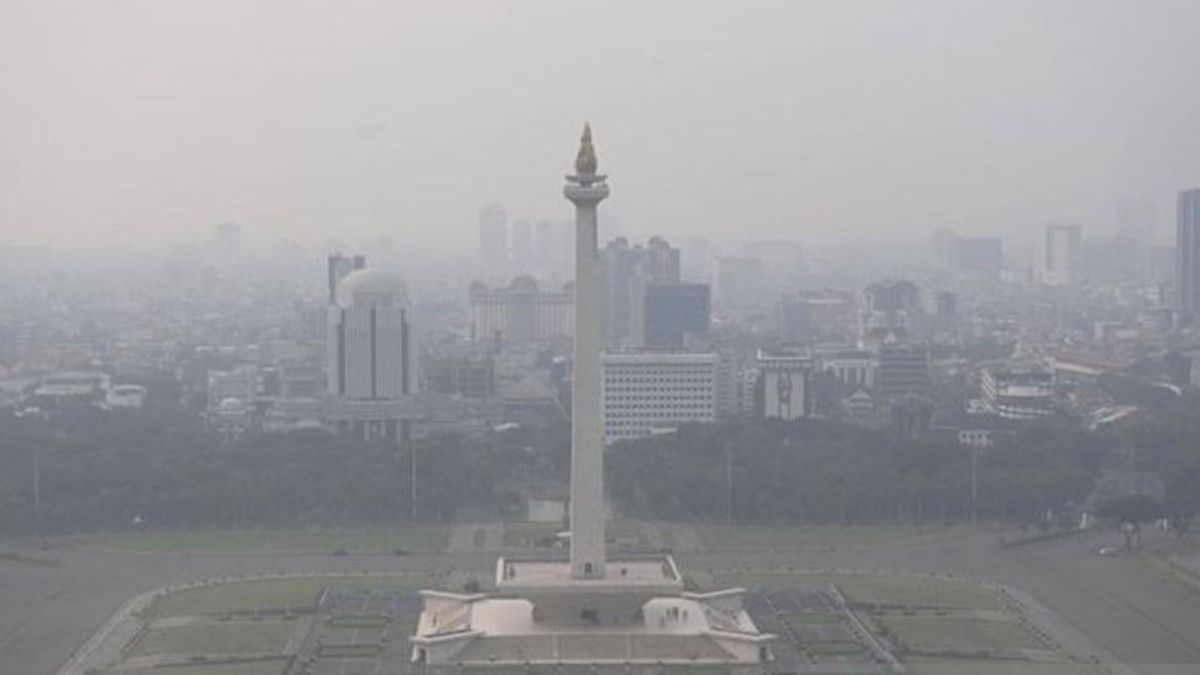


JAKARTA - The DKI Jakarta Provincial Government is preparing a quick response to tackle air pollution in the capital during the dry season which is predicted to occur in early May to August.
Head of the Environmental Pollution and Damage Control Division of the DKI Jakarta Environmental Service (DLH), Erni Pelita Fitratunnisa, said this step was issued several years ago but did not have a legal umbrella.
"We have made 10 quick response steps to combat air pollution. But because the air quality conditions improved in 2024, 2025 and hopefully now, we haven't had time to process it into one regulation," said Erni, Thursday, March 5.
Erni said that the DKI DLH would take quick steps to handle air pollution during the dry season, including improving the quality of air quality monitoring systems and motor vehicle emission tests.
Among the steps to handle air pollution, "water mist" spraying is included in those that have been implemented in Jakarta. Currently, 100 buildings in Jakarta have implemented efforts to reduce air pollution.
"We have installed 'water mist' in several buildings, now 100 have been installed," he said.
On the other hand, the DKI Provincial Government has an Air Pollution Control Strategy (SPPU) which is currently being evaluated from various aspects, ranging from PM2.5 trends, emission loads per sector to its impact on public health.
"SPPU is being evaluated. We are dividing SPPU again, we are looking for which activities are most effective in tackling Jakarta's air pollution," said Erni.
The Meteorology, Climatology and Geophysics Agency (BMKG) warns that the dry season in Indonesia this year will be longer and relatively drier compared to 2025.
The beginning of the dry season is predicted to begin in April 2026 in a number of regions of Indonesia, namely 114 seasonal zones and will gradually begin to be felt in other regions in May and June.
This condition shows that the beginning of the dry season in Indonesia has come earlier this year compared to normal conditions.
The English, Chinese, Japanese, Arabic, and French versions are automatically generated by the AI. So there may still be inaccuracies in translating, please always see Indonesian as our main language. (system supported by DigitalSiber.id)
Most Popular Tags
#Prabowo Subianto #donald trump #2026 World Cup #Febrie Adriansyah #8791Popular


