


JAKARTA - The Indonesian Mining Experts Association (PERHAPI) emphasized that the controversy over the impact of mining operations on the flood and landslide disasters in North Sumatra in November 2025 must be dealt with proportionately and based on transparent and measurable scientific studies, so that government decisions are appropriate, objective, and accountable.
The flood and landslide disasters that hit the Sumatra region in November 2025 were mainly triggered by extreme weather anomalies that exceeded the normal limits of the design of national infrastructure mitigation.
The consensus of independent experts in the PERHAPI Group Discussion Forum (FGD) reviewed scientific studies that verified that the incident was dominated by extreme hydrometeorological factors.
Based on hydrological and geospatial data, the contribution of industrial activities to flood events is considered very small. Technical data also proves the existence of engineering infrastructure in the operational area actually serves as a buffer for water runoff which helps reduce the flow discharge before flowing to the downstream area.
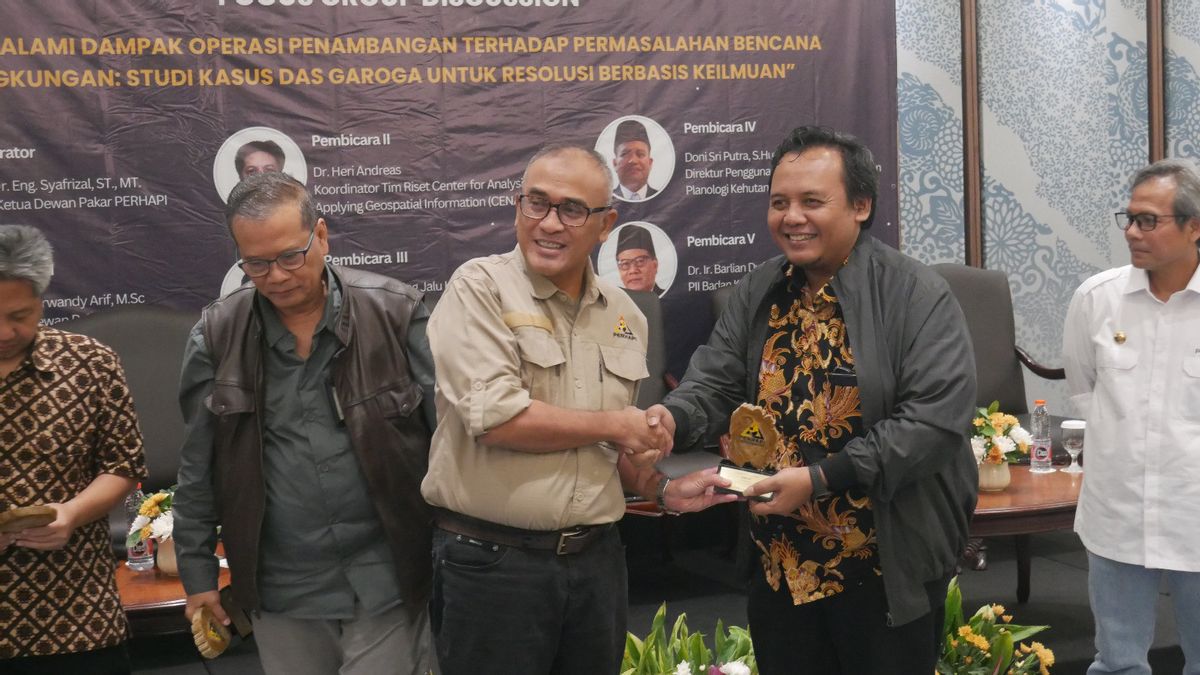
The affirmation emerged in a Focus Group Discussion (FGD) themed "Understanding the Impact of Mining Operations on Environmental Disaster Problems: Case Study of the Garoga River Basin, for Science-Based Solutions" held by PERHAPI in Jakarta. This forum was attended by mining experts as well as the team from the Center for Analysis and Applying Geospatial Information (CENAGO) of the Bandung Institute of Technology (ITB) to present the results of forensic studies on geospatial-based disasters.
The Chairman of PERHAPI, Sudirman Widhy Hartono, explained that as a professional organization, PERHAPI has taken the initiative to provide recommendations based on data validation to emphasize the importance of policies based on scientific studies in disaster risk management and industry.
"Every decision on the continuation of mining operations must be based on in-depth studies. We refer to the CENAGO ITB independent study as well as the presentation of experts to explain the correct mining technical aspects. The validation of these experts aims to ensure that every policy taken by the government is based on scientific facts (science-based policy) and can be considered by the government in making decisions," said Sudirman, Wednesday (4/3/2026).
PERHAPI stated that it would summarize the recommendations of the FGD, including the results of the CENAGO study, to be submitted to the government as material for evaluation and follow-up steps. PERHAPI also assessed the certainty of decisions on industrial operations in the region was necessary so that the management of social and economic impacts could be carried out on a measurable basis.
PERHAPI Expert Council, Irwandy Arif, explained that mining activities must have environmental risks, but each company is obliged to mitigate them through the implementation of good mining practice principles consistently, one of which is as carried out by PTAR.
Technical infrastructure such as drainage systems and settling ponds have proven to function as vital water retention systems that help hold water runoff in operational areas before being controlled. Irwandy also explained in terms of hydrology and morphology, the location of the Martabe Gold Mine is separate from the area affected by flash floods. From the water flow system and land form conditions, the mine location is not in the same system as the flash flood area in the Garoga River Basin.
CENAGO ITB Scientific StudyCENAGO ITB Research Team Coordinator, Heri Andreas, presented the results of a study related to the West Sumatra, North Sumatra, and Aceh flood disasters. The conclusion, the flood and landslide disasters at the end of November 2025 in several areas of Sumatra were triggered by extreme weather related to the Senyar Tropical Cyclone phenomenon with rare precipitation anomalies. Rainfall was recorded in the extreme category of 150-300 mm per day to very extreme above 300 mm per day. The probability model shows that the scale of the event is in the R700 to R1000 category. Meanwhile, government mitigation regulations only require standards up to R50.
In the context of the Garoga River Basin, CENAGO also assessed the contribution of corporate land cover changes to flooding as relatively small: PTAR around 1.6%, PT TBS 0.4%, and PT NSHE 0.02%.
"This means that this phenomenon is a Super Force Majeure that exceeds the technical capabilities of all stakeholders. Hydrological data show that the operational contribution of mines to flooding is very small, only 0.32%, so that the application of Strict Liability (absolute liability) needs to be reviewed proportionally based on scientific findings," said Heri.
"For the sake of objectivity, it should be reviewed again," concluded Heri.
To conclude, Sudirman Widhy Hartono emphasized the importance of ensuring that every policy decision is based on comprehensive and objective scientific studies. "Every decision made must be fair, transparent, and free from the pressure of opinions that are not data-based. We hope that the results of this expert consensus will be the main basis for the Government in making wise decisions to restore the operational of strategic national industries," he concluded.
The Chairman of the Indonesian Mining Association (API-IMA), Rachmat Makkasau, previously also emphasized the importance of maintaining a conducive investment climate in the mining sector. According to him, the government will certainly conduct a thorough evaluation regarding mining business permits that are currently a public concern.
"We believe that the government will conduct a more detailed evaluation regarding the operational permits that are being revoked. Companies that operate well and are responsible, prioritize the aspects of Environmental, Social and Governance (ESG), and comply with applicable regulations, including aspects of environmental management, can certainly continue to operate. This is important to ensure that the investment climate in the mining sector remains conducive," said Rachmat.
The English, Chinese, Japanese, Arabic, and French versions are automatically generated by the AI. So there may still be inaccuracies in translating, please always see Indonesian as our main language. (system supported by DigitalSiber.id)
Most Popular Tags
#Prabowo Subianto #donald trump #Febrie Adriansyah #8791 #giias 2026Popular


