
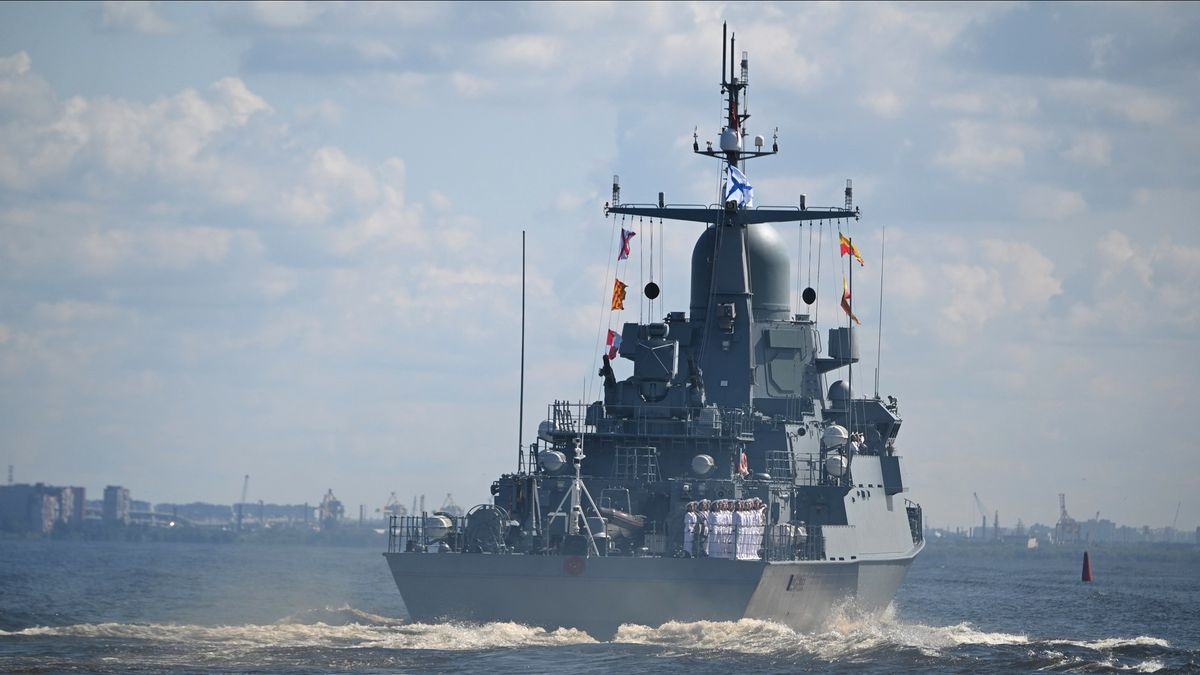


JAKARTA - The Russian Navy will thwart any Western attempt to impose a naval blockade on the country, a senior official said on Tuesday.
In an interview with Russian newspaper Argumenty i Fakty, Russian Presidential Aide and Head of the Maritime Council Nikolay Patrushev described the recent detention of a Russian oil tanker as "an attack that is essentially a pirate."
On January 22, the French Navy intercepted and detained the Grinch oil tanker in the Western Mediterranean, which was sailing from Murmansk.
Authorities suspect the tanker is part of Russia's "shadow fleet" used to evade international sanctions.
Since the end of 2025, Ukraine has stepped up attacks on Russian tankers using the Sea Baby naval drone. The Kairos, Virat, Dashan, Elbus, and other ships were attacked in the Black Sea, and in December, Ukraine attacked the Qendil tanker with a drone in the Mediterranean Sea.
Britain, the Baltic states, and the Scandinavian countries discussed the possibility of systematic detention of ships from the Russian shadow fleet at the Munich Security Conference this month. More than 600 such vessels have been sanctioned by the EU, Britain, and the US.
According to Patrushev, the actions show that Western opponents have decided to attack one of the most important sectors of the Russian economy - foreign trade - with the intention of crippling it.
He predicted that the actions would increase, with attacks on ships and cargo becoming more frequent.
"If we do not give them a firm rejection, then soon Britain, France, and even the Baltic countries will be so bold that they will try to completely block our country's access to the sea, at least in the Atlantic Basin," he said, launching Anadolu (18/2).
Furthermore, Patrushev emphasized, steps to respond to Western attacks are being developed, including through the Maritime Council.
"We believe that, as in the past, the best guarantor of navigational safety is the navy," he said.
Furthermore, Patrushev argued, "an impressive force" must always be present on the main sea lanes, including in areas far from Russia, "ready to dampen the spirits of Western pirates."
However, Patrushev admitted that the Russian Navy is currently carrying out duties to protect maritime trade "with a fairly high level of pressure."
"We need more ships for the far sea and ocean zones, which are capable of operating independently for long periods at a considerable distance from their bases," he explained.
"The current situation shows that of all branches of the armed forces, the navy is the most powerful and at the same time flexible geopolitical tool, suitable for active use both in peacetime and during armed conflicts," Patrushev said.
"The existence of the navy, the ability to protect our economic activities at sea, to export our oil, wheat, and fertilizer, is a condition for the normal functioning of the country," he said.
"In this case, the Maritime Council is including the appropriate requirements for naval development into the updated ship development program for the navy until 2050," he said.
"Russia needs a balanced fleet, capable of solving all urgent tasks and meeting the demands of the times, especially the demands of technology," he said.
In his assessment, a difficult situation is developing in the Baltic Sea, where NATO "effectively creates a multinational group oriented towards offensive actions."
"Among other things, NATO plans imply a blockade of the Kaliningrad region, seizure of merchant ships, and sabotage of undersea communications, which they will then cynically blame on us," he said.
"As a first step, Russia will use universally recognized political-diplomatic and legal mechanisms," he said.
"If this situation cannot be resolved peacefully, then the blockade will be broken and removed by the navy. We must not forget that many ships sail in the sea under European flags. We may also be interested in what they are carrying and where they are going," said Patrushev.
According to him, "the facts show that the sea is again becoming a battlefield for military aggression, and the old practice of 'warfare diplomacy' is back, as evidenced by events in Venezuela or around Iran."
"But we should not judge only based on the actions of Western countries. The West dominated the sea for a long time, until the beginning of this century, but now their hegemony has largely become a thing of the past," he said.
"Currently, the main task is to build a multipolar world order in the world ocean, and Russia, together with its like-minded partners, is actively working to make it a reality," Patrushev added.
The English, Chinese, Japanese, Arabic, and French versions are automatically generated by the AI. So there may still be inaccuracies in translating, please always see Indonesian as our main language. (system supported by DigitalSiber.id)
Most Popular Tags
#Prabowo Subianto #donald trump #Febrie Adriansyah #8791 #giias 2026Popular


