

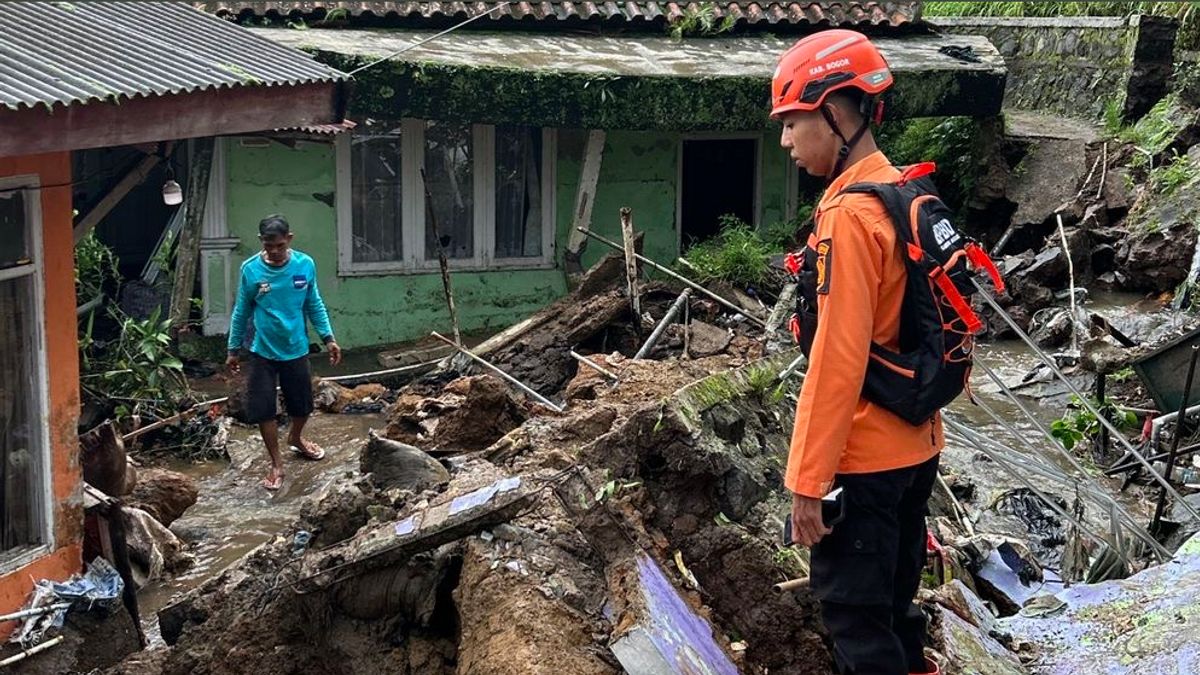


JAKARTA - The house of residents who were buried by landslides in South Tugu Village, Cisarua District, Bogor Regency, West Java, has not yet been evacuated. The cleaning process will continue the next day.
Head of the National Disaster Management Agency (BNPB) Data, Information, and Communication Center, Abdul Muhari, said the landslide occurred on Saturday, February 14 at around 16.30 WIB.
"Heavy rain and a long duration caused the overflow of drainage water, so that the retaining wall (TPT) collapsed and triggered landslides," said Abdul Muhari in his statement, Sunday, February 15.
Abdul Muhari explained that the soil material and the overflow of water entered the residents' houses and caused damage to a number of buildings.
"Until now, the condition at the location is still in the process of being handled. The house building that was buried by the landslide material cannot be evacuated, and the cleaning of the material will continue the next day," he said.
From the temporary data collection, as many as 11 families or 36 people were affected. One family consists of four people in a threatened condition. Meanwhile, 12 families or 40 people have fled to safer locations.
Material losses were recorded for six affected houses, three houses were slightly damaged, and one house was in a landslide-prone condition.
Some of the houses affected by the flow of water have been cleaned independently by residents. Distribution of logistics and clean water continues, although the situation at the location is said to not be completely conducive.
The handling was carried out by the Bogor Regency BPBD together with local authorities and a number of related elements. The current status is an emergency alert for meteorological disasters in West Java Province in 2025/2026 until April 30, 2026.
"Urgent needs on site include emergency response logistics, tarpaulins, and clean water supplies that are being distributed to affected residents," said Abdul Muhari.
BNPB also reminded people in vulnerable areas to increase vigilance against the potential for wet hydrometeorological disasters.
"The public is expected to monitor weather information and early warnings from authorized agencies, maintain the cleanliness of drainage channels, avoid activities in disaster-prone areas during heavy rain, and immediately evacuate to a safer place if there is an increased risk," he added.
The English, Chinese, Japanese, Arabic, and French versions are automatically generated by the AI. So there may still be inaccuracies in translating, please always see Indonesian as our main language. (system supported by DigitalSiber.id)
Most Popular Tags
#Prabowo Subianto #donald trump #Febrie Adriansyah #8791 #giias 2026Popular


