

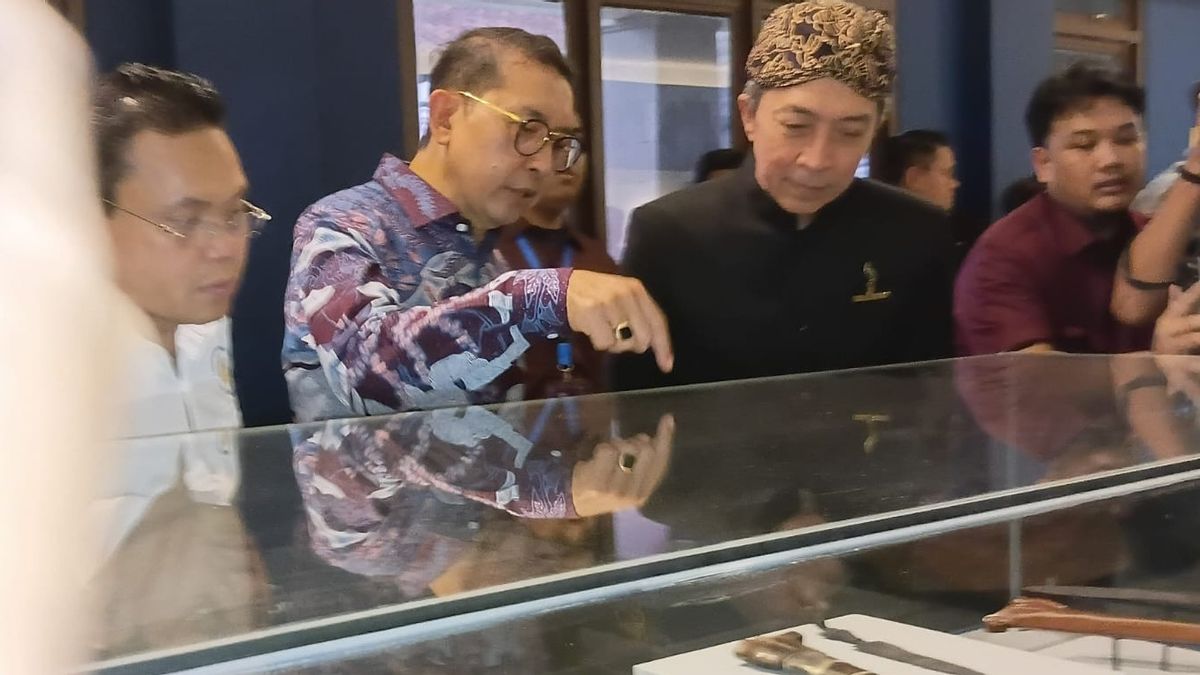


BOGOR - The Minister of Culture of the Republic of Indonesia, Fadli Zon, officially opened the Riksa Wisesa Exhibition at the Pajajaran Museum, South Bogor District, Bogor City, Thursday, February 5. This exhibition is the first step in strengthening the function of museums as a center of information on Sunda history and culture, especially the traces of the Pajajaran Kingdom.
The Riksa Wisesa exhibition showcases the traces of power, heritage, and the teachings of Sunda culture through around 60 historical collections. The exhibited objects come from various cultural communities, private collections, to loans from Sumedang Larang and cultural activists in Bogor.
In his remarks, Fadli Zon said that this exhibition is expected to be an educational space as well as motivation for the public to get to know the roots of history and civilization of the nation.
"We make this as a motivational force to continue to know our cultural history and our very rich civilization. This is just the beginning, the first stage. In the future, we will develop this exhibition space more fully," he said.
He explained that the initial phase of the exhibition focuses on the kujang and Pasundan kris. However, in the future the collection will be expanded with various other cultural expressions such as wayang, gamelan, and intangible cultural heritage which have been recognized as cultural heritage.
"We start with kujang and keris. Later we will develop it with wayang, gamelan, and other cultural expressions. That way we have a complete and integrated exhibition space," he said.
Fadli also touched on the revitalization of the museum area which has been carried out in recent months, including repairing the roof so that the collection is more protected. He admitted that he had several times reviewed the renovation process directly.
"In two months we will improve. At that time I conveyed to the Mayor, let's activate this place to become the Pajajaran Museum. Alhamdulillah now we can carry out the exhibition," he said.
According to him, the Pajajaran Museum will be directed to become a cultural pocket as well as a center of art activities. This year, the empty space in the museum area is planned to be built as an amphitheater as an open performance space. The Ministry of Culture will also help arrange the interior and fill the artifacts gradually.
"Slowly we will fill the artifacts. We will invite artists and cultural activists to contribute to the collection with good curation, whether it is tosan aji, heritage, kujang, or other artifacts," explained Fadli.
He added that cooperation would also be carried out with a number of parties, including the possibility of borrowing long-term collections from the National Museum and the palaces in West Java such as Cirebon.
Fadli assessed that the Sunda land has a long history that has not been fully documented in an integrated manner. Therefore, the presence of the Pajajaran Museum is important as a center for affirming the history of the Pajajaran Pakwan Kingdom which was successful from the 10th century to the 17th century.
"We want this museum to be a cultural center and an information center about the great kingdom in the land of Sunda. Whoever comes to Bogor, both from outside the city and abroad, if they want to know the history of Pajajaran must come here," he said.
Through the Riksa Wisesa Exhibition, the public is invited to get closer to the wealth of Sundanese culture, including the Kujang and Pasundan kris which have a high historical value and traces of acculturation to various regions of the archipelago.
"These antiques are not just objects, but part of our identity and the journey of our civilization. Hopefully this exhibition will be the beginning of the awakening of people's cultural awareness," concluded Fadli.
The English, Chinese, Japanese, Arabic, and French versions are automatically generated by the AI. So there may still be inaccuracies in translating, please always see Indonesian as our main language. (system supported by DigitalSiber.id)
Most Popular Tags
#Prabowo Subianto #donald trump #firearm #8791 #giias 2026Popular


