

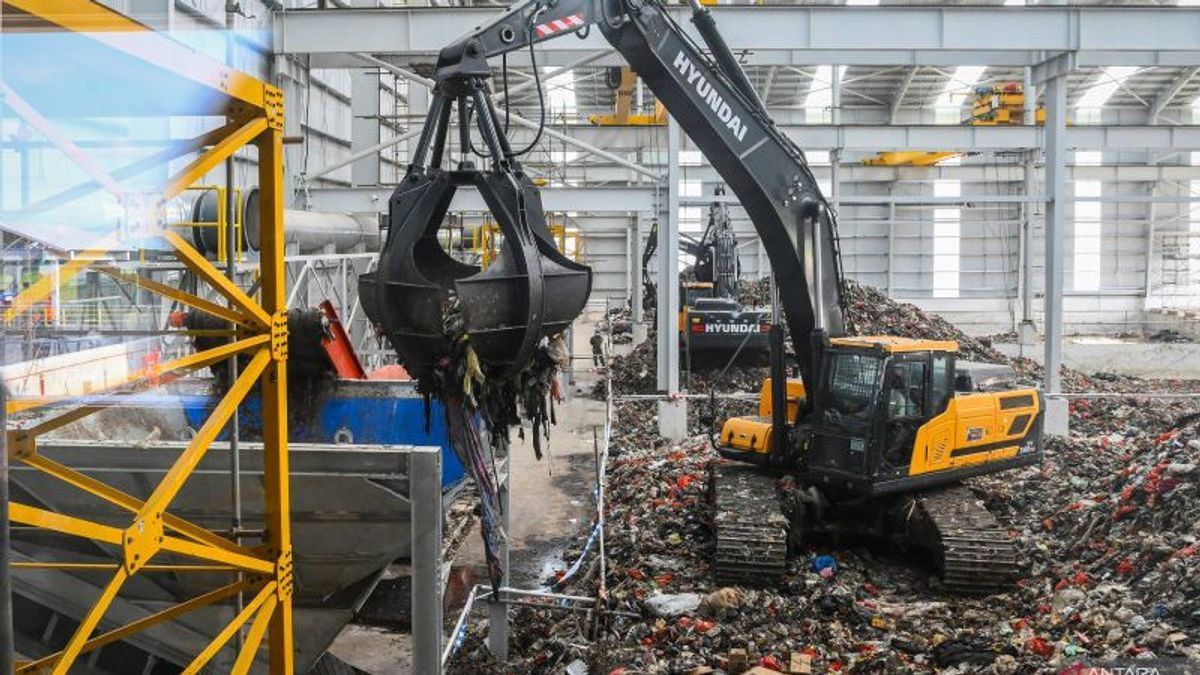


JAKARTA - The D Commission of the DKI Jakarta DPRD will call on the DKI Provincial Government, especially the DKI Jakarta Environment Service, to discuss the issue of waste odor pollution at the Rorotan RDF Plant RDF Plant, which has again been complained about by residents.
In the following meeting, the DPRD will question the LH Office regarding the preparation of an environmental impact analysis (AMDAL). According to Member of Commission D of the DKI DPRD Ali Lubis, the DKI Provincial Government's environmental study is a question in the midst of public complaints about the odor pollution of RDF operations that seem to be unresolved.
"If there is a meeting with the Environment Service, what I will ask seriously is about AMDAL. This AMDAL is the key. How can there still be odor impacts," Ali told reporters, Tuesday, February 3.
According to Ali, the DKI Provincial Government should be able to take into account the aspects of security and health impacts in the operation of waste processing, from the waste delivery route to the processing process.
"If the waste is wet, where is the water? Does it seep into the ground and have an impact on the community? All of this should have been completed in the AMDAL," said Ali.
Ali admitted that he had received information from residents that until now the LH Service had not opened a transparent AMDAL study to the public, with the excuse that repairs were still being carried out.
"If it continues to be closed and not transparent, the public will only ask more questions. Moreover, this budget is very large, Rp. 1.3 trillion. If it does not run as it should, it will certainly be very detrimental to the community," he said.
Meanwhile, the DKI Jakarta Environmental Service (DLH) claimed that waste processing at the Rorotan RDF was still carried out gradually with strict supervision, following residents' concerns regarding the potential for odors, pollution, and environmental impacts.
Head of the DKI Jakarta DLH Asep Kuswanto said that the RDF Plant Rorotan is currently operating five days a week with two shifts. Saturday and Sunday are used for cleaning and arranging the operational area.
"We understand the residents' concerns. Therefore, RDF Rorotan operations are not immediately carried out at a maximum capacity of 2,500 tons per day. We started at 200 tons per day, then increased to 400 tons, 600 tons, and gradually reached a capacity of 1,000 tons per day according to the Governor's instructions," said Asep.
He explained that the waste processed at the Rorotan RDF Plant came from six sub-districts in North Jakarta and five sub-districts in East Jakarta. The increase in capacity was carried out gradually to ensure that all emission and odor control systems run according to technical standards.
Apart from the processing process, DLH also highlights the aspect of waste transportation which has been frequently complained about by residents. According to Asep, the delivery of waste to the Rorotan RDF Plant is now only using closed compactor trucks from procurement in 2024 and 2025.
"No more open vehicles enter the RDF Plant Rorotan. This closed compactor truck is designed to prevent odors and water splashes along the transport route," said Asep.
The English, Chinese, Japanese, Arabic, and French versions are automatically generated by the AI. So there may still be inaccuracies in translating, please always see Indonesian as our main language. (system supported by DigitalSiber.id)
Most Popular Tags
#Prabowo Subianto #donald trump #Febrie Adriansyah #8791 #giias 2026Popular


