

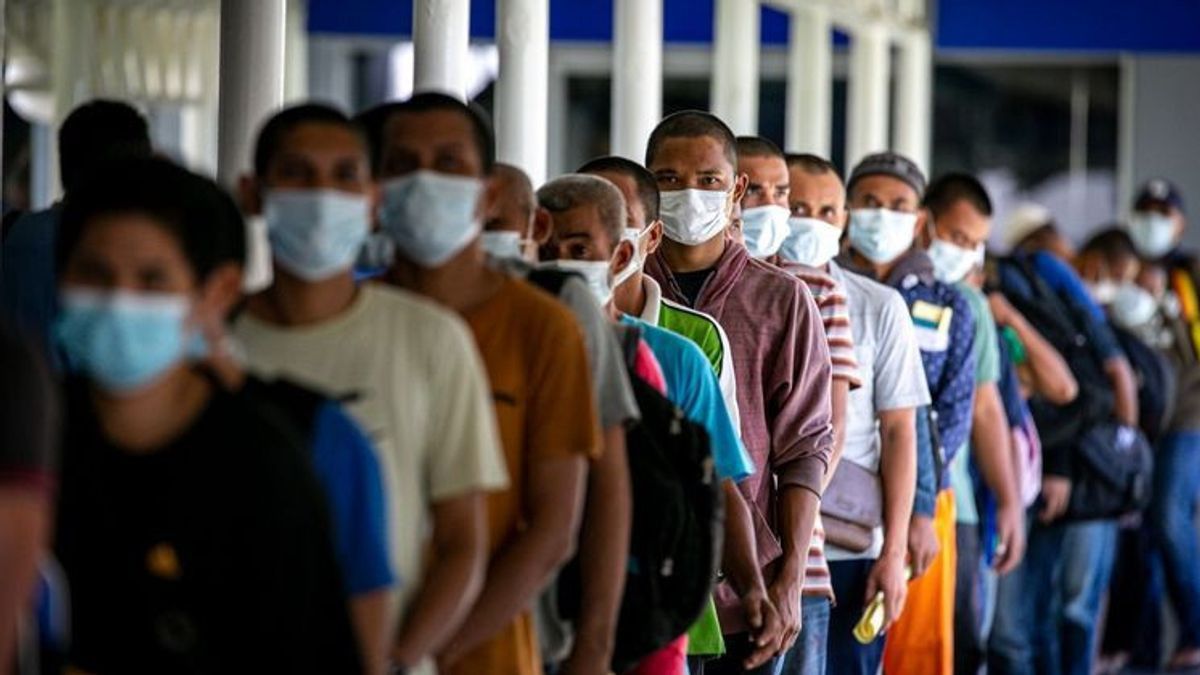


Member of Commission XIII of the Indonesian House of Representatives, Mafirion, asked the government to conduct a comprehensive and human rights-based (HAM) handling of 2,000 Indonesian citizens (WNI) who were involved in online scam networks in Cambodia.
According to him, the government must distinguish clearly between online scam perpetrators and human trafficking victims.
"The state must not be hasty, there must be a clear distinction between victims and perpetrators. A haphazard approach has the potential to violate human rights," Mafirion told reporters, Monday, January 26.
Mafirion also highlighted the difference in assessments between the Financial Services Authority (OJK) which said that the Indonesian citizens were part of a syndicate, with the facts on the ground showing that many Indonesian citizens left because they were deceived by fictitious job vacancies. He assessed that many of them had experienced kidnapping, violence, and modern slavery.
Although encouraging protection for victims, Mafirion emphasized that law enforcement should not be lax towards intellectual actors and syndicate coordinators. He urged the government to form a Human Rights-Based Integrated Task Force to conduct an individual assessment of all Indonesian citizens who were caught.
"The victim's narrative should not be used as an excuse to let the perpetrators, coordinators, and recruiters escape the clutches of the law. The state must be present decisively to punish the core perpetrators and break the chain of crime," he said.
Furthermore, this PKB legislator reminded Indonesia's international obligations in the Palermo Protocol and the International Covenant on Civil and Political Rights (ICCPR) to eradicate human trafficking and forced labor. Mafirion asked the government to exert diplomatic pressure on Cambodia to dismantle the scam camps permanently.
For the domestic market, Mafirion also urged the authorities to take firm action against illegal agents who are the gateway for sending Indonesian citizens to Cambodia. He assessed that the failure of the state to act seriously would trigger sharp criticism from international human rights mechanisms.
"Human rights principles should not be used as an excuse for impunity. On the other hand, law enforcement should not eliminate human dignity. The state must be present in its entirety until it breaks the chain of crime to its roots," concluded Mafirion.
It is known that this issue emerged along with the massive raids carried out by the Cambodian government against foreign nationals in online fraud camps. Based on initial data, there are more than 2,000 Indonesian citizens who have been identified as being in the vortex of the syndicate.
Currently there is no clarity between which pure online scam perpetrators are victims of human trafficking (TPP).
The English, Chinese, Japanese, Arabic, and French versions are automatically generated by the AI. So there may still be inaccuracies in translating, please always see Indonesian as our main language. (system supported by DigitalSiber.id)
Most Popular Tags
#Prabowo Subianto #donald trump #Febrie Adriansyah #8791 #giias 2026Popular


