



JAKARTA - Entering the 60th day after the flood and landslide disaster that hit Sumatra, the National Disaster Management Agency (BNPB) together with the South Tapanuli Regency Government and cross-ministries/institutions focused on recovery and rehabilitation and reconstruction processes.
The priority of handling is directed at accelerating the construction of temporary housing (huntara) and the normalization of the Batang Toru River.
Head of the BNPB Disaster Data, Information, and Communication Center, Abdul Muhari, said that accelerating the construction of huntara was a major concern so that affected residents could immediately occupy more decent homes.
BNPB recorded a total of 816 families receiving huntara in South Tapanuli Regency. Of these, 683 KK will occupy a centralized huntara and 133 KK will receive independent huntara built on land owned by residents.
"The central huntara development in South Tapanuli is carried out jointly by Danantara, the Ministry of Public Works (PU), and BNPB," said Abdul Muhari in his statement, Sunday, January 25.
The details, 186 huntara units in Simarpinggan Village, South Angkola District, were carried out by Danantara. Meanwhile, 245 huntara units in Napa Village, Batang Toru District, were carried out by the Ministry of Public Works.
BNPB itself is working on two centralized huntara locations, 118 units each in Aek Lantong Village, Sipirok District, and 134 units in Simatohir Village, Angkola Sangkunur District. The construction of the self-sufficient huntara is carried out entirely by BNPB.
The government targets the completion of all huntara construction before Ramadan so that affected residents can carry out fasting in a safer and more comfortable condition.
In addition to huntara, the construction of permanent housing (huntap) is also running parallel in South Tapanuli. To date, the progress of the huntap construction has reached about 30 percent of the total 227 units targeted. The government hopes that all the huntap can be completed by the end of March.
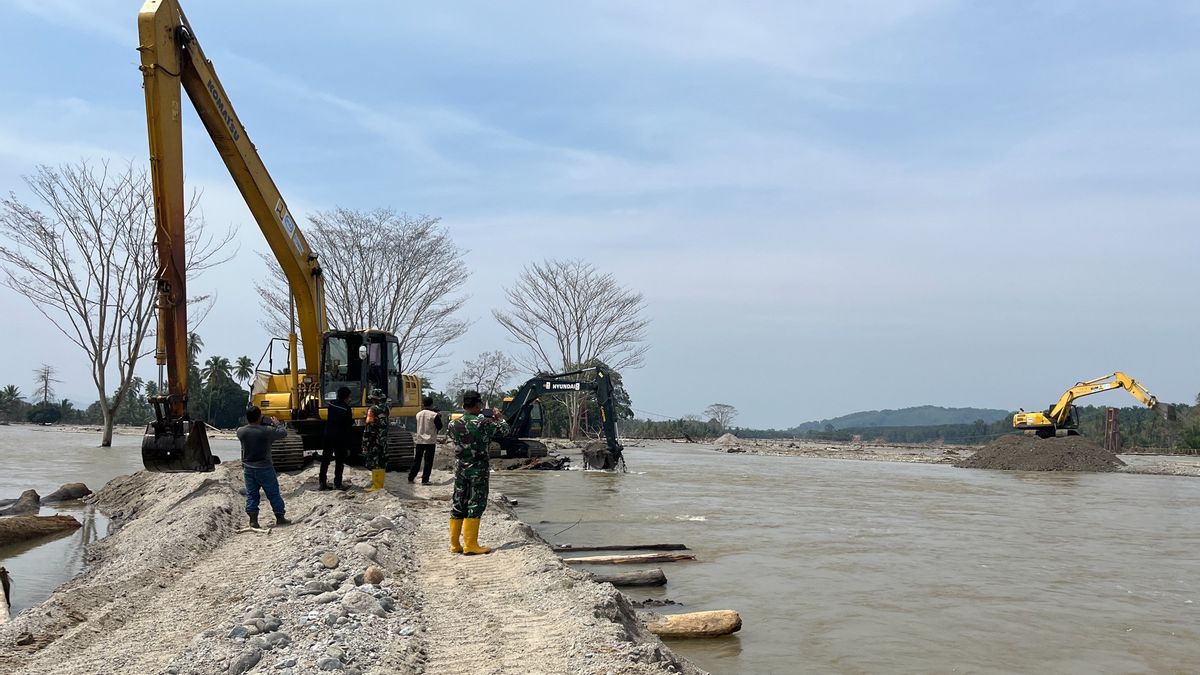
Post-disaster recovery efforts are also focused on normalizing the Batang Toru River, which had overflowed and swept away settlements and farmland areas when flash floods occurred at the end of November. After the incident, the river experienced significant siltation due to piles of sand, stone, and wood.
The normalization of the Batang Toru River, which is the largest and longest river in South Tapanuli Regency, has begun since January 8, 2026 by the North Sumatra Provincial Public Works Agency and is still ongoing until Saturday, January 24.
A total of six units of heavy equipment were deployed to dredge sediment material in the river body as well as build emergency embankments along the Hapesong Village area.
This step is carried out as part of disaster mitigation, considering the forecast of the rainy season with high intensity is still potentially occurring until March.
"The normalization of the Batang Toru river is a mitigation step for disasters considering the forecast of the rainy season and the risk of high-intensity rain that is predicted to still occur until March. This effort is important to prevent flooding later," he explained.
The English, Chinese, Japanese, Arabic, and French versions are automatically generated by the AI. So there may still be inaccuracies in translating, please always see Indonesian as our main language. (system supported by DigitalSiber.id)
Most Popular Tags
#Prabowo Subianto #donald trump #2026 World Cup #Febrie Adriansyah #8791Popular


