
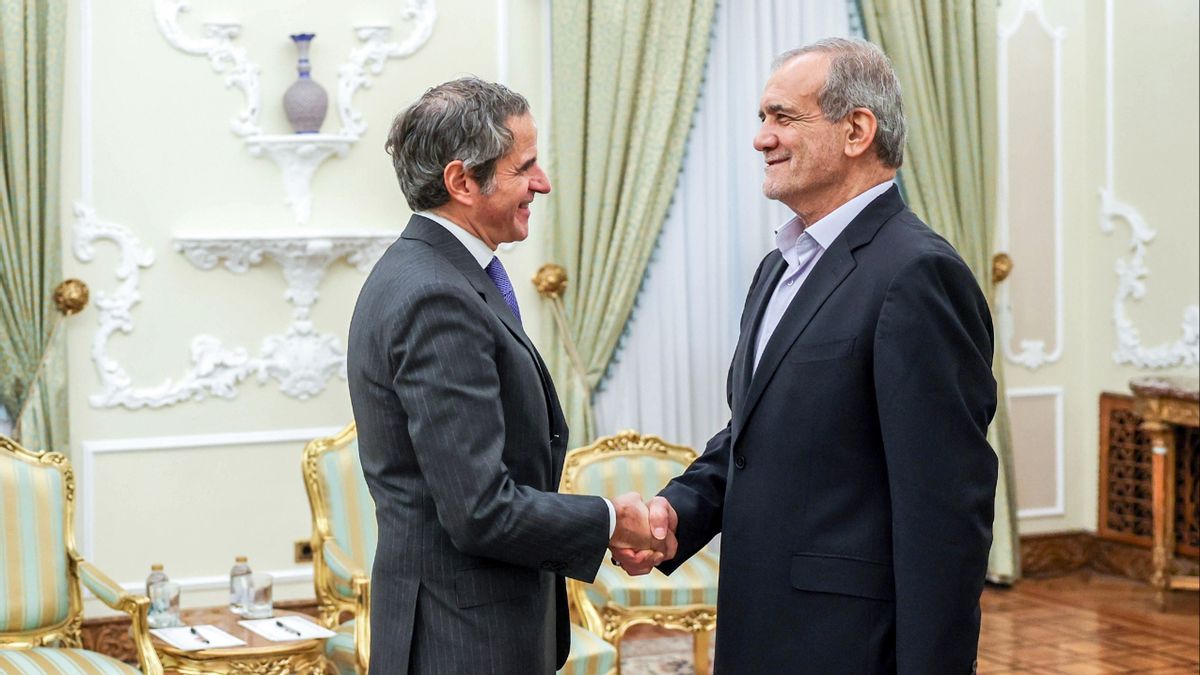


JAKARTA - The head of the International Atomic Energy Agency (IAEA) Rafael Grossi on Tuesday said the impasse with Iran regarding accountability for highly enriched uranium stocks, as well as inspections of nuclear facilities bombed by the United States and Israel, cannot drag on.
"The IAEA has inspected all 13 declared nuclear facilities in Iran that were not bombed, but has not been able to inspect the three main locations that were bombed in June - Natanz, Fordow and Isfahan," Grossi told Reuters in an interview at the World Economic Forum in Davos.
Iran must first submit a report to the IAEA on what happened at the site and the material, including about 440.9 kg of uranium enriched to 60 percent purity, close to the nuclear weapons purity level of about 90 percent.
That is enough material, if further enriched, for 10 nuclear bombs, according to the IAEA benchmark.
Iran has not submitted the special report to the IAEA.
"This cannot continue forever because at some point, I have to say, 'Well, I don't know where this material is'," which means there is no guarantee that the material has not been diverted or hidden, Grossi said, citing Al Arabiya from Reuters (21/1).
"I don't have that belief or conclusion at this time, but what we are saying to Iran is that they need to engage," he added.
Iran itself said it was fully cooperating with the IAEA.
It has now been at least seven months since the IAEA last verified Iran's stockpile of high-enriched uranium. According to the agency's guidelines, verification is carried out every month.
Grossi said he was exercising "diplomatic caution," but Iran must meet its obligations as a party to the Nuclear Non-Proliferation Treaty (NPT).
"This cannot continue like this for a long time without me, unfortunately, having to declare them non-compliant," he said, noting that parties to the NPT have no "a la carte" option where they can choose and determine what to comply with.
Asked if the issue could be resolved this spring, he said: "That's a reasonable timeframe."
One of the "real world" realities that Grossi said he had to face was the influence of diplomatic efforts aimed at reaching a broader agreement between Iran and the United States that had been spearheaded by US special envoy Steve Witkoff.
"I can't ignore it, and I wish the best that an understanding can be reached without the threat of new military activities there or the like," he explained.
Last November, the IAEA said it had inspected most of Iran's nuclear facilities that were not hit by US and Israeli attacks. Grossi said that since then, further inspections have been carried out until the end of December.
However, he said inspections could not be carried out during civil unrest, referring to recent protests that triggered a crackdown by Iran.
Later, Iranian authorities have indicated that the riots have stopped, he said.
"They said that the situation was calm and they were under control," Grossi said. "If the situation is like this, shouldn't we continue (inspection)? " he asked.
Grossi added that he would meet with Iranian Foreign Minister Abbas Araghchi in "the coming days or weeks."
The English, Chinese, Japanese, Arabic, and French versions are automatically generated by the AI. So there may still be inaccuracies in translating, please always see Indonesian as our main language. (system supported by DigitalSiber.id)
Most Popular Tags
#Prabowo Subianto #donald trump #2026 World Cup #Febrie Adriansyah #8791Popular


