

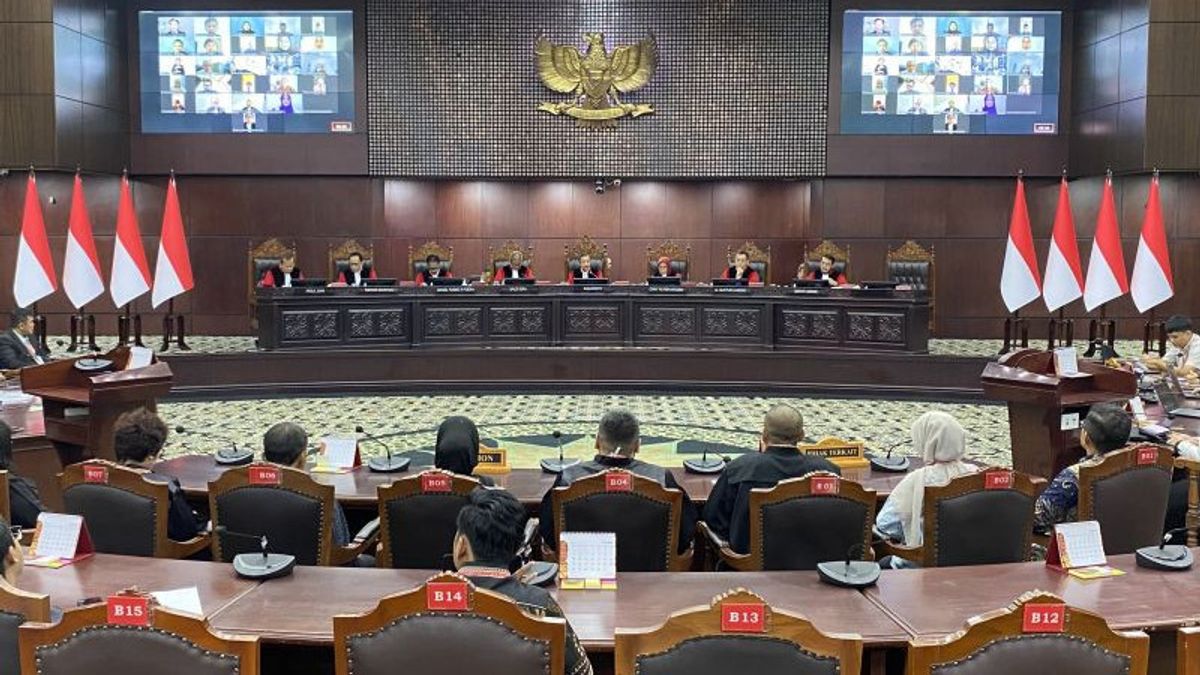


JAKARTA - The Constitutional Court (MK) has clarified the meaning of the phrase "legal protection" for journalists as regulated in Article 8 of Law Number 40 of 1999 concerning the Press.
The Constitutional Court stated that this legal protection includes the provision that criminal and civil sanctions against journalists in carrying out their profession can only be used after the press dispute mechanism in the Press Council has been completed.
"Granting the applicants' request for a part," said Chief Justice Suhartoyo, reading the verdict on Case Number 145/PUU-XXIII/2025 in the MK Plenary Session Room, Jakarta, Monday, quoted by Antara.
The Court stated that the phrase "legal protection" in the norm of Article 8 of the Press Law is in conflict with the Constitution of the Republic of Indonesia conditionally as long as it is not interpreted:
Including the application of criminal and/or civil sanctions against journalists in the legitimate exercise of their profession can only be used after the mechanisms of the right to reply, the right to correction, and the alleged violation of the journalistic code of ethics based on consideration and settlement efforts by the Press Council have not reached an agreement as part of the application of restorative justice.
The article originally only read: In carrying out their profession, journalists are protected by law.
According to the Court, the norm of the article in question does not clearly regulate the form of legal protection in order to guarantee legal certainty and justice for journalists.
Constitutional Justice M. Guntur Hamzah said the norm of Article 8 of the Press Law is a declarative norm without any real legal protection consequences. Therefore, the Constitutional Court considers it necessary to have a clear and concrete interpretation.
"If the norm is not given a clear and concrete interpretation by the Court, it has the potential to immediately trap journalists without first going through the mechanisms contained in Law Number 40 of 1999," he said.
The funeral, added Guntur, must ensure that legal action against journalists in carrying out their journalistic duties must prioritize mechanisms and principles of protection for the press.
The court emphasized that if there is a dispute originating from journalistic works, the solution must prioritize the mechanism as regulated in the Press Law by obtaining consideration from the Press Council.
In its legal consideration, the Constitutional Court highlighted the fact that there are still journalists who face legal charges as a result of carrying out their journalistic functions. This is recognized by the Court as potentially leading to the criminalization of the press.
The Constitutional Court also said that journalists have a vulnerable position because journalistic activities often intersect with the interests of power, politics, economy, and society.
Therefore, the Constitutional Court considers that the provision of special and affirmative legal protection to journalists is not a form of privilege, but an instrument to realize substantive justice.
Based on these considerations, the Court stated that the arguments for the application submitted by the Law Journalists Association (Iwakum) and national media journalist, Rizky Suryarandika, were reasonable according to the law.
However, three constitutional judges, namely Saldi Isra, Daniel Yusmic P. Foekh, and Arsul Sani, have a different opinion (dissenting opinion) on this decision. The three of them argued that this application should be rejected.
The English, Chinese, Japanese, Arabic, and French versions are automatically generated by the AI. So there may still be inaccuracies in translating, please always see Indonesian as our main language. (system supported by DigitalSiber.id)
Most Popular Tags
#Prabowo Subianto #donald trump #2026 World Cup #Febrie Adriansyah #8791Popular


