

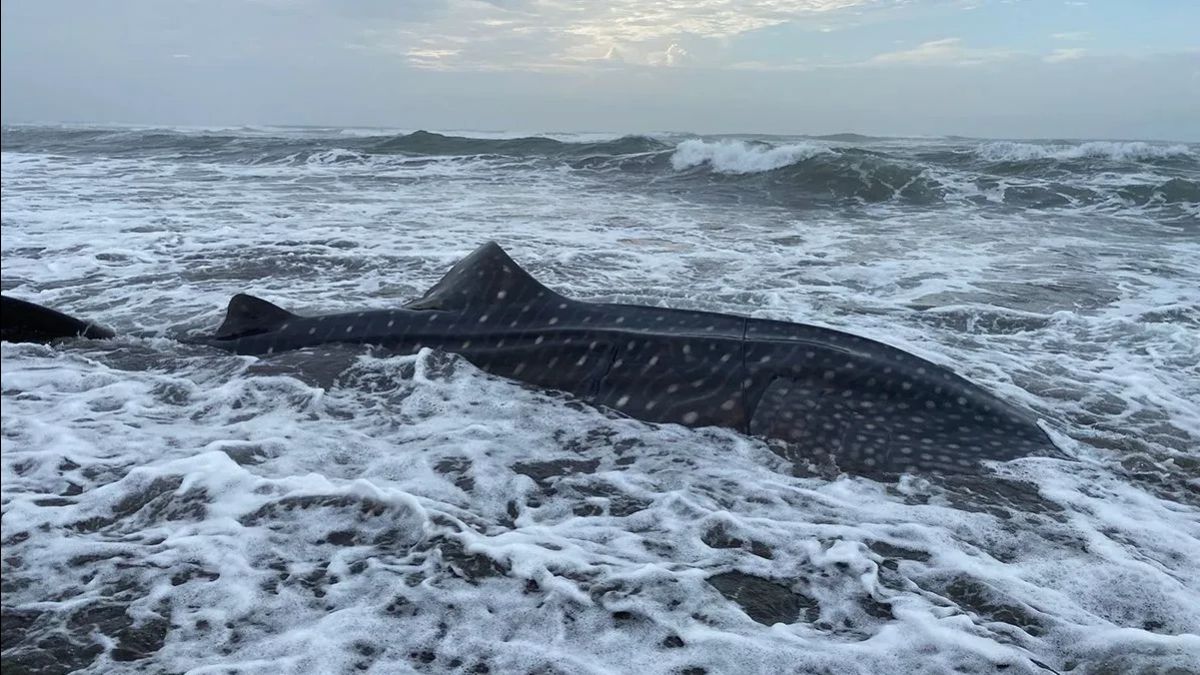


Cilacap Regency Government (Pemkab) in Central Java (Jateng) has strengthened cross-sectoral networks to address the high incidence of whale shark (Rhincodon typus) entanglement on the southern coast of Java.
The Secretary of the Cilacap Regency Fisheries Office, Achmad Hadiyanto, said that efforts to protect whale sharks are not only oriented towards animal conservation, but also an important indicator of the health of the marine ecosystem and long-term food security.
"We must work with our hearts and build strong synergy to maintain the sustainability of this marine life," he said when opening the Sarasehan Handling of the Stranded Whale Shark Incident in Cilacap, Wednesday, quoted by Antara.
He emphasized the need for collaboration between local governments, technical institutions, security forces, academics, and volunteer communities so that each incident of abandonment can be handled quickly, appropriately, and according to conservation standards.
Narasumber dari Balai Pengelolaan Kelautan (BPK) Pontianak Satuan Pelayanan Jakarta di Semarang, Darmawan mengatakan hiu paus merupakan satwa laut yang dilindungi penuh dan masuk dalam daftar Appendix I Convention on International Trade in Endangered Species of Wild Fauna and Flora (CITES).
"This protection is emphasized through the Decree of the Minister of Marine Affairs and Fisheries Number 18 of 2013 which prohibits all forms of extractive use, both in a living and dead state," he said.
He also reminded the public not to consume stranded whale shark meat because it is high risk to health.
In addition, he said, the removal of body parts such as fins or meat can be subject to legal sanctions in accordance with laws and regulations.
Sealife Indonesia's Principal Trainer, Dwi Suprapti, said that whale sharks are migratory animals with a long life, so they have the potential to accumulate marine debris, including heavy metals, in their bodies.
"Consumption of whale shark meat is very dangerous because of its high potential for toxicity. There is also a risk of zoonosis or transmission of diseases from animals to humans, especially if the carcass is not medically handled and left to rot," he said.
Based on data from the Indonesian Conservation Foundation, the southern coast of Java, ranging from Central Java, the Special Region of Yogyakarta to Jember, East Java, has been recorded as the highest whale shark extinction hotspot in Indonesia.
"In Cilacap Regency alone, there have been seven cases in the last three years, with a peak of five consecutive incidents in 2022," he said.
He said the high frequency encouraged the need to strengthen the network of local first responders, including the involvement of veterinarians to conduct necropsies to find out the exact cause of the animal's death, such as suspected poisoning or other health disorders.
In terms of technical aspects, he said the evacuation of the whale shark carcass could be optimized with the support of heavy equipment from related agencies and local communities, as well as the use of tarpaulins or zinc bases so that the removal process in sandy areas is more effective.
He also emphasized the importance of ethical handling in public spaces to prevent negative content.
"To prevent negative content or inappropriate actions from residents, the whale shark body should be covered with a large tarpaulin while waiting for expert teams or heavy equipment to arrive," he said.
Dwi hopes that the seminar can produce a more integrated standard operating procedure for handling stranded marine life in Cilacap by involving various government agencies, TNI, Polri, Basarnas, village governments, to volunteers to ensure that each incident is handled professionally and safely for the environment.
The English, Chinese, Japanese, Arabic, and French versions are automatically generated by the AI. So there may still be inaccuracies in translating, please always see Indonesian as our main language. (system supported by DigitalSiber.id)


