

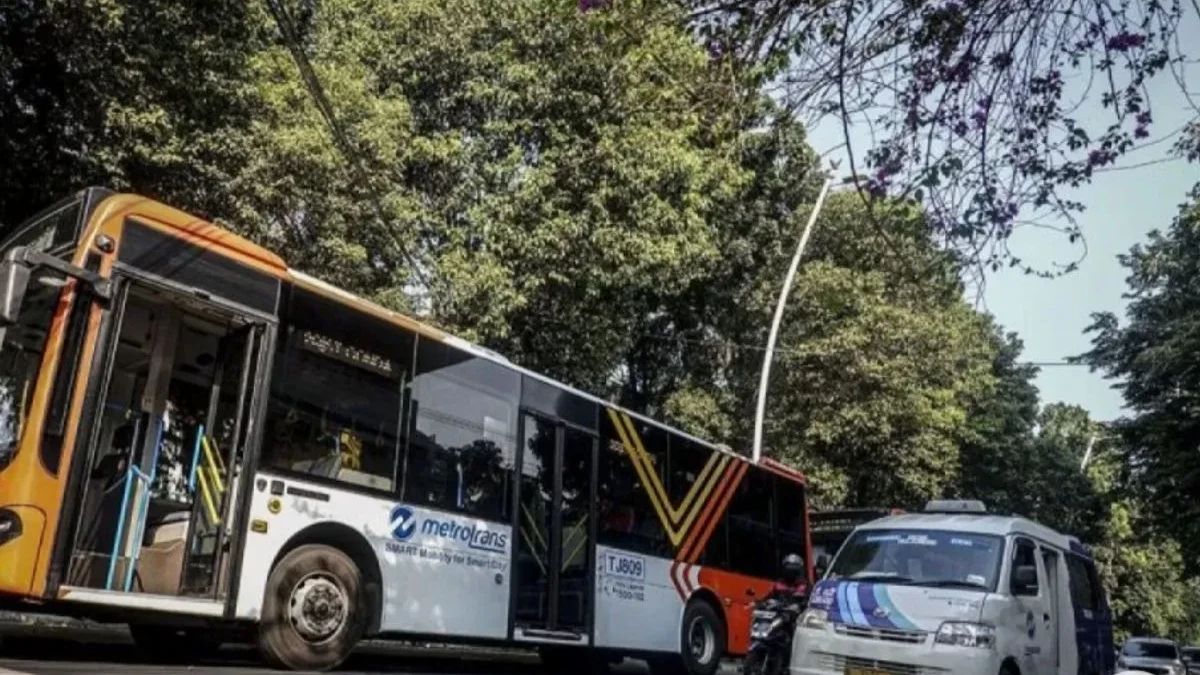


JAKARTA - Special Staff for DKI Jakarta Governor for Development and City Planning, Nirwono Joga, said there was one obstacle faced in developing the Transjabodetabek service from Jakarta to the buffer area.
Nirwono revealed that one of the obstacles was experienced by the Depok City Government. Depok does not yet have a budget to build supporting facilities for the Transjabodetabek service, including official stops and stops in its area.
Meanwhile, the DKI Jakarta Provincial Government has previously requested that a stop or official stop point be provided to ensure the safety and comfort of Transjabodetabek passengers to Depok.
"Actually, when you exit the Desari toll road to the Sawangan Terminal, the DKI Government has asked for supporting facilities, namely in the form of a stop or official stop point, which will really provide passenger safety," said Nirwono in a discussion in Jakarta, Thursday, January 8.
The request, continued Nirwono, is constrained by the limited budget of the Depok City Government. This condition is expected to continue in 2026 in line with the policy of budget efficiency in the region.
In fact, based on a provisional evaluation, the Transjabodetabek Sawangan-Lebak Bulus route recorded a daily passenger volume above the initial target. From the target of 2,000 passengers per day, the realization has reached 3,000 to 4,000 passengers.
"Well, because of the budget constraints, yes, in 2026 also with budget efficiency, the Depok City Government, does not have the budget to improve, let alone provide stops and supporting infrastructure," said Nirwono.
He assessed that similar problems also occurred in other areas in the Jabodetabek agglomeration, especially regarding the integration of public transportation with feeder modes in border areas.
"How is the Bodetabek government not having a budget to develop supporting transportation only here, around the border, for example. So, PR-PR is what I think will also be a record in 2026," he said.
According to Nirwono, this condition will be an important record in the development of cross-regional public transportation in 2026. He said there were two ways of looking at the situation, namely optimistic and pessimistic.
"If the glasses are optimistic, in the midst of these budget constraints, we encourage the need for creativity from local governments to think normally to start working outside the APBD, yes, which is called creative financing," said Nirwono.
He assessed that the creative financing approach could be used to develop public transportation, build sidewalks, and encourage city growth centers without relying entirely on the APBD.
On the other hand, from a pessimistic perspective, Nirwono is worried that budget efficiency will actually make the development of public transportation stagnate if the area is still entirely dependent on the APBD.
"If everything is still like now, that is based on the APBD, once the budget efficiency is carried out, it can be ensured that there will not be many changes," he added.
The English, Chinese, Japanese, Arabic, and French versions are automatically generated by the AI. So there may still be inaccuracies in translating, please always see Indonesian as our main language. (system supported by DigitalSiber.id)
Most Popular Tags
#Prabowo Subianto #donald trump #Febrie Adriansyah #8791 #giias 2026Popular


